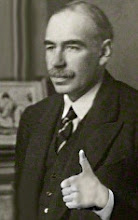
This is from Bryan Magee’s famous series Conversations with Famous Philosophers from the episode in which Magee talks with (an unrecognisably young!) Peter Singer on Georg Wilhelm Friedrich Hegel (1770–1831) and Marx.
Marx’s philosophy was influenced by Hegelianism, and, when Hegel’s movement split, Marx was attached to the left Young Hegelians and abandoned Hegel’s idealism for materialism.
Showing posts with label interview. Show all posts
Showing posts with label interview. Show all posts
Wednesday, April 8, 2015

Friday, January 23, 2015
Steve Keen Interview on Economics, Austrians, and Debt
Steve Keen is interviewed below by Gordon Long of the Financial Repression website. More details here.
Most interesting are Steve Keen’s comments on Austrians and the EU.
Steve Keen also blogs at Forbes now. See his latest post here, where he analyses what might happen if the anti-austerity Greek party Syriza forms a coalition government in Greece in the coming election.
Most interesting are Steve Keen’s comments on Austrians and the EU.
Steve Keen also blogs at Forbes now. See his latest post here, where he analyses what might happen if the anti-austerity Greek party Syriza forms a coalition government in Greece in the coming election.
Thursday, January 1, 2015
Marshall Auerback Interviews Bill Mitchell on Modern Monetary Theory
A very nice interview here with Professor Bill Mitchell by Marshall Auerback on Modern Monetary Theory (MMT), which was done at an Institute for New Economic Thinking (iNET) conference in April 2014 in Toronto, Canada. More details here.
Wednesday, June 18, 2014
L. Randall Wray on the Thom Hartmann Program
L. Randall Wray is interviewed on the Thom Hartmann Program below.
The interview ranges over quite a few issues, including Piketty.
The interview ranges over quite a few issues, including Piketty.
Wednesday, May 14, 2014
Interview with Mark Blaug
This is an interesting audio interview with by John Fountain in March 2007 at the University of Canterbury:
“A Conversation with Mark Blaug,” March 2007.Blaug, of course, was well known for his work on economic methodology, and was author of The Methodology of Economics: Or how Economists explain (2nd edn.). Cambridge University Press, Cambridge, UK, 1992.
Wednesday, February 26, 2014
Michael Ayers on Berkeley’s Idealism
This is an old interview by Bryan Magee with the philosopher Michael Ayers on Berkeley, from The Great Philosophers (1987) series of interviews, and it gives a short overview of Berkeley’s Idealism.
The first video begins with the end of their discussion of John Locke. Discussion of Berkeley begins at 6.45 in the first video.
The first video begins with the end of their discussion of John Locke. Discussion of Berkeley begins at 6.45 in the first video.
Saturday, February 22, 2014
Philip Pilkington Interviews Philip Mirowski
Here:
Philip Pilkington, “An Interview With and Overview of the Work of Philip Mirowski,” Fixing the Economists, February 21, 2014.The interview ranges widely over many fascinating subjects, but, above all, the origin of neoclassical economics in the late 19th century marginalist revolution and its questionable derivation of fundamental ideas, such as general equilibrium, from classical physics, when those ideas are not warranted in a social science like economics.
Saturday, December 28, 2013
Steve Keen Interview from “Economics in Debate”
A very short interview here with Steve Keen posted on the “Economics in Debate” website.
Sunday, December 1, 2013
Marshall Auerback Interviews Jan Kregel
Marshall Auerback interviews Jan Kregel in the video below in a short but interesting discussion about China, the East Asian financial crisis, financial systems and the over-the-counter (OTC) derivatives.
Wednesday, November 6, 2013
Ha-Joon Chang Interview
Ha-Joon Chang (a Reader in development economics at the University of Cambridge) is interviewed here on the myth of free markets, neoliberalism and economics.
Friday, August 16, 2013
Richard Koo Interview on the Causes of Economic Crises
Though the interview is a few months old, Richard Koo discusses quite a few issues here, such as Japan’s recent economic policies, the causes of the Great Recession, and balance sheet recessions.
Friday, June 14, 2013
Mario Rizzo Interview
An interview with the Austrian economist Mario Rizzo is available here and makes interesting reading:
For example, can anyone name a modern Austrian economist who is pragmatic on government interventions in economic life? While Hayek appears to have endorsed some government interventions in the mature phase of his career, there is no doubt he was still in essence strongly opposed to government intervention.
But what are the similarities between (some) versions of Austrian economics and Post Keynesianism?
One might list them as follows:
Post Keynesian price theory is radically different from Austrian theory and stresses the importance of administered prices, while Austrian price theory is not much more than a development of neoclassical price theory. Aggregate demand is seen as a fundamental driving force of investment and production in Post Keynesianism (along with business expectations), while Austrians seem to see the driving force as saving, even with some version of Say’s law.
The Austrian business cycle theory is unacceptable to Post Keynesians, and inflation is seen as driven by factor input and wage cost increases (cost push inflation) and not just demand-pull inflation, and so on.
And another fundamental difference is political outlook: Post Keynesians have no dogmatic hostility to government intervention, as their theory tells them (and rightly so) that market economies are in need of macroeconomic steering and regulation.
“Austrians Need to Make Some Noise (and They Are!),” ThinkMarkets, June 14, 2013.At one point, Rizzo describes one of the purposes of The Economics of Time and Ignorance (a book which holds interest for some Post Keynesians), as follows:
“We also wanted to draw connections with other schools of though – especially some aspects of Post Keynesianism and other version of subjectivist economics. We saw that, behind political or ideological differences, we had some fundamental ideas that we could share and discuss with these people. We wanted to make clear that Austrian economics is not coextensive with classical liberalism. We were not propagandists for capitalism.”But the political views or prescriptive anti-government ideology of Austrians is precisely what gets in the way of mutual dialogue, since all Austrians appear to be either minimal state liberals or anarcho-capitalists.
For example, can anyone name a modern Austrian economist who is pragmatic on government interventions in economic life? While Hayek appears to have endorsed some government interventions in the mature phase of his career, there is no doubt he was still in essence strongly opposed to government intervention.
But what are the similarities between (some) versions of Austrian economics and Post Keynesianism?
One might list them as follows:
(1) the importance of time in economic life in a dynamic sense and fundamental uncertainty (more or less the same as Knightian uncertainty);But even with these similarities there are important differences.
(2) many events of the future relevant for economic life and decision making today cannot be calculated with objective probability scores.
(3) from (1) and (2) it follows that expectations are subjective, not “rational” in the neoclassical sense;
(4) a rejection of the neoclassical view that markets converge towards general equilibrium states. But here some Austrians have their own substitutes for Walrasian general equilibrium, such as the Misesian final state of rest, plan coordination, or pattern coordination, and accept other (alleged) equilibrating processes such as the Wicksellian natural rate of interest, loanable funds theory, and equilibrium prices, so it is perhaps only the Lachmannian radical subjectivists with whom Post Keynesians are in agreement on the lack of equilibrium tendencies in market economies.
(5) a belief that the quantity theory of money is unsatisfactory, but for different reasons, and the Post Keynesian rejection of the quantity theory is much stronger.
Post Keynesian price theory is radically different from Austrian theory and stresses the importance of administered prices, while Austrian price theory is not much more than a development of neoclassical price theory. Aggregate demand is seen as a fundamental driving force of investment and production in Post Keynesianism (along with business expectations), while Austrians seem to see the driving force as saving, even with some version of Say’s law.
The Austrian business cycle theory is unacceptable to Post Keynesians, and inflation is seen as driven by factor input and wage cost increases (cost push inflation) and not just demand-pull inflation, and so on.
And another fundamental difference is political outlook: Post Keynesians have no dogmatic hostility to government intervention, as their theory tells them (and rightly so) that market economies are in need of macroeconomic steering and regulation.
Sunday, June 9, 2013
Steve Keen on TalkingStickTV
A nice Steve Keen interview here, with some history of his career, comments on the Cambridge capital controversy, Hyman Minsky, and neoclassical economics. What a tragedy his university was a victim of austerity!
Tuesday, May 28, 2013
Interview with Ha-Joon Chang
An interesting interview with Ha-Joon Chang on his book 23 Things They Don't Tell You about Capitalism (Penguin, London, 2011).
Monday, November 19, 2012
Steve Keen Interview on China, Environmental Issues and Minsky Models
This appears to be a recent interview given on November 18, 2012 while Steve Keen was at the International Conference on Sustainability, Transition and Culture Change (Grand Rapids, Michigan, November 16-18, 2012).
Steve talks about a variety of issues, but all interesting.
Steve talks about a variety of issues, but all interesting.
Friday, October 26, 2012
Skidelsky on the Tory Austerity in the UK
Robert Skidelsky is interviewed here on Russia Today (RT) on the results of Tory-Liberal Democrat austerity in the UK.
At one point, the interviewer (at 7.46) refers to Steve Keen as “James” Keen, a rather unfortunate error!
At one point, the interviewer (at 7.46) refers to Steve Keen as “James” Keen, a rather unfortunate error!
Tuesday, October 9, 2012
Russ Roberts Interviews Robert Skidelsky
Below is a link to an audio interview by Russ Roberts with Robert Skidelsky. The discussion partly deals with the new book How Much is Enough: Money and the Good Life by Robert Skidelsky and Edward Skidelsky:
http://files.libertyfund.org/econtalk/y2012/Skidelskyenough.mp3
Monday, September 17, 2012
Steve Keen on Forecasting the Next Financial Crisis
Another Steve Keen interview here, but a short one from his recent time in New Zealand, on his prediction of the financial crisis.
Saturday, September 15, 2012
Steve Keen Interview with Bernard Hickey
A quick interview here done during Steve Keen’s visit to New Zealand.
Tuesday, August 14, 2012
Skidelsky on the Keynesian Beauty Contest
A short interview with Robert Skidelsky here by the Financial Times (FT) on the state of Eurozone financial markets and the UK, with a brief comment on the metaphor of the Keynesian beauty contest.
Subscribe to:
Posts (Atom)