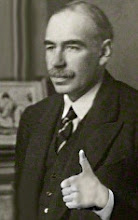
The talk below by Steve Keen is the first lecture in his introductory subject “Becoming an Economist” at Kingston University (in the UK), though personally I wish he had not shown that stupid rap video about Keynes and Hayek, which shows very little except that the tiresome libertarians who made it do not understand Keynes’ thought.
Showing posts with label talk. Show all posts
Showing posts with label talk. Show all posts
Thursday, October 15, 2015

Sunday, October 5, 2014
Steve Keen on the “Overdue Copernican Revolution in Economics”
A talk given by Steve Keen at the first conference of the International Student Initiative for Pluralism in Economics in Tübingen, Germany, on September 19–21, 2014. More background here.
Wednesday, April 2, 2014
Marc Lavoie on Heterodox and Post Keynesian Economics
This video is a talk by Marc Lavoie on the essentials of heterodox and Post Keynesian economics, given on March 21, 2014 at the University of Missouri Kansas City.
You can get the slides for the talk here.
Marc Lavoie is the author of these important books (one with Wynne Godley) on Post Keynesian economics:
You can get the slides for the talk here.
Marc Lavoie is the author of these important books (one with Wynne Godley) on Post Keynesian economics:
Lavoie, Marc. 1994. Foundations of Post-Keynesian Economic Analysis. Edward Elgar Publishing.
Godley, W. and M. Lavoie. 2007. Monetary Economics: An Integrated Approach to Credit, Money, Income, Production and Wealth. Palgrave Macmillan, Basingstoke, England and New York.
Lavoie, Marc. 2009. An Introduction to Post-Keynesian Economics (rev. edn), Palgrave Macmillan, Basingstoke.
Saturday, February 8, 2014
Steve Keen on the Tapering of Quantitative Easing
This is old, but still an interesting talk on quantitative easing and the end of that policy.
The graph of US private debt since 1830 that can be seen from 29.05 is particularly interesting to me, even though I do not know what data sources were used for the pre-1945 period. You can see the graph below.

As an aside, there appears to be a large fall in the level of private debt as a percentage of GDP from about 1915 to about 1919, which is very interesting since this must have preceded the recession of 1920 to 1921.
The graph of US private debt since 1830 that can be seen from 29.05 is particularly interesting to me, even though I do not know what data sources were used for the pre-1945 period. You can see the graph below.

As an aside, there appears to be a large fall in the level of private debt as a percentage of GDP from about 1915 to about 1919, which is very interesting since this must have preceded the recession of 1920 to 1921.
Tuesday, July 16, 2013
John King on Pluralism in Economics
Professor John King (La Trobe University, Australia) gives a talk here on pluralism in economics.
He is also the author of The Microfoundations Delusion: Metaphor and Dogma in the History of Macroeconomics (Cheltenham, 2012), and A History of Post-Keynesian Economics since 1936 (Cheltenham, 2002), both excellent books.
He is also the author of The Microfoundations Delusion: Metaphor and Dogma in the History of Macroeconomics (Cheltenham, 2012), and A History of Post-Keynesian Economics since 1936 (Cheltenham, 2002), both excellent books.
Sunday, June 16, 2013
Steve Keen on Monetary Macroeconomics
Steve Keen gives a lecture here on monetary macroeconomics, held (I think) in May 2013 in Seattle. The sound is not the best, and the actual talk begins around 34.00.
Saturday, September 22, 2012
Steve Keen at the American Monetary Institute Conference
This is Steve Keen’s presentation to the American Monetary Institute Conference (Chicago, September 21 2012). Keen talks about endogenous money, loanable funds, Schumpeter, and Minsky.
The sound is not the best!
The sound is not the best!
Thursday, September 13, 2012
Steve Keen on Schumpeter, Minsky and Endogenous Money
A great audio talk here by Steve Keen, recently given in New Zealand (in Wellington on 10th September, 2012, if I am not mistaken), on debt deflation, Schumpeter, Minsky and endogenous money.
Monday, September 10, 2012
Skidelsky on the Economic Crisis and its Aftermath
A short talk here by Robert Skidelsky to the Institute of International and European Affairs (IIEA) on the aftermath of the great recession of 2008 to 2009, and the disaster of contractionary fiscal policy in the UK.
Skidelsky shatters the pro-austerity myths of the Tory-Lib Dem coalition currently ruling Britain.
Skidelsky shatters the pro-austerity myths of the Tory-Lib Dem coalition currently ruling Britain.
Wednesday, February 8, 2012
Richard Koo on Europe, the US, and Japan
Richard Koo (Chief Economist at the Nomura Research Institute, Ltd.) gives a talk here at the Foreign Press Center (Japan) on the “Rebuilding of the European and US Economy and Japan” (January 19, 2012).
Richard Koo’s work on asset bubbles, debt deflation and balance sheet recessions is consistent with the Post Keynesian view of these problems. In many ways, his work complements that of Steve Keen.
Richard Koo’s work on asset bubbles, debt deflation and balance sheet recessions is consistent with the Post Keynesian view of these problems. In many ways, his work complements that of Steve Keen.
Wednesday, November 16, 2011
Marshall Auerback on the Eurozone
An interesting talk here by Marshall Auerback (from the Levy Economics Institute), the proponent of modern monetary theory (MMT). As Auerback says, the fundamental problem with the Eurozone is the lack of a union-wide fiscal policy, and the fact that member nations have given up their monetary independence.
Monday, September 12, 2011
Mark Hayes on Post Keynesian Economic Policies
Mark Hayes is Fellow and Director of Studies in Economics at Robinson College at Cambridge University, and also Secretary of the excellent Post Keynesian Economics Study Group (PKSG), which I highly recommend (it’s the Mises.org of Post Keynesian economics!).
Mark Hayes gives a wide-ranging talk here on the practical policies advocated by Post Keynesians and the basics of Post Keynesian macroeconomic theory:
Some points:
Mark Hayes gives a wide-ranging talk here on the practical policies advocated by Post Keynesians and the basics of Post Keynesian macroeconomic theory:
Mark Hayes, “The Post Keynesian (Policy) Difference,” 2010.A transcript of the talk is also available here.
Some points:
(1) Hayes considers Modern Monetary Theory (MMT) as a branch of Post Keynesian economics. I have often done so too on this blog.
(2) Hayes’s summary of the Post Keynesian view on inflation stands out to my mind:“Another implication of the principle of effective demand is that the money-wage determines not employment but the price level. There is no room in Post Keynesian theory for the quantity theory of money. Equally there is no room for the Marxist idea that class struggle can change the aggregate share of wages in national income. Of course an individual union can improve its relative position at the expense of other workers, but a rise in money-wages across the board simply produces inflation. The real wage and profit shares are determined by a combination of the degree of competition between employers and the rate of interest. The Post Keynesian remedy for inflation has always been some form of incomes policy combined with commodity price stabilisation.”I have also written on the Post Keynesian cure for stagflation here.
(3) On financing of business and industry and speculation in financial asset markets:“First of all, Post Keynesians follow Kalecki, Galbraith and Eichner in recognising the well-established empirical evidence about the financing of investment. This is that the vast majority of physical capital formation or accumulation is financed from the internal cash flow of large corporations supplemented to some extent by bank credit lines. The social purpose of the stock market is not to finance new physical investment but to permit transfers of existing assets, including corporate control. Its speculative tendencies are not in fact offset by the benefits for enterprise which Keynes allowed. Industry could function quite well without the equity market, given alternative institutions focused on enterprise rather than speculation. ....
Post Keynesians would, in the words of Winston Churchill, see finance less proud and industry more content. Keynes thought casino banking should be kept expensive and inaccessible. A significant transactions tax going well beyond the current stamp duty should be imposed – a tax on speculation.”
Subscribe to:
Posts (Atom)