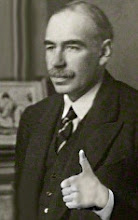
In an interesting interview below, James Galbraith speaks on the role of government, the way it can be captured by the private sector, but also how it can play a crucial role in regulation and supporting the private sector.
Showing posts with label government. Show all posts
Showing posts with label government. Show all posts
Sunday, November 9, 2014

Saturday, September 21, 2013
Robert Skidelsky on Capitalism, Government and the Good Society
Though the talks and discussion afterwards involve many people, Robert Skidelsky gives his opinions from 21.50. This was a Liberty Fund event at Butler University on April 10, 2013 (not long after the death of Margaret Thatcher).
Sunday, December 23, 2012
Murphy versus Huerta de Soto on the Government’s Ability to Increase Employment and Output
Robert Murphy tells us that it is not at all clear that we “should credit QE1 and/or [sc. the] Obama stimulus” with the US recovery in 2009. That reflects a most extreme view that some Austrians can now be found peddling: the idea that expansionary government fiscal policy does nothing or little to increase private investment and consumption, and that government stimulus programs do not work.
How strange it is, then, to see that other Austrians have never denied that government fiscal and monetary policies can increase employment and output.
Take this statement by Huerta de Soto (who is himself an advocate of a most extreme Rothbardian program):
Curiously, Ludwig Lachmann went further than Huerta de Soto and saw public works spending in a depression as a genuinely useful measure:
Huerta de Soto, J. 2012. Money, Bank Credit and Economic Cycles (3rd edn.; trans. M. A. Stroup), Ludwig von Mises Institute, Auburn, Ala.
How strange it is, then, to see that other Austrians have never denied that government fiscal and monetary policies can increase employment and output.
Take this statement by Huerta de Soto (who is himself an advocate of a most extreme Rothbardian program):
“Under certain conditions, government and union intervention, along with the institutional rigidity of the markets, may prevent the necessary readjustments which precede any recovery of economic activity. If wages are inflexible, hiring conditions very rigid, union power great and governments succumb to the temptation of protectionism, then extremely high unemployment can actually be maintained indefinitely, without any adjustment to new economic conditions on the part of the original means of production. Under these circumstances a cumulative process of contraction may also be triggered. By such a process the massive growth of unemployment would give rise to a widespread decrease in demand, which in turn would provoke new doses of unemployment, etc. Some theorists have used the term secondary depression to refer to this process, which does not arise from spontaneous market forces, but from coercive government intervention in labor markets, products, and international trade. In some instances, ‘secondary depression’ theorists have considered the mere possibility of such a situation a prima facie argument to justify government intervention, encouraging new credit expansion and public spending. However the only effective policy for avoiding a ‘secondary depression,’ or for preventing the severity of one, is to broadly liberalize markets and resist the temptation of credit expansion policies. Any policy which tends to keep wages high and make markets rigid should be abandoned. These policies would only make the readjustment process longer and more painful, even to the point of making it politically unbearable.First, before I come to my main point, Huerta de Soto is entirely wrong to blame “secondary depressions” solely on government intervention and “union power.” Has this man never heard of debt deflation and subjective expectations affecting the outlook of capitalists? In an environment of high private-sector debt, wage cuts would prove disastrous as the burden of debt soared, which causes bankruptcy to both debtors and creditors. And, in any case, markets lack the reliable equilibrating mechanisms so beloved by neoclassicals and Austrians, for the following reasons:
What should be done if, under certain circumstances, it appears politically ‘impossible’ to take the measures necessary to make labor markets flexible, abandon protectionism and promote the readjustment which is the prerequisite of any recovery? This is an extremely intriguing question of economic policy, and its answer must depend on a correct evaluation of the severity of each particular set of circumstances. Although theory suggests that any policy which consists of an artificial increase in consumption, in public spending and in credit expansion is counterproductive, no one denies that, in the short run, it is possible to absorb any volume of unemployment by simply raising public spending or credit expansion, albeit at the cost of interrupting the readjustment process and aggravating the eventual recession.
Nonetheless Hayek himself admitted that, under certain circumstances, a situation might become so desperate that politically the only remaining option would be to intervene again, which is like giving a drink to a man with a hangover. In 1939 Hayek made the following related comments:it has, of course, never been denied that employment can be rapidly increased, and a position of ‘full employment’ achieved in the shortest possible time by means of monetary expansion. ... All that has been contended is that the kind of full employment which can be created in this way is inherently unstable, and that to create employment by these means is to perpetuate fluctuations. There may be desperate situations in which it may indeed be necessary to increase employment at all costs, even if it be only for a short period—perhaps the situation in which Dr. Brüning found himself in Germany in 1932 was such a situation in which desperate means would have been justified. But the economist should not conceal the fact that to aim at the maximum of employment which can be achieved in the short run by means of monetary policy is essentially the policy of the desperado who has nothing to lose and everything to gain from a short breathing space.Now let us suppose politicians ignore the economist’s recommendations and circumstances do not permit the liberalization of the economy, and therefore unemployment becomes widespread, the readjustment is never completed and the economy enters a phase of cumulative contraction. Furthermore let us suppose it is politically impossible to take any appropriate measure and the situation even threatens to end in a revolution. What type of monetary expansion would be the least disturbing from an economic standpoint? In this case the policy with the least damaging effects, though it would still exert some very harmful ones on the economic system, would be the adoption of a program of public works which would give work to the unemployed at relatively reduced wages, so workers could later move on quickly to other more profitable and comfortable activities once circumstances improved. At any rate it would be important to refrain from the direct granting of loans to companies from the productive stages furthest from consumption. Thus a policy of government aid to the unemployed, in exchange for the actual completion of works of social value at low pay (in order to avoid providing an incentive for workers to remain chronically unemployed) would be the least debilitating under the extreme conditions described above.” (Huerta de Soto 2012: 452–456).
(1) the essential property of all highly liquid assets (with money as the most liquid asset) is that there is a zero or near zero elasticity of substitution between these liquid assets and producible commodities. This means that the gross substitution axiom is false and any acts of spending on liquid assets causing their price to rise will not necessarily induce substitution effects leading to more demand for cheaper producible commodities.But to return to my original point: the crucial issue here is that even Huerta de Soto states that “no one denies that, in the short run, it is possible to absorb any volume of unemployment by simply raising public spending or credit expansion” – no one, that is, except (apparently) Robert Murphy!
(2) it is unlikely that all markets have equilibrium prices (and even less likely that price setting businesses would be willing to adjust the prices rapidly anyway if they existed). The very notion of an economy with a tendency to general equilibrium, where all product markets converge to market-clearing prices, depends on unrealistic assumptions, such as flexible prices and demand and supply curves behaving with substitution effects in the absence of income effects;
(3) owing to uncertainty and subjective expectations, it is unlikely that shattered expectations of business people will change suddenly to induce the necessary level of investment in a severe recession or depression;
(4) there is thus no guarantee that savings will match investment (even if you assume a loanable funds theory of interest) or that Say’s law is much more than a fantasy;
(5) there is no such thing as some natural rate of interest that will equilibrate savings and investment;
(6) as Keynes himself argued, absence of wage and price flexibility is not the reason why neoclassical theory is flawed: even if we had complete wage and price flexibility, there would still be no guarantee of full employment.
Curiously, Ludwig Lachmann went further than Huerta de Soto and saw public works spending in a depression as a genuinely useful measure:
“In the British situation of 1932, Hayek and his friends rejected the proposals of Keynes and some non-Keynesian British economists – that at the bottom of the depression the government should take certain steps, and so on. Hayek has now realised that that was wrong. That is to say, I think Austrians today would not reject all measures to relieve unemployment and increase employment, in a situation in which nothing really is scarce. And in this respect I think Austrians … would have … have ... learned.”BIBLIOGRAPHY
Huerta de Soto, J. 2012. Money, Bank Credit and Economic Cycles (3rd edn.; trans. M. A. Stroup), Ludwig von Mises Institute, Auburn, Ala.
Tuesday, January 31, 2012
Fractional Reserve Banking, Option Clauses, and Government
The anti-fractional reserve banking (FRB) Austrians sometimes allege that FRB would not have survived without governmental intervention. By this, they usually mean that governments sometimes allowed suspension of specie during financial crises. While that is true, many times governments have legislated to stop banks from inserting “option clauses” in their demand deposit contracts allowing them suspend specie payments for a temporary period.
The so-called “option clause” (to suspend specie payments temporarily) was used freely in private FR banking contacts in Scotland from 1730–1765, Sweden from 1864–1903 and Canada during the 19th century (Selgin 1996: 247). The banks required no government support or intervention to allow them to suspend specie payment in liquidity crises, to stop runs and bank collapses.
The option and discretion to create an option clause in a bank’s FR contract gave the bank the right, in some circumstances, to suspend payments temporarily until it was able to obtain the liquidity needed for meeting obligations (Barth et al. 2001: 30). When its customers accepted such a contract, this was a perfectly voluntary and successful example of free contact: a “wicked” or “evil” government was not needed to enforce temporary suspensions of specie payment in such a case.
If that “option clause” was in your contract and the bank decided to suspend for a temporary period, this was not fraud, but free contract. Nor was government required for this process to arise and operate in free markets with fractional reserve banking. Nor was government required for the origin and success of fractional reserve banking.
BIBLIOGRAPHY
Barth, J. R., Brumbaugh Jr., R. D. and G. Yago (eds.), 2001. Restructuring Regulation and Financial Institutions, Kluwer Academic Publishers, Boston, Mass. and London.
Selgin, George A. 1996. Bank Deregulation and Monetary Order, Routledge, London and New York.
The so-called “option clause” (to suspend specie payments temporarily) was used freely in private FR banking contacts in Scotland from 1730–1765, Sweden from 1864–1903 and Canada during the 19th century (Selgin 1996: 247). The banks required no government support or intervention to allow them to suspend specie payment in liquidity crises, to stop runs and bank collapses.
The option and discretion to create an option clause in a bank’s FR contract gave the bank the right, in some circumstances, to suspend payments temporarily until it was able to obtain the liquidity needed for meeting obligations (Barth et al. 2001: 30). When its customers accepted such a contract, this was a perfectly voluntary and successful example of free contact: a “wicked” or “evil” government was not needed to enforce temporary suspensions of specie payment in such a case.
If that “option clause” was in your contract and the bank decided to suspend for a temporary period, this was not fraud, but free contract. Nor was government required for this process to arise and operate in free markets with fractional reserve banking. Nor was government required for the origin and success of fractional reserve banking.
BIBLIOGRAPHY
Barth, J. R., Brumbaugh Jr., R. D. and G. Yago (eds.), 2001. Restructuring Regulation and Financial Institutions, Kluwer Academic Publishers, Boston, Mass. and London.
Selgin, George A. 1996. Bank Deregulation and Monetary Order, Routledge, London and New York.
Sunday, January 1, 2012
Government is Not Inherently Evil
That is, according to Ludwig von Mises. The issue of what Mises thought is raised here.
This is Mises’s view:
We can see how far even Mises was from anarcho-capitalism, and if there is any doubt let Mises speak for himself:
BIBLIOGRAPHY
Mises, L. von. 2007. Economic Freedom and Interventionism: An Anthology of Articles and Essays (ed. B. B. Greaves), Liberty Fund, Indianapolis, Ind.
Mises, L. von. 2010 [1944]. Omnipotent Government: The Rise of the Total State and Total War, Yale University Press, New Haven.
This is Mises’s view:
“The intellectual and moral faculties of man can thrive only where people associate with one another peacefully. Peace is the origin of all human things, not—as the ancient Greek philosopher Heraclitus said—war. But as human nature is, peace can be established and preserved only by a power fit and ready to crush all peacebreakers.Mises’s utililitarian ethics is very clear here, although, in a rhetorical flourish, he even quotes St Paul (Romans 13.1–7) at the end (“for there is no authority except from God, and those authorities that exist have been instituted by God. Therefore whoever resists authority resists what God has appointed, and those who resist will incur judgement”).
Government or state is the social apparatus of coercion and compulsion. Its purpose is to make the world safe for peaceful human cooperation by protecting society against attacks on the part of foreign aggressors or domestic gangsters. The characteristic mark of a government is that it has, within a definite part of the earth’s surface, the exclusive power and right to resort to violence.
Within the orbit of Western civilization the power and the functions of government are limited. Many hundreds, even thousands of years of bitter conflicts resulted in a state of affairs that granted to the individual citizens effective rights and freedom, not mere freedoms. In the market economy the individuals are free from government intervention as long as they do not offend against the duly promulgated laws of the land. The government interferes only to protect decent law-abiding people against violent or fraudulent attacks.
There are people who call government an evil, although a necessary evil. However, what is needed in order to attain a definite end must not be called an evil in the moral connotation of the term. It is a means, but not an evil. Government may even be called the most beneficial of all earthly institutions as without it no peaceful human cooperation, no civilization, and no moral life would be possible. In this sense the apostle declared that ‘the powers that be are ordained of God.’” (Mises 2007: 57).
We can see how far even Mises was from anarcho-capitalism, and if there is any doubt let Mises speak for himself:
“There is a school of thought which teaches that social cooperation of men could be achieved without compulsion or coercion. Anarchism believes that a social order could be established in which all men would recognize the advantages to be derived from cooperation and be prepared to do voluntarily everything which the maintenance of society requires and to renounce voluntarily all actions detrimental to society. But the anarchists overlook two facts. There are people whose mental abilities are so limited that they cannot grasp the full benefits that society brings to them. And there are people whose flesh is so weak that they cannot resist the temptation of striving for selfish advantage through actions detrimental to society. An anarchistic society would be exposed to the mercy of every individual. We may grant that every sane adult is endowed with the faculty of realizing the good of social coöperation and of acting accordingly. However, it is beyond doubt that there are infants, the aged, and the insane. We may agree that he who acts antisocially should be considered mentally sick and in need of cure. But as long as not all are cured, and as long as there are infants and the senile, some provision must be taken lest they destroy society.In all fairness, Mises is very probably thinking of left-wing anarchism here, but that does not really matter: his view of the “illusions of the anarchists” is clear.
Liberalism differs radically from anarchism. It has nothing in common with the absurd illusions of the anarchists. We must emphasize this point because etatists sometimes try to discover a similarity. Liberalism is not so foolish as to aim at the abolition of the state. Liberals fully recognize that no social coöperation and no civilization could exist without some amount of compulsion and coercion. It is the task of government to protect the social system against the attacks of those who plan actions detrimental to its maintenance and operation. (Mises 2010 [1944]: 48).
BIBLIOGRAPHY
Mises, L. von. 2007. Economic Freedom and Interventionism: An Anthology of Articles and Essays (ed. B. B. Greaves), Liberty Fund, Indianapolis, Ind.
Mises, L. von. 2010 [1944]. Omnipotent Government: The Rise of the Total State and Total War, Yale University Press, New Haven.
Tuesday, October 4, 2011
How Can Government Overcome Uncertainty?
S. D. Parsons poses the following question:
When you introduce an intervention to influence the state of a nonergodic stochastic system, that process and outcome is not in the same ontological category or status as the future of that system, without intervention. The past data from which one draws inferences about what the intervention will do consist of examples of past such interventions, ideally of the same type. For example, there is no doubt that induction from past data will not be a reliable method to predict the future value of certain shares on the stock market or the future value of the whole market itself measured by some index, but predicting what happens when an entity with the power to influence certain shares or the whole system is a different matter. If the Treasury bought up the stock of a certain promising company, making the shares scarce when demand is high, announcing it will even support the value of the shares, we can make a empirical prediction about the outcome, which can be falsified. How? I have already addressed the question of the epistemological justification for such things and even Keynesian stimulus (and other government interventions) here:
Fundamentally, if Austrians or neoclassicals think that they can evade their own such epistemological problems, they are deeply mistaken. How, for example, does the Austrian praxeologist justify his belief that that the axiom of disutility of labour will continue to be true in the future? Mises explicitly tells us that this axiom is “not of a categorial and aprioristic character”, but “experience teaches that there is disutility of labor” (Mises 1998: 65). In other words, it is a synthetic proposition and its truth is only known a posteriori. Praxeologists require either induction or Popper’s falsificationism by hypothetico-deduction using empirical evidence to justify their belief in its truth now and for the future.
The concept of radical uncertainty in the Post Keynesian or Knightian sense applies to non-ergodic, stochastic systems. But human life does not just consist only of non-ergodic systems. The economic system we know as capitalism, where most commodities are produced by decentralised investment decision-making by millions of agents and consumption by other agents with shifting subjective utilities, is not the only institution of modern life. We have government and quasi-government entities, private non-profit organisations, private voluntary organisations, and at the basic level families.
The free market itself has attempted to overcome uncertainty by certain institutions. Government interventions in economies are merely a much more powerful and more effective instrument for reducing uncertainty than what has emerged on the market.
Its many institutions that exist alongside and influence modern capitalism (such as law courts that enforce contracts, buffer stocks, and even central banks) have developed precisely to deal with uncertainty, as “outside” entities capable of reducing uncertainty by interventions designed to influence the state of the system. Law and order is a basic human institution without which commerce would be impossible. It has been enforced through the ages essentially by governments, not by private enterprise. When, for example, the trade of the Roman Republic was threatened by pirates in the east Mediterranean, it was the state that ended that threat and allowed commerce to resume with confidence. Indeed, some conventions or institutions that reduce uncertainty (for example, forward/future markets for commodities, and even money) are so deeply ingrained that we think of them now as a fundamental part of capitalism. A futures market was developed to reduce uncertainty for producers of commodities, often primary commodities. There is a great deal of evidence that standardised coinage in Western European civilisation was essentially the invention of the state. Indeed, the state had a great role in monetising economies.
Central banks developed in the 19th and 20th centuries precisely because business and financial interests wanted a system that would reduce the uncertainty caused by liquidity crises and financial panics, because they were frightened by the potentially disastrous consequences of unregulated financial markets and banking systems.
It is interesting that the Austrian Ludwig Lachmann’s view that institutions have an important part to play in free market systems is similar to the view I have had described above. It is important to note the logical consequences these ideas had for Lachmann as well:
BIBLIOGRAPHY
Barkley Rosser, J. 2010. “How Complex are the Austrians?,” in R. Koppl, S. Horwitz, and P. Desrochers (eds), What is So Austrian About Austrian Economics?, Emerald Group Publishing Limited, Bingley, UK. 165–180.
Callahan, G. 2004. Economics for Real People: An Introduction to the Austrian School (2nd edn), Ludwig von Mises Institute, Auburn, Ala.
Parsons, S. D. 2003. “Austrian School of Economics,” in J. E. King (ed.), The Elgar Companion to Post Keynesian Economics, E. Elgar Pub., Cheltenham, UK and Northhampton, MA. 5–10.
“Post Keynesian economists can, with considerable justification, criticize the view in some Austrian circles that it is possible to emphasize both uncertainty and market coordination. However, it would also seem that the Post Keynesian emphasis on uncertainty raises problems for the argument that governments can resolve coordination problems. ... Keynes may well have correctly identified problems of market coordination when he wrote, and correctly identified policy instruments to resolve them. However, given uncertainty, the past is a fickle guide to the future and, given transmutation, the world is now a different place. In conclusion, Post Keynesians have a valid point when they argue that an emphasis on economic uncertainty raises problems for the assumption that market coordination can occur in the absence of governmental intervention. However, it can also be argued that the emphasis on uncertainty raises problems for the assumption that market coordination can occur through government intervention.” (Parsons 2003: 9).It is not, however, difficult to answer these charges.
When you introduce an intervention to influence the state of a nonergodic stochastic system, that process and outcome is not in the same ontological category or status as the future of that system, without intervention. The past data from which one draws inferences about what the intervention will do consist of examples of past such interventions, ideally of the same type. For example, there is no doubt that induction from past data will not be a reliable method to predict the future value of certain shares on the stock market or the future value of the whole market itself measured by some index, but predicting what happens when an entity with the power to influence certain shares or the whole system is a different matter. If the Treasury bought up the stock of a certain promising company, making the shares scarce when demand is high, announcing it will even support the value of the shares, we can make a empirical prediction about the outcome, which can be falsified. How? I have already addressed the question of the epistemological justification for such things and even Keynesian stimulus (and other government interventions) here:
“Risk and Uncertainty in Post Keynesian Economics,” December 8, 2010.The problem revolves around whether induction can be rationally justified. If one thinks that induction can be defended rationally, then inductive arguments using past empirical evidence can be used to provide justification for policy interventions. Induction can be reliable when used outside of nonergodic stochastic systems or events. If one thinks that induction has no rational justification, then Karl Popper’s falsificationism by hypothetico-deduction can be used to test predictive hypotheses about what will happened in the future under government intervention. In the absence of falsification, we have empirical support for such polices.
Fundamentally, if Austrians or neoclassicals think that they can evade their own such epistemological problems, they are deeply mistaken. How, for example, does the Austrian praxeologist justify his belief that that the axiom of disutility of labour will continue to be true in the future? Mises explicitly tells us that this axiom is “not of a categorial and aprioristic character”, but “experience teaches that there is disutility of labor” (Mises 1998: 65). In other words, it is a synthetic proposition and its truth is only known a posteriori. Praxeologists require either induction or Popper’s falsificationism by hypothetico-deduction using empirical evidence to justify their belief in its truth now and for the future.
The concept of radical uncertainty in the Post Keynesian or Knightian sense applies to non-ergodic, stochastic systems. But human life does not just consist only of non-ergodic systems. The economic system we know as capitalism, where most commodities are produced by decentralised investment decision-making by millions of agents and consumption by other agents with shifting subjective utilities, is not the only institution of modern life. We have government and quasi-government entities, private non-profit organisations, private voluntary organisations, and at the basic level families.
The free market itself has attempted to overcome uncertainty by certain institutions. Government interventions in economies are merely a much more powerful and more effective instrument for reducing uncertainty than what has emerged on the market.
Its many institutions that exist alongside and influence modern capitalism (such as law courts that enforce contracts, buffer stocks, and even central banks) have developed precisely to deal with uncertainty, as “outside” entities capable of reducing uncertainty by interventions designed to influence the state of the system. Law and order is a basic human institution without which commerce would be impossible. It has been enforced through the ages essentially by governments, not by private enterprise. When, for example, the trade of the Roman Republic was threatened by pirates in the east Mediterranean, it was the state that ended that threat and allowed commerce to resume with confidence. Indeed, some conventions or institutions that reduce uncertainty (for example, forward/future markets for commodities, and even money) are so deeply ingrained that we think of them now as a fundamental part of capitalism. A futures market was developed to reduce uncertainty for producers of commodities, often primary commodities. There is a great deal of evidence that standardised coinage in Western European civilisation was essentially the invention of the state. Indeed, the state had a great role in monetising economies.
Central banks developed in the 19th and 20th centuries precisely because business and financial interests wanted a system that would reduce the uncertainty caused by liquidity crises and financial panics, because they were frightened by the potentially disastrous consequences of unregulated financial markets and banking systems.
It is interesting that the Austrian Ludwig Lachmann’s view that institutions have an important part to play in free market systems is similar to the view I have had described above. It is important to note the logical consequences these ideas had for Lachmann as well:
“Because of his focus on uncertainty, Lachmann came to doubt that, in a laissez-faire society, entrepreneurs would be able to achieve any consistent meshing of their plans. The economy, instead of possessing a tendency toward equilibrium, was instead likely to careen out of control at any time. Lachmann thought that the government had a role to play in stabilizing the economic system and increasing the coordination of entrepreneurial plans. We call his position ‘intervention for stability.’” (Callahan 2004: 293).While I doubt whether Lachmann’s interventions would have been anything but minimal by Post Keynesian standards, nevertheless his intellectual journey is actually a lesson for his fellow Austrians: once they take fundamental uncertainty and subjective expectations seriously they would find themselves forced to much the same conclusions that he eventually drew.
BIBLIOGRAPHY
Barkley Rosser, J. 2010. “How Complex are the Austrians?,” in R. Koppl, S. Horwitz, and P. Desrochers (eds), What is So Austrian About Austrian Economics?, Emerald Group Publishing Limited, Bingley, UK. 165–180.
Callahan, G. 2004. Economics for Real People: An Introduction to the Austrian School (2nd edn), Ludwig von Mises Institute, Auburn, Ala.
Parsons, S. D. 2003. “Austrian School of Economics,” in J. E. King (ed.), The Elgar Companion to Post Keynesian Economics, E. Elgar Pub., Cheltenham, UK and Northhampton, MA. 5–10.
Subscribe to:
Posts (Atom)