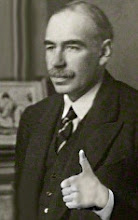
Robert Skidelsky talks about Keynes’ life from his three volume biography, the last volume of which is John Maynard Keynes: Fighting for Freedom, 1937–1946 (vol. 3; London, 2000). Skidelsky here, however, muddles up some of his economic theory and seems to identify neoclassical synthesis Keynesianism with Keynes’ economics.
Showing posts with label Skidelsky. Show all posts
Showing posts with label Skidelsky. Show all posts
Saturday, June 18, 2016

Sunday, March 8, 2015
Skidelsky on Automation, Economics and Ethics
The video below is a short but interesting talk by Robert Skidelsky, given on 15 October, 2014, on automation, economics and ethics, and invoking his book How Much is Enough? Money and the Good Life (2012).
It also refers to Keynes’ somewhat utopian ideas in his essay “Economic Possibilities for our Grandchildren” (Keynes 1930a and 1930b; Keynes 1933), which I have written about here.
Skidelsky points to something very important indeed: that the Austrian and neoclassical disutility of labour axiom is not universally true. There really are certain jobs that people find rewarding and that bring satisfaction or utility (Lavoie 1992: 218).
Moreover, Skidelsky also highlights the negative distributional effects of the neoliberal era, and the effects of automation and IT as a driver of modern structural unemployment, though some of his suggested polices to retard the rise of automation seem misguided to me.
BIBLIOGRAPHY
Keynes, John Maynard. 1930a. “Economic Possibilities for our Grandchildren II,” The Nation and Athenaeum 48.3 (October 18): 96–98.
Keynes, John Maynard. 1930b. “Economic Possibilities for our Grandchildren II,” The Nation and Athenaeum 48.2 (October 11, 1930): 36–37.
Keynes, John Maynard. 1933. Essays in Persuasion. Macmillan, London.
Lavoie, Marc. 1992. Foundations of Post-Keynesian Economic Analysis. Edward Elgar Publishing, Aldershot, UK.
It also refers to Keynes’ somewhat utopian ideas in his essay “Economic Possibilities for our Grandchildren” (Keynes 1930a and 1930b; Keynes 1933), which I have written about here.
Skidelsky points to something very important indeed: that the Austrian and neoclassical disutility of labour axiom is not universally true. There really are certain jobs that people find rewarding and that bring satisfaction or utility (Lavoie 1992: 218).
Moreover, Skidelsky also highlights the negative distributional effects of the neoliberal era, and the effects of automation and IT as a driver of modern structural unemployment, though some of his suggested polices to retard the rise of automation seem misguided to me.
BIBLIOGRAPHY
Keynes, John Maynard. 1930a. “Economic Possibilities for our Grandchildren II,” The Nation and Athenaeum 48.3 (October 18): 96–98.
Keynes, John Maynard. 1930b. “Economic Possibilities for our Grandchildren II,” The Nation and Athenaeum 48.2 (October 11, 1930): 36–37.
Keynes, John Maynard. 1933. Essays in Persuasion. Macmillan, London.
Lavoie, Marc. 1992. Foundations of Post-Keynesian Economic Analysis. Edward Elgar Publishing, Aldershot, UK.
Wednesday, May 14, 2014
Skidelsky on Uncertainty and Knowledge
This an old video in which Skidelsky talks about fundamental uncertainty, but it is concise and insightful.
The more one learns about economics and epistemology, the more that one understands that uncertainty is a crucial concept, and one that is strongly related to probability and the limits of human knowledge.
The more one learns about economics and epistemology, the more that one understands that uncertainty is a crucial concept, and one that is strongly related to probability and the limits of human knowledge.
Wednesday, November 27, 2013
Joseph Stiglitz’s Review of Skidelsky’s Keynes: The Return of the Master
The review below is actually a very good read and has a letter from Paul Davidson at the end:
Joseph Stiglitz, “The Non-Existent Hand” (review of Robert Skidelsky, Keynes: The Return of the Master), London Review of Books 32.8 (22 April), 2010: 17–18.Joseph Stiglitz is a New Keynesian and his interpretation of Skidelsky is interesting, not least of all for his insights into debt deflation.
Thursday, February 21, 2013
Skidelsky on Robots and Unemployment
An interesting article here:
If you accept that market economies have no tendency to full employment equilibrium, then it follows logically that large-scale automation is most likely to cause serious structural unemployment and a chronic aggregate demand shortfall.
And it will not do to say, “oh, well, enough new jobs will be created designing and maintaining the machines.” For a while they might. But the inexorable march of artificial intelligence means that eventually there is no reason why machines will not design and maintain other machines.
Machines will eventually design, manufacture, test and provide maintenance for new generations of machines, with minimal human supervision.
Robert Skidelsky, “The Rise of the Robots,” Project-syndicate.org, February 19, 2013.Some people complain that Skidelsky is being a Luddite, but that is utterly unfair, as he does not oppose automation per se.
If you accept that market economies have no tendency to full employment equilibrium, then it follows logically that large-scale automation is most likely to cause serious structural unemployment and a chronic aggregate demand shortfall.
And it will not do to say, “oh, well, enough new jobs will be created designing and maintaining the machines.” For a while they might. But the inexorable march of artificial intelligence means that eventually there is no reason why machines will not design and maintain other machines.
Machines will eventually design, manufacture, test and provide maintenance for new generations of machines, with minimal human supervision.
Tuesday, April 3, 2012
Skidelsky on Keynes and the Crisis of Capitalism
This is an excellent lecture by Robert Skidelsky (Emeritus Professor of Political Economy at the University of Warwick) recorded on 7 October, 2009, on Keynes, a critique of neoclassical economics, and the financial crisis of 2008 and resulting global recession.
Saturday, May 7, 2011
Skidelsky on “The Relevance of Keynes”
Robert Skidelsky has a very good essay on Keynes’s thought and how it applies to the financial crisis of 2008 and the state we find ourselves in today:
Robert Skidelsky, “The Relevance of Keynes,” January 17, 2011, www.skidelskyr.com.This has also been published as an article:
Robert Skidelsky, “The Relevance of Keynes,” Cambridge Journal of Economics 35.1 (2011): 1–13.Skidelsky is Keynes’s biographer and his interpretation of Keynes is in fact very close to that of the Post Keynesian school, which is why his work is important. The interested reader looking for something more substantial can also read Skidelsky’s new book Keynes: The Return of the Master (Allen Lane, 2009). A reasonably good summary can be found here:
Keynes: The Return of the Master, Wikipedia.org.The reaction to this book shows us the schism that runs through modern New Keynesian macroeconomics. First, we have quite positive reviews of Skidelsky’s book by the liberal New Keynesians Krugman and Stiglitz:
Paul Krugman, “Keynes: The Return of the Master by Robert Skidelsky,” Guardian, 30 August 2009.In contrast, we have the conservative New Keynesian N. Gregory Mankiw in a remarkably cold review in the Wall Street Journal:
Joseph Stiglitz, “The Non-Existent Hand,” London Review of Books 32.8, 22 April 2010.
(this also has a letter by the Post Keynesian Paul Davidson clarifying Keynes’s views on uncertainty).
N. Gregory Mankiw, “Back In Demand,” Wall Street Journal, September 21, 2009.Mankiw asserts that Keynesianism “is based in part on the premise that wages and prices do not adjust to levels that ensure full employment.” In fact, Keynes also showed that even if wages and prices were flexible, there would still be involuntary unemployment and failures of aggregate demand. The so-called New Keynesian tradition developed by Mankiw and others (which is rather different from the New Keynesianism of Krugman and Stiglitz) is actually a travesty of Keynes’ thought, and part of the problem plaguing modern economics.
Sunday, May 1, 2011
Skidelsky on Keynesian Uncertainty
This is a nice summary by Robert Skidelsky of the concept of uncertainty in Keynes’ thought.
I would add that the interested reader can go straight to Keynes’ important 1937 article where he emphasised the concept of uncertainty and its implications for economics:
I would add that the interested reader can go straight to Keynes’ important 1937 article where he emphasised the concept of uncertainty and its implications for economics:
Keynes, “The General Theory of Employment,” Quarterly Journal of Economics 51 (1937): 209–223.The crucial passage is here:
“By ‘uncertain’ knowledge, let me explain, I do not mean merely to distinguish what is known for certain from what is only probable. The game of roulette is not subject, in this sense, to uncertainty; nor is the prospect of a Victory bond being drawn. Or, again, the expectation of life is only slightly uncertain. Even the weather is only moderately uncertain. The sense in which I am using the term is that in which the prospect of a European war is uncertain, or the price of copper and the rate of interest twenty years hence, or the obsolescence of a new invention, or the position of private wealthowners in the social system in 1970. About these matters there is no scientific basis on which to form any calculable probability whatever” (Keynes 1937: 213–214).
Subscribe to:
Posts (Atom)