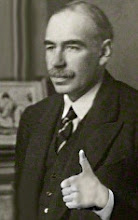
In this fascinating interview of heterodox economist Bob Rowthorn, he makes a very interesting point about the importance of capacity utilisation and fixprices in Keynesian economics, in terms of the differences between the views of Keynes in the General Theory and Kalecki (N.B. the video may start at an earlier point than I set it at in Mozilla Firefox!).
Now I have not looked carefully into this, but does anyone know any good literature about this subject, and specific references in Kalecki’s work?
The crucial point is that Keynes was opposed to nominal wage cuts (for reasons explained in Chapter 19 of the General Theory), and his analysis there seems to assume a flexprice world (Hayes 2006: 178: “The General Theory itself is a ‘flex-price’ system, but not of Hick’s Walrasian type”) as a concession to the neoclassical theory of Keynes’s day, in order to show that even flexible prices and wages do not necessarily cure unemployment.
But, once we have a mark-up pricing world with adjustments in capacity utilisation where prices are generally relatively inflexible, then expansion of aggregate demand does not simply cause inflation as it would if prices were generally flexprice.
And once we move to the real world of fixprices (the world of mark-up prices and capacity utilisation as in Kalecki’s models), Keynesian economics simply becomes an even stronger and more robust theory of modern market economies.
BIBLIOGRAPHY
Hayes, Mark. 2006. The Economics of Keynes: A New Guide to The General Theory. Edward Elgar, Cheltenham.
Showing posts with label aggregate demand. Show all posts
Showing posts with label aggregate demand. Show all posts
Thursday, January 30, 2014

Thursday, March 21, 2013
Hayek on Aggregate Demand in a Depression
Gottfried von Haberler describes Hayek’s views on the role of aggregate demand in an economy, and the two instances where Hayek admitted that aggregate demand was able to affect the level of employment:
One can only marvel at the inconsistency in Hayek’s thought. And what was Hayek’s explanation for the repeated instances we see in the real world in which government fiscal stimulus is followed by increased private investment and falling unemployment?
BIBLIOGRAPHY
Haberler, G. 1986. “Reflections on Hayek’s Business Cycle Theory,” Cato Journal 6: 421–435.
Haberler, G. 1991. “Reflections on Hayek’s Business Cycle Theory,” in John Cunningham Wood and Ronald N. Woods (eds.), Friedrich A. Hayek: Critical Assessments (vol. 4). Routledge, London. 249–262.
“In later writings Hayek (1974, 1975) has clarified and somewhat modified his views, coming to grips with the problem of secondary deflation. He still rejects what he believes is the basic mistake of Keynesian economics, namely, ‘that employment is a direct and simple function of what is called aggregate demand, and that by keeping aggregate demand at a sufficiently high level we can lastingly secure full employment’ (1975, p. 4). In a later publication he goes so far as to say that ‘the whole notion that he [Keynes] has made popular, macroeconomics,’ must be ‘set aside.’Yet it seems difficult to see why an increase in aggregate demand would increase employment in a depression, but not in a recession, or indeed in any situation where extensive unemployment and idle resources exist.
Hayek now says there are two exceptions to the rule that changes in aggregate demand do not affect the level of employment. The first one was ‘an accidental historic situation.’ In 1925 Britain made the mistake of returning to the gold standard at the prewar parity, which meant that real wages were too high. ‘In this situation,’ he wrote, ‘the restoration of employment required a reduction of real wages which could he achieved by a general rise of prices’ (1974, p. 4).
‘The second situation in which it is true that an increase of employment requires an increase in aggregate demand,’ Hayek (1974, p. 5) now maintains, ‘is found in the later stages of a depression when, in consequence of the appearance of extensive unemployment, the economy frequently is subjected to a cumulative process of contraction. … of secondary deflation, which may go on for a very long time.’” (Haberler 1986: 426; reprinted in Haberler 1991).
One can only marvel at the inconsistency in Hayek’s thought. And what was Hayek’s explanation for the repeated instances we see in the real world in which government fiscal stimulus is followed by increased private investment and falling unemployment?
BIBLIOGRAPHY
Haberler, G. 1986. “Reflections on Hayek’s Business Cycle Theory,” Cato Journal 6: 421–435.
Haberler, G. 1991. “Reflections on Hayek’s Business Cycle Theory,” in John Cunningham Wood and Ronald N. Woods (eds.), Friedrich A. Hayek: Critical Assessments (vol. 4). Routledge, London. 249–262.
Monday, December 10, 2012
Rise of the Robots?
Yes, this is already the title of a recent post by Krugman here:
But what about the possible problems it will cause? Firstly, I want to qualify everything I say below with the clear statement: I do not oppose the trend to automation; I welcome it. Labour saving machinery was the key to the industrial revolution and the many increases in productivity growth we have seen over the past two centuries. The problem is that a new era of mass automation requires macroeconomic policies to deal with its perverse negatives consequences.
The media already reports that some economists think mass automation might not necessarily benefit everyone, but the analysis there is poor because it is based on the fantasy of neoclassical general equilibrium models.
In contrast, Krugman focuses on the implications for income distribution: away from workers to capital. First, the wealthy have a lower marginal propensity to consume (or alternatively a higher marginal propensity to save), and they are likely to buy financial assets on secondary markets with their extra money, not final goods and services.
Secondly, America and many Western nations already have a chronic unemployment problem, which, without proper fiscal expansion, will continue for years. What will happen when that persistent unemployment problem is exacerbated by large-scale structural unemployment owing to mass automation in industry?
Factors (1) and (2) above already strongly suggest a serious aggregate demand shortfall in the future. Keynesian demand management and income distribution are going to be more important than anyone ever dreamed. Government must step in and provide employment programs or funds to employ those who are unemployed and who seek employment. (In fact, structural unemployment induced by technology was already a problem in the 19th century and even as strong a defender of laissez faire as Jean-Baptiste Say – the inventor of Say’s law – advocated public works as a solution to such unemployment. See Appendix 1 below.)
No doubt additional jobs will be created in new private businesses, but it is unlikely to be enough. Free markets do not guarantee full employment, nor does Say’s law work. Employment in tradable goods and services in many countries will probably fall dramatically. Our employment future will probably be mainly in services, education, and most probably in employment programs funded by government or in government-sector jobs. There will probably be a great reduction in the hours that people need to work as well and more leisure.
It might well be that much of the government-funded labour force will be in education (e.g., universities), sciences, research and development, or other services. I suspect a much greater labour force working in basic sciences and applied R&D would mean a much more rapid advancement of science and technology too – a virtuous circle.
As we move down the route of radical automation in the course of this century, equally radical Keynesian demand management will be necessary to maintain demand for goods and services, income equality, and continuing rises in living standards.
Addendum
Some other points that occur to me as an afterthought:
APPENDIX 1: SAY ADVOCATED PUBLIC WORKS AS A SOLUTION TO UNEMPLOYMENT INDUCED BY TECHNOLOGY
In his discussion of the introduction of labour saving machines, Say recognised that this would create short term unemployment, and in a footnote actually advocated public works spending by government:
BIBLIOGRAPHY
Say, J. B. 1832. A Treatise on Political Economy; or, the Production, Distribution, and Consumption of Wealth (4th edn; trans. C. R. Princep and C. C. Bibble), Grigg & Elliott, Philadelphia
Paul Krugman, “Rise of the Robots,” December 8, 2012I have to say I feel rather vindicated, since I made similar points over two years ago in this post:
“Automation and Robotics: The Future of Manufacturing?,” September 12, 2010.Krugman notes that the strong trend towards industrial automation is good news for American manufacturing. Indeed, it is, and we can expect to see some return of manufacturing to the US and Western nations from East Asia and other developing, low wage countries. As Krugman says, robots “mean that labor costs don’t matter much, so you might as well locate in advanced countries with large markets and good infrastructure.” This means that the US should see a fall in its unbalanced trade deficit with other nations.
But what about the possible problems it will cause? Firstly, I want to qualify everything I say below with the clear statement: I do not oppose the trend to automation; I welcome it. Labour saving machinery was the key to the industrial revolution and the many increases in productivity growth we have seen over the past two centuries. The problem is that a new era of mass automation requires macroeconomic policies to deal with its perverse negatives consequences.
The media already reports that some economists think mass automation might not necessarily benefit everyone, but the analysis there is poor because it is based on the fantasy of neoclassical general equilibrium models.
In contrast, Krugman focuses on the implications for income distribution: away from workers to capital. First, the wealthy have a lower marginal propensity to consume (or alternatively a higher marginal propensity to save), and they are likely to buy financial assets on secondary markets with their extra money, not final goods and services.
Secondly, America and many Western nations already have a chronic unemployment problem, which, without proper fiscal expansion, will continue for years. What will happen when that persistent unemployment problem is exacerbated by large-scale structural unemployment owing to mass automation in industry?
Factors (1) and (2) above already strongly suggest a serious aggregate demand shortfall in the future. Keynesian demand management and income distribution are going to be more important than anyone ever dreamed. Government must step in and provide employment programs or funds to employ those who are unemployed and who seek employment. (In fact, structural unemployment induced by technology was already a problem in the 19th century and even as strong a defender of laissez faire as Jean-Baptiste Say – the inventor of Say’s law – advocated public works as a solution to such unemployment. See Appendix 1 below.)
No doubt additional jobs will be created in new private businesses, but it is unlikely to be enough. Free markets do not guarantee full employment, nor does Say’s law work. Employment in tradable goods and services in many countries will probably fall dramatically. Our employment future will probably be mainly in services, education, and most probably in employment programs funded by government or in government-sector jobs. There will probably be a great reduction in the hours that people need to work as well and more leisure.
It might well be that much of the government-funded labour force will be in education (e.g., universities), sciences, research and development, or other services. I suspect a much greater labour force working in basic sciences and applied R&D would mean a much more rapid advancement of science and technology too – a virtuous circle.
As we move down the route of radical automation in the course of this century, equally radical Keynesian demand management will be necessary to maintain demand for goods and services, income equality, and continuing rises in living standards.
Addendum
Some other points that occur to me as an afterthought:
(1) Eventually automation and structural unemployment will affect even services. Artificial intelligence is not far fetched, and it is undoubtedly the way of the future. Already when you ring some companies you can find voice recognition software doing the work of people.
(2) Perhaps we will see a very strong deflation in the prices of many industrial goods, especially those where at present high wages are a major factor input cost.
(3) Some more relevant news and commentary here:Paul Krugman, “Robots and Robber Barons,” December 9, 2012.
Christopher Matthews, “Can Robots Bring Manufacturing Jobs Back to the U.S.?,” Time.com, September 27, 2012.
Will Knight, “This Robot Could Transform Manufacturing,” MIT Technology Review, September 18, 2012.
Vivek Wadhwa, “The End of Chinese Manufacturing and Rebirth of U.S. Industry,” Forbes.com, 23 July, 2012.
APPENDIX 1: SAY ADVOCATED PUBLIC WORKS AS A SOLUTION TO UNEMPLOYMENT INDUCED BY TECHNOLOGY
In his discussion of the introduction of labour saving machines, Say recognised that this would create short term unemployment, and in a footnote actually advocated public works spending by government:
“Without having recourse to local or temporary restrictions on the use of new methods or machinery which are invasions of the property of the inventors or fabricators a benevolent administration can make prevision for the employment of supplanted or inactive labour in the construction of works of public utility at the public expense as of canals, roads, churches or the like …” (Say 1832: 87).This must come as a shock to Austrians and libertarians who so frequently cite Say’s law with approval.
BIBLIOGRAPHY
Say, J. B. 1832. A Treatise on Political Economy; or, the Production, Distribution, and Consumption of Wealth (4th edn; trans. C. R. Princep and C. C. Bibble), Grigg & Elliott, Philadelphia
Monday, March 26, 2012
Some Discussion of Aggregates in the Blogosphere
There are some interesting posts on various blogs at the moment dealing with the Austrian attitude to aggregates:
But our universe contains a vast number of abstract things that have no concrete existence, say, like universals or numbers. For example, the number 5 has no concrete existence, but does anyone doubt that the number 5, and indeed numbers in general, are real, meaningful concepts? (of course, the advocates of the philosophical position called nominalism would dispute the idea that numbers are real, but the crude Austrians never seem even to have the wit or intelligence to frame the debate on aggregates in terms of nominalism versus realism. I take a “moderate realist” position, for the record). Do people doubt that the sum of 5, 6, 3, 4, 8, and 1 (itself a number) is not a real, meaningful concept?
Aggregates just have no concrete existence like a concrete particular, as, for example, the particular chair you are sitting on, as you read this post.
When we move to economics or finance, it is obvious how aggregates permeate everything.
A business can sell units of a good or even units of heterogeneous goods. But it can calculate value of the volume of its sales of goods as a monetary aggregate in any given period (say, the financial year or even a month or day). It is the same with the aggregated money value of purchased final goods and services throughout an economy in a given year, the aggregate that is used to express or calculate the value of aggregate demand.
Aggregate concepts are required by Say’s law: (1) the value of total factor payments considered as aggregate supply, and (2) aggregate demand as the aggregate of spending on output that has been earned from total factor payments. If aggregate concepts are invalid, then Say’s law is also invalid.
While I am pleased to see Jonathan Finegold Catalán proclaim that only crude Austrians deny the existence of aggregates, a more interesting question is whether he is willing to repudiate statements like this from the Austrian William L. Anderson:
And this sort of stupidity is far more common amongst Austrians, especially internet Austrians, than the more “astute” Austrians think.
(1) “Is There Macroeconomics?,” 3 March, 2012.I have always said that it is utterly absurd to watch Austrians deny the existence of aggregates. Often it is the sign of a truly infantile mind that thinks that, just because something has no concrete existence, then it must not exist.
(2) “Crude Austrians, Macroeconomics, and Complexity,” Facts & Other Stubborn Things, 25 March, 2012.
(3) Jonathan Finegold Catalán, “AAA = Aggregates Annoy (Crude) Austrians,” Economic Thought, 26 March, 2012.
(4) “‘Free Market’ Double Standards 4.0,” Unlearning Economics, March 23, 2012.
(see point 6).
(5) Gene Callahan, “Vulgar Austrians and Aggregates,” September 25, 2011.
(this post by Gene Callahan is somewhat older than the ones above, but I will post a link to it anyway).
But our universe contains a vast number of abstract things that have no concrete existence, say, like universals or numbers. For example, the number 5 has no concrete existence, but does anyone doubt that the number 5, and indeed numbers in general, are real, meaningful concepts? (of course, the advocates of the philosophical position called nominalism would dispute the idea that numbers are real, but the crude Austrians never seem even to have the wit or intelligence to frame the debate on aggregates in terms of nominalism versus realism. I take a “moderate realist” position, for the record). Do people doubt that the sum of 5, 6, 3, 4, 8, and 1 (itself a number) is not a real, meaningful concept?
Aggregates just have no concrete existence like a concrete particular, as, for example, the particular chair you are sitting on, as you read this post.
When we move to economics or finance, it is obvious how aggregates permeate everything.
A business can sell units of a good or even units of heterogeneous goods. But it can calculate value of the volume of its sales of goods as a monetary aggregate in any given period (say, the financial year or even a month or day). It is the same with the aggregated money value of purchased final goods and services throughout an economy in a given year, the aggregate that is used to express or calculate the value of aggregate demand.
Aggregate concepts are required by Say’s law: (1) the value of total factor payments considered as aggregate supply, and (2) aggregate demand as the aggregate of spending on output that has been earned from total factor payments. If aggregate concepts are invalid, then Say’s law is also invalid.
While I am pleased to see Jonathan Finegold Catalán proclaim that only crude Austrians deny the existence of aggregates, a more interesting question is whether he is willing to repudiate statements like this from the Austrian William L. Anderson:
“When Krugman uses ‘demand,’ he means ‘aggregate demand,’ which economically speaking is a nonsensical term. There is no such thing as “aggregate demand.’”Anderson sets himself up as a serious Austrian critic of Paul Krugman, yet here he is caught making the most risible, stupid statements.
William L. Anderson, “Krugman: In the Long Run, We Screw Future Generations,” Krugman-in-Wonderland, June 25, 2010.
“The problem is that Krugman, as a Keynesian macro guy, cannot see anything but aggregates, which is not economics at all. There is no such thing as ‘aggregate demand’ and ‘aggregate supply,’ or at least something with such terms that can be represented in the crude ‘Keynesian Cross’ or an AD-AS graph.”
William L. Anderson, “The ‘Stimulus’ that Failed to ‘Fix’ the Economy ,” Krugman-in-Wonderland, December 21, 2011.
“For all of his ‘credentials,’ let us not forget that Krugman is a Keynesian who has no clue whatsoever what happens in a real economy. His world is the imaginary world of aggregates, GDP numbers, crude graphs, and no real people and certainly no real production.”
William L. Anderson, “Jeremy Warner Gets It Right on Krugman,” Krugman-in-Wonderland, March 21, 2010.
And this sort of stupidity is far more common amongst Austrians, especially internet Austrians, than the more “astute” Austrians think.
Thursday, December 1, 2011
Jean Baptiste Say on Failures of Aggregate Demand
In modern formulations of Say’s law (or the “law of markets”), there are two main variants of it, as follows:
There is a question here about whether Jean Baptiste Say ever expressed his “law of markets” as Say’s Identity. This is complicated by the fact that there was more than one edition of his Treatise on Political Economy. The second edition of the Treatise on Political Economy was published in 1814 and has a revised version of Say’s law (Baumol 1977: 147), while in the first edition the law of markets is not nearly so complete. It was only in the second edition of the Treatise on Political Economy (1814) that Say’s discussion is identifiable as a “form of a type of Say’s equality, i.e., supply and demand are always equated by a rapid and powerful equilibration mechanism” (Baumol 1977: 159). Indeed, Jean Baptiste Say even criticised Ricardo for using a version of the law of markets we would recognise as Say’s Identity (Blaug 1996: 150). The second version of the law of markets – Say’s Equality – is obviously a far weaker version of it, for it admits the possibility of short term failures of aggregate demand, even if a long run inequality between aggregate supply and demand is denied.
A relevant passage by Jean Baptiste Say on this issue occurs in one of his letters to Malthus:
BIBLIOGRAPHY
Baumol, W. J. 1977. “Say’s (at Least) Eight Laws, or What Say and James Mill May Really Have Meant,” Economica n.s. 44.174: 145–161.
Blaug, M. 1996. Economic Theory in Retrospect (5th edn). Cambridge University Press, Cambridge.
Kates, S. (ed.), 2003. Two Hundred Years of Say’s Law: Essays on Economic Theory’s Most Controversial Principle. Edward Elgar Pub, Cheltenham ; Northampton, Mass.
Say, J. B. 1821. Letters to Mr. Malthus: On Several Subjects of Political Economy, and on the Cause of the General Stagnation of Commerce. To Which is added A Catechism of Political Economy. Sherwood, Neely, and Jones, London.
(1) Say’s IdentitySay’s Identity requires that no failures of aggregate demand can occur, as money is not held for significant periods of time and factor payments from aggregate supply are spent in aggregate demand (either in consumption or investment). Thus in particular commodity markets there might be excess supply, but overall there is “zero value of the sum of excess demands” (Kates 2003: 45). It appears that James Mill and John Ramsay McCulloch both used Say’s Identity and Say’s Equality in their writings (Blaug 1996: 150).
According to Baumol (1977: 146), this“is the assertion that no one ever wants to hold money for any significant amount of time, so that, as a result, every offer (supply) of a quantity of goods automatically constitutes a demand for a bundle of some other items of equal market value.”(2) Say’s Equality
Again, according to Baumol (1977: 146), Say’s Equality“admits the possibility of (brief) periods of disequilibrium during which the total demand for goods may fall short of the total supply, but maintains that there exist reliable equilibrating forces that must soon bring the two together.
There is a question here about whether Jean Baptiste Say ever expressed his “law of markets” as Say’s Identity. This is complicated by the fact that there was more than one edition of his Treatise on Political Economy. The second edition of the Treatise on Political Economy was published in 1814 and has a revised version of Say’s law (Baumol 1977: 147), while in the first edition the law of markets is not nearly so complete. It was only in the second edition of the Treatise on Political Economy (1814) that Say’s discussion is identifiable as a “form of a type of Say’s equality, i.e., supply and demand are always equated by a rapid and powerful equilibration mechanism” (Baumol 1977: 159). Indeed, Jean Baptiste Say even criticised Ricardo for using a version of the law of markets we would recognise as Say’s Identity (Blaug 1996: 150). The second version of the law of markets – Say’s Equality – is obviously a far weaker version of it, for it admits the possibility of short term failures of aggregate demand, even if a long run inequality between aggregate supply and demand is denied.
A relevant passage by Jean Baptiste Say on this issue occurs in one of his letters to Malthus:
“Mr. Ricardo insists that, notwithstanding taxes and other charges, there is always as much industry as capital employed; and that all capital saved is always employed, because the interest is not suffered to be lost. On the contrary, many savings are not invested, when it is difficult to find employment for them, and many which are employed are dissipated in ill-calculated undertakings. Besides, Mr. Ricardo is completely refuted not only by what happened to us in 1813, when the errors of Government ruined all commerce, and when the interest of money fell very low, for want of good opportunities of employing it; but by our present circumstances, when capitals are quietly sleeping in the coffers of their proprietors. The bank of France alone possesses 223 millions of specie in its chests, more than double the amount of its notes in circulation, and six times what it would be prudent to reserve for the ordinary course of its payments.” (Say 1821: 49; it was also published in New Monthly Magazine, Volume 14 [1820, October 1], p. 368ff.).What we have here is:
(1) a recognition that money savings will not necessarily be invested in capital goods and that an aggregate demand failure has occurred;All that needed to be added was an analysis of the role of demand for money used in speculation on secondary financial asset markets for liquid assets as a store of value and subjective expectations in the investment decision.
(2) “many savings are not invested,” a rudimentary insight not far removed from Keynes’s theory of liquidity preference.
BIBLIOGRAPHY
Baumol, W. J. 1977. “Say’s (at Least) Eight Laws, or What Say and James Mill May Really Have Meant,” Economica n.s. 44.174: 145–161.
Blaug, M. 1996. Economic Theory in Retrospect (5th edn). Cambridge University Press, Cambridge.
Kates, S. (ed.), 2003. Two Hundred Years of Say’s Law: Essays on Economic Theory’s Most Controversial Principle. Edward Elgar Pub, Cheltenham ; Northampton, Mass.
Say, J. B. 1821. Letters to Mr. Malthus: On Several Subjects of Political Economy, and on the Cause of the General Stagnation of Commerce. To Which is added A Catechism of Political Economy. Sherwood, Neely, and Jones, London.
Say Repudiated Say’s Law
This is an interesting point that is rarely mentioned by the apologists for Say’s law. Say did in fact acknowledge that downturns in the business cycle could happen. Baumol has noted:
We can see that eventually Say partly (though not fully) understood what Keynes himself believed: changes in liquidity preference can cause insufficient demand and involuntary unemployment. Both Say and J. S. Mill in some writings even appear to have allowed that failures in aggregate demand can cause recession (Hollander 2005: 383-284).
While Say’s recantation is of historical interest, it actually does not provide good grounds in itself for dismissing Say’s law. Why? The reason is that it is possible in principle for Say’s law to be true, even if the original inventor of it later rejected it. E.g., suppose Copernicus rejected the heliocentric theory of the solar system in later life: such a hypothetic repudiation in itself does not in fact provide good evidence for rejection of the heliocentric theory. What matter are arguments and evidence. The evidence for the heliocentric theory is overwhelming. The evidence against Say’s law is also overwhelming:
NOTE
* N.B. I am not telling readers to believe this just because Sowell says so. So, to the various libertarian readers of my blog: don’t waste my time invoking the argument from authority fallacy; it’s irrelevant. Moreover, not all arguments from authority are necessarily fallacious at all.
BIBLIOGRAPHY
Baumol, W. J. 1999. “Retrospectives: Say’s Law,” Journal of Economic Perspectives 13.1: 195–204.
Hollander, S. 2005. “Review of Two Hundred Years of Say’s Law: Essays on Economic Theory’s Most Controversial Principle,” History of Political Economy 37.2: 382–385.
Sowell, T. 2006. On Classical Economics. Yale University Press, New Haven, Conn.
“Say and other writers recognized that the zero value of the sum of excess demands, or supply creates its own demand (“Say’s identity”), may not hold in the short run. Say’s passage in his Letters to Malthus … even suggests an explanation – a desire to hoard or, as we would now put it, a temporary excess demand for money. But they thought the market would fairly quickly and automatically restore equilibrium” (Baumol 1999: 201).Thomas Sowell, who is usually regarded as the scholarly expert on Say’s law*, also states that Say “admitted to Malthus that Say’s Law was ‘subject to some restrictions’ and to Sismondi that the fifth edition of his Traite contained a ‘concession’ to the latter’s theory of equilibrium income” (Sowell 2006: 31).
We can see that eventually Say partly (though not fully) understood what Keynes himself believed: changes in liquidity preference can cause insufficient demand and involuntary unemployment. Both Say and J. S. Mill in some writings even appear to have allowed that failures in aggregate demand can cause recession (Hollander 2005: 383-284).
While Say’s recantation is of historical interest, it actually does not provide good grounds in itself for dismissing Say’s law. Why? The reason is that it is possible in principle for Say’s law to be true, even if the original inventor of it later rejected it. E.g., suppose Copernicus rejected the heliocentric theory of the solar system in later life: such a hypothetic repudiation in itself does not in fact provide good evidence for rejection of the heliocentric theory. What matter are arguments and evidence. The evidence for the heliocentric theory is overwhelming. The evidence against Say’s law is also overwhelming:
“The Myth of Say’s Law,” October 7, 2010.This is why it should be rejected.
NOTE
* N.B. I am not telling readers to believe this just because Sowell says so. So, to the various libertarian readers of my blog: don’t waste my time invoking the argument from authority fallacy; it’s irrelevant. Moreover, not all arguments from authority are necessarily fallacious at all.
BIBLIOGRAPHY
Baumol, W. J. 1999. “Retrospectives: Say’s Law,” Journal of Economic Perspectives 13.1: 195–204.
Hollander, S. 2005. “Review of Two Hundred Years of Say’s Law: Essays on Economic Theory’s Most Controversial Principle,” History of Political Economy 37.2: 382–385.
Sowell, T. 2006. On Classical Economics. Yale University Press, New Haven, Conn.
Saturday, May 28, 2011
Say’s Law Presupposes Aggregate Demand as a Meaningful Concept
It never ceases to amaze me to see certain Austrians and pro-free market libertarians making statements like this:
In modern formulations of Say’s law, there are two main variants:
If we turn to Thomas Sowell (1994: 39–41), one of the supposed experts on Say’s law, we can see his summary of what the Classical economists meant by the expression:
BIBLIOGRAPHY
Baumol, W. J. 1977. “Say’s (at Least) Eight Laws, or What Say and James Mill May Really Have Meant,” Economica n.s. 44.174: 145–161.
Sowell, T. 1994. Classical Economics Reconsidered, Princeton University Press, Princeton, N.J.
“When Krugman uses ‘demand,’ he means ‘aggregate demand,’ which economically speaking is a nonsensical term. There is no such thing as ‘aggregate demand’ …”In fact, the concept of aggregate demand is presupposed by Say’s law, and if aggregate demand is a “nonsensical term,” “not meaningful” or if “there is no such thing,” then Say’s law utterly collapses with it.
In modern formulations of Say’s law, there are two main variants:
(1) Say’s IdentitySay’s equality asserts that, in a given time period (say a year), total factor payments from production (= aggregate supply) will be spent on consumption or capital goods/business investment in new commodity output (= aggregate demand), and this either will be equal or tend to be equal to the value of aggregate supply in the short run. How can anyone seriously deny that the total demand for final goods and services in an economy is not a fundamental and meaningful concept here?
According to Baumol (1977: 146), this
“is the assertion that no one ever wants to hold money for any significant amount of time, so that, as a result, every offer (supply) of a quantity of goods automatically constitutes a demand for a bundle of some other items of equal market value.”
(2) Say’s Equality
Again, according to Baumol (1977: 146), Say’s Equality
“admits the possibility of (brief) periods of disequilibrium during which the total demand for goods may fall short of the total supply, but maintains that there exist reliable equilibrating forces that must soon bring the two together.”
If we turn to Thomas Sowell (1994: 39–41), one of the supposed experts on Say’s law, we can see his summary of what the Classical economists meant by the expression:
“(1) The total factor payments received for producing a given volume (or value) of output are necessarily sufficient to purchase that volume (or value) of output [an idea in James Mill].As we can see, propositions 3 and 4 above require aggregate demand as a fundamental concept. If there is no such thing as aggregate demand, how could these propositions even be true?
(2) There is no loss of purchasing power anywhere in the economy. People save only to the extent of their desire to invest and do not hold money beyond their transactions need during the current period [James Mill and Adam Smith].
(3) Investment is only an internal transfer, not a net reduction, of aggregate demand. The same amount that could have been spent by the thrifty consumer will be spent by the capitalists and/or the workers in the investment goods sector [John Stuart Mill].
(4) In real terms, supply equals demand ex ante [= “before the event”], since each individual produces only because of, and to the extent of, his demand for other goods. (Sometimes this doctrine was supported by demonstrating that supply equals demand ex post.) [James Mill.]
(5) A higher rate of savings will cause a higher rate of subsequent growth in aggregate output [James Mill and Adam Smith].
(6) Disequilibrium in the economy can exist only because the internal proportions of output differ from consumer’s preferred mix—not because output is excessive in the aggregate” [Say, Ricardo, Torrens, James Mill] (Sowell 1994: 39–41).
BIBLIOGRAPHY
Baumol, W. J. 1977. “Say’s (at Least) Eight Laws, or What Say and James Mill May Really Have Meant,” Economica n.s. 44.174: 145–161.
Sowell, T. 1994. Classical Economics Reconsidered, Princeton University Press, Princeton, N.J.
Thursday, October 7, 2010
The Myth of Say’s Law
Jean Baptiste Say (1767–1832) is credited with Say’s law or Say’s law of markets (“loi des débouchés”, in French), of which Walras’ law appears to be a modern neoclassical restatement. Although Say did not use the expression “law” to describe his views, his writings on this subject are to be found in A Treatise on Political Economy (or the Traité d’économie politique in French), Book 1, Chapter 15 (Say 1832: 132–140; the first edition of which was published in 1803) and in the Catechism of Political Economy (Say 1816: 103–105).
In modern formulations of Say’s law, there are two main variants of it:
A reading of the modern interpreters of the law of markets make it clear that by Say’s equality, Say did not mean that downturns in the business cycle cannot occur. Say was attempting to show that there could not be a general glut or general overproduction of all commodities, and that there could never be an overall shortfall in aggregate demand. Say’s view was compatible with the possibility of downturns caused by individual commodities being overproduced. That is, there could be specific but limited types of commodities where overproduction occurred relative to demand for those commodities. Say’s law of markets appears to be compatible with short-term gluts of specific commodities. As Steve Keen has argued:
John Maynard Keynes in the General Theory had this to say about Say’s law:
However, the general view of Say and the 19th century classical economists seemed to be that recessions and involuntary unemployment could occur, but mainly by sectoral imbalances (though Hollander maintains that Say and Mill glimpsed that failures of aggregate demand might be involved), and that Say’s law of markets was the mechanism by which equilibrium was rapidly restored in a free market economy (Kates 1998: 14).
So what does all this prove? That Say’s law of markets is true? Hardly.
In fact, Keynes still refuted the version of Say’s law in J. S. Mill and Marshall, even if they did not understand Say properly.
And a careful examination of Say’s writings on demand and production shows that his reasoning is deeply flawed. A good starting point is this passage in Say’s Catechism of Political Economy (1816: 103–105):
First, Say holds that buyers of commodities cannot obtain money except by having acquired it from the sale of other commodities. This is also expressed in A Treatise on Political Economy, Book 1, Chapter 15:
The answer is that without production people would have no commodities (= wealth) for consumption. They might still have money. The premise of such a question is that without prior production there is no money to purchase commodities. This commits Austrians to the view that money is a “produced” commodity. But today we live in a fiat money world. Money is no longer “commodity” money. It is not “produced” in the way that gold and silver are dug out of the ground. Today fractional reserve banking creates money through debt, and open market operations create new money in the form of bank reserves. This is the real world in which we live, and even in Say’s own time fractional reserve banking was creating fiduciary media without prior creation of commodities.
Say’s law appears to require a world where money is produced like any other commodity, and this is one condition for the law of markets to work. But the condition does not exist today: Say’s law is irrelevant to modern fiat money using economies, where money also has a store of value role.
The second fatal and ridiculous flaw in Say’s argument is the belief that “every producer asks for money in exchange for his products, only for the purpose of employing that money again immediately in the purchase of another product.”
In fact, it simply isn’t the case that producers of commodities (whether individuals or businesses) or the recipients of the money profits of the firm like workers or owners will always use the money they earn from the sale of commodities “only for the purpose of employing that money again immediately in the purchase of another product.” Money can be saved and it can become idle. Capitalism also has markets for real and financial assets. Money can flow into the purchasing of financial assets. If there are financial assets or real assets whose prices are rising, modern capitalists, producers and even workers might decide to start speculating on asset prices. This would take money away from the purchasing of commodities and instead tie it up in exchanges on asset markets, as money alternates between being (1) held idle before buying assets and (2) purchasing assets, and then being held idle again by the new owner of the money in preparation for further speculation.
Another fatal flaw in Say’s reasoning is that money has no utility and cannot be used as a store of value:
It should be noted of course that Say’s ideas were later developed by the Classical economists, so Say’s law in that historical sense is not the same as the ideas found in Say’s own writings.
So what was Say’s law in its developed form and as held by modern defenders of it?
Thomas Sowell (1994: 39–41) argues that in Classical economics Say’s law can be expressed by these propositions:
First, it is perfectly possible that supply equals demand ex ante, which is asserted in proposition (1) and in the first statement in (4) (if one ignores the qualification “since each individual produces only because of, and to the extent of, his demand for other goods,” which does not follow at all), but to assert that it will always hold ex post is a non sequitur, without demonstrating the truth of propositions (2), (3), (5), and (6).
Unfortunately, these propositions cannot be held to be true.
Let’s start with proposition (2). Under conditions of uncertainty, money has utility (see my previous post “The Utility of Money in Post Keynesianism”, which I will use in what follows). It is deeply flawed to regard money only as a “neutral veil” that overcomes the inconveniences of direct barter. Such an idea is associated with the “neutral money axiom” (Davidson 2002: 19). In reality, people really do choose to hold money in and of itself as (1) a store of value and (2) a way of dealing with future uncertainty. Thus there is a precautionary motive for holding money, in addition to the transactions motive. Say’s law of markets requires neutral money or the idea that money only has a medium of exchange role. As Paul Davidson has argued,
Moreover, Keynes in the General Theory made the fundamental point that fiat money and even commodity money have special properties:
The property of zero or very small elasticity of production also applies to liquid financial assets. If consumers decide to buy less producible commodities and increase their holding of money or ownership of financial assets, unemployment will result in some sectors as demand for commodities declines. The price of financial assets will rise and it is possible that the price of money could also rise. But private businesses cannot hire the unemployed to “produce” or “manufacture” more money or financial assets to exploit profit opportunities in the high-price liquid assets (Davidson 2010: 255–256).
In classical and neoclassical economics, however, money is held to be a commodity (e.g., gold, silver or some other type of commodity). If the demand for commodity money rises, neoclassical theory says it can be “produced” like any other commodity by hiring unemployed workers. But this idea is utterly false in a world where the commodity money consists of rare metals like gold or silver, and certainly false in the modern world of fiat money.
The second special property of money and liquid financial assets is that they have zero or near zero elasticity of substitution:
Thus a shortfall in aggregate demand is possible.
Moreover, there are other obvious leakages from the aggregate income arising from production that result in insufficient aggregate demand. There is no necessary reason why all the income will be spent on commodities in a particular time period, or even at all. Savings and changes in the rate of saving may happen.
Sowell’s proposition (3) above is also unacceptable. Classical advocates of Say’s law argued that saving would result in reasonably quick consumption or investment, but that simply does not follow. Money savings can become idle balances (“hoards,” in the terminology of Keynes). But even idle balances of money are not the only cause of a shortfall in demand. We can list the various “leakages” from aggregate income as described above, as well as some other ones, as follows:
For all these reasons, aggregate demand failures can cause recessions, whenever aggregate demand falls short of supply. Equilibrium will not result and is not necessarily a condition of free markets. Say’s law is a myth.
APPENDIX 1: SAY ADVOCATED PUBLIC WORKS
In his discussion of the introduction of labour saving machines, Say recognised that this would create short term unemployment, and in a footnote actually advocated public works spending by government:
APPENDIX 2: RESERVATION DEMAND DOES NOT RESCUE SAY’S LAW
Reservation demand is defined as a type of demand in which producers or sellers of commodities hold their commodities off the market and refuse to sell them, because they expect higher prices in the future.
Reservation demand was never invoked by J. B. Say or other classical economists in defence of Say’s law, but one modern libertarian defence of Say’s law appears to use this concept.
As J. T. Salerno notes,
To see how the concept of reservation demand is applied to money we can turn to Rothbard’s Man, Economy, and State: A Treatise on Economic Principles (1962):
Moreover, Rothbard treats money as a commodity since he is an advocate of the gold standard. When we come to money, Rothbard also uses the concept of reservation demand:
It is here that libertarians might jump on Rothbard’s analysis to argue that Say’s law can be saved from collapse by applying the concept of reservation demand to money.
But what can the expression “reservation demand” mean when applied to money? When applied to commodities, it means that commodities are held off the market by sellers in expectation of higher prices in the future. Logically, then, reservation demand for money would be holding money in expectation of a higher price for money in the future in terms of its purchasing power. That is, a higher price for money can only mean a rise in money’s purchasing power, whether through general price deflation or falls in the prices of a commodity or commodities one wishes to purchase. Rothbard’s other comments support this:
At most, “reservation demand” for money can only describe one subcategory of Keynes’ speculative demand for money: that category that involves holding money in expectation of general price deflation or price falls in one or other commodities.
Speculative demand for money includes many other categories, including holding money to buy assets expected to rise in price in the future.
And even if one chooses to make “reservation demand” for money in its only proper sense equal to its value as inserted into aggregate supply, this still leaves other idle money balances not spent on consumption or investment in capital goods.
A revised version of Say’s law according to the libertarian defence can be given here:
As for AD, the value of total factor payments will be divided into these three categories when spent in aggregate demand:
Rothbard’s sleight of hand is to lump (3), (4), (5), and (6) into one category he called reservation or ‘cash balance’ demand.
This can be used to then argue that Say’s law holds because the category “cash balance demand” is by definition equal to that value in aggregate supply when it is inserted into AS.
But this trick will not save Say’s law. In (3), (4), (5), and (6), money will be idle and not spent on aggregate supply. Without total factor payments going to purchase commodities or to capital goods investment, aggregate demand failures can occur.
I also note that Hoppe, Hulsmann, Block, in response to Selgin and White (1996), have also used the concept of reservation demand in discussing Say’s law and in arguing against the existence of fiduciary media:
BIBLIOGRAPHY
Baumol, W. J. 1977. “Say’s (at Least) Eight Laws, or What Say and James Mill May Really Have Meant,” Economica n.s. 44.174: 145–161.
Baumol, W. J. 1999. “Retrospectives: Say’s Law,” Journal of Economic Perspectives 13.1: 195–204.
Becker, G., and W. Baumol, 1952. “The Classical Monetary Theory,” Economica 19.4: 355–376.
Davidson, P. 2002. Financial Markets, Money, and the Real World, Edward Elgar, Cheltenham.
Davidson, P. 2010. “Keynes’ Revolutionary and ‘Serious’ Monetary Theory,” in R. W. Dimand, R. A. Mundell, and A. Vercelli (eds), Keynes’s General Theory after Seventy Years, Palgrave Macmillan, Basingstoke, England and New York. 241–267.
Gootzeit, M. 2003. “Savings, Hoarding and Say’s Law,” in S. Kates (ed.), Two Hundred Years of Say’s Law: Essays on Economic Theory’s Most Controversial Principle, Edward Elgar Pub, Cheltenham; Northampton, Mass. 168–186.
Hahn, F. H. 1977. “Keynesian Economics and General Equilibrium Theory: Reflections on Some Current Debates,” in G. C. Harcourt (ed.), The Microeconomic Foundations of Macroeconomics, Macmillan, London. 25–40.
Hollander, S. 2005. Review of Two Hundred Years of Say’s Law: Essays on Economic Theory’s Most Controversial Principle, History of Political Economy 37.2: 382–385.
Hoppe, H.-H., Hulsmann, G. and W. Block, 1998. “Against Fiduciary Media,” Quarterly Journal of Austrian Economics 1.1: 19–50.
Kates, S. (ed.), 2003. Two Hundred Years of Say’s Law: Essays on Economic Theory’s Most Controversial Principle, Edward Elgar Pub, Cheltenham ; Northampton, Mass.
Keen, S. 2001. Debunking Economics: The Naked Emperor of the Social Sciences, Zed Books, London and New York.
Keynes, J. M. 1936. The General Theory of Employment, Interest, and Money, Macmillan, London.
Lange, O. 1942. “Say’s Law: A Restatement and Criticism,” in O. Lange, F. McIntyre and T. O. Matema (eds), Studies in Mathematical Economics and Econometrics: In Memory of Henry Schultz, University of Chicago Press, Chicago. 49–68.
Mises, L. 2005 [1950], “Lord Keynes and Say’s Law,” Mises Daily, April 25, 2005, http://mises.org/daily/1803
Murphy, R. P. 2006. Study Guide to Man, Economy, and State: A Treatise on Economic Principles, with Power and Market: Government and the Economy, Ludwig von Mises Institute, Auburn, Ala.
Rothbard, M. N. 2004 [1962]. Man, Economy, and State: A Treatise on Economic Principles, Ludwig von Mises Institute, Auburn, Ala.
Say, J. B. 1816. Catechism of Political Economy, or, Familiar conversations on the manner in which wealth is produced, distributed, and consumed in society (trans. J. Richter), Sherwood, Neely, and Jones, London.
Say, J. B. 1832. A Treatise on Political Economy; or, The Production, Distribution, and Consumption of Wealth (4th edn; trans. C. R. Princep and C. C. Bibble), Grigg & Elliott, Philadelphia.
Salerno, J. T. 2006. “A Simple Model of the Theory of Money Prices,” Quarterly Journal of Austrian Economics 9.4: 39–55.
Selgin, G. A., and L. H. White, 1996. “In Defense of Fiduciary Media – or, We are Not Devo(lutionists), We are Misesians!,” Review of Austrian Economics 9.2: 83–107.
Sowell, T. 1972. Say’s Law: An Historical Analysis, Princeton University Press, Princeton, N.J.
Sowell, T. 1994. Classical Economics Reconsidered, Princeton University Press, Princeton, N.J.
Smith, A. 1811. An Inquiry into the Nature and Causes of the Wealth of Nations (11 edn; vol. 1), Oliver D. Cooke, Hartford.
Visser, H. 2002. “Neutrality of Money,” in B. Snowdon and H. R. Vane (eds), An Encyclopedia of Macroeconomics, Edward Elgar Publishing, Cheltenham. 526–532.
Wicker, E. 1996. The Banking Panics of the Great Depression, Cambridge University Press, Cambridge and New York.
In modern formulations of Say’s law, there are two main variants of it:
(1) Say’s IdentityThe issue of what J. B. Say himself thought is complicated by the fact that there was more than one edition of his Treatise on Political Economy. The second edition was published in 1814 and has a revised version of Say’s law (Baumol 1977: 147), while in the first edition the law of markets is not so complete. It was only in the second edition of the Treatise on Political Economy (1814) that Say’s discussion is identifiable as a “form of a type of Say’s equality, i.e., supply and demand are always equated by a rapid and powerful equilibration mechanism” (Baumol 1977: 159).
According to Baumol (1977: 146), this
“is the assertion that no one ever wants to hold money for any significant amount of time, so that, as a result, every offer (supply) of a quantity of goods automatically constitutes a demand for a bundle of some other items of equal market value.”
(2) Say’s Equality
Again, according to Baumol (1977: 146), Say’s Equality
“admits the possibility of (brief) periods of disequilibrium during which the total demand for goods may fall short of the total supply, but maintains that there exist reliable equilibrating forces that must soon bring the two together.”
A reading of the modern interpreters of the law of markets make it clear that by Say’s equality, Say did not mean that downturns in the business cycle cannot occur. Say was attempting to show that there could not be a general glut or general overproduction of all commodities, and that there could never be an overall shortfall in aggregate demand. Say’s view was compatible with the possibility of downturns caused by individual commodities being overproduced. That is, there could be specific but limited types of commodities where overproduction occurred relative to demand for those commodities. Say’s law of markets appears to be compatible with short-term gluts of specific commodities. As Steve Keen has argued:
“[sc. before Keynes] mainstream economics did not believe there were any intractable macroeconomic problems. Individual markets might be out of equilibrium at any one time – and this could include the market for labour or the market for money – but the overall economy, the sum of all those individual markets, was bound to be balanced” (Keen 2001: 189).On the neoclassical and classical view, there could not be a downturn caused by an overall deficiency in aggregate demand: slumps were caused by sectoral imbalances/sectoral disequilibrium or by external shocks. Aggregate supply could never exceed aggregate demand (Kates 1998: 4–5).
John Maynard Keynes in the General Theory had this to say about Say’s law:
“From the time of Say and Ricardo the classical economists have taught that supply creates its own demand;—meaning by this in some significant, but not clearly defined, sense that the whole of the costs of production must necessarily be spent in the aggregate, directly or indirectly, on purchasing the product …. As a corollary of the same doctrine, it has been supposed that any individual act of abstaining from consumption necessarily leads to, and amounts to the same thing as, causing the labour and commodities thus released from supplying consumption to be invested in the production of capital wealth” (Keynes 1936: 18–19).Keynes’ remark about the classical economists is correct (Baumol 1999: 200). For example, Adam Smith held these ideas:
“In all countries where there is tolerable security, every man of common understanding will endeavour to employ whatever stock he can command, in procuring either present enjoyment or future profit. If it is employed in procuring present enjoyment, it is a stock reserved for immediate consumption. If it is employed in procuring future profit, it must procure this profit, either by staying with him, or by going from him. In the one case it is a fixed, in the other it is a circulating capital. A man must be perfectly crazy who, where there is tolerable security, does not employ all the stock which he commands, whether it be his own, or borrowed of other people, in some one or other of those three ways.” (Smith 1811: 198).These passages are essentially an assertion of Say’s Identity (Baumol 1977: 158). Keynes also states:
“What is annually saved is as regularly consumed as what is annually spent, and nearly in the same time too; but it is consumed by a different set of people. That portion of his revenue which a rich man annually spends is, in most cases consumed by idle guests, and menial servants, who leave nothing behind them in return for their consumption. That portion which he annually saves, as for the sake of the profit it is immediately employed as a capital, is consumed in the same manner, and nearly in the same time too, but by a different set of people, by labourers, manufacturers, and artificers, who re-produce with a profit the value of their annual consumption. His revenue, we shall suppose, is paid him in money. Had he spent the whole, the food, clothing, and lodging, which the whole could have purchased, would have been distributed among the former set of people. By saving a part of it, as that part is for the sake of the profit immediately employed as a capital either by himself or by some other person, the food, clothing, and lodging, which may be purchased with it, are necessarily reserved for the latter. The consumption is the same, but the consumers are different” (Smith 1811: 240).
“Thus Say’s law, that the aggregate demand price of output as a whole is equal to its aggregate supply price for all volumes of output, is equivalent to the proposition that there is no obstacle to full employment” (Keynes 1936: 26).This was perhaps a mischaracterization of Say’s actual ideas (Kates 1998; Keen 2001: 189–190). In this passage, Keynes was refuting the reformulation of Say’s law by John Stuart Mill and Alfred Marshall. Say did in fact acknowledge that downturns in the business cycle could happen. Baumol has even argued that
“Say and other writers recognized that the zero value of the sum of excess demands, or supply creates its own demand (“Say’s identity”), may not hold in the short run. Say’s passage in his Letters to Malthus … even suggests an explanation – a desire to hoard or, as we would now put it, a temporary excess demand for money. But they thought the market would fairly quickly and automatically restore equilibrium” (Baumol 1999: 201).In other words, it appears that Say eventually partly though not fully understood what Keynes himself believed: changes in liquidity preference can cause insufficient demand and involuntary unemployment. Both Say and J. S. Mill in some writings even appear to have allowed that failures in aggregate demand can cause recession (Hollander 2005: 383-284).
However, the general view of Say and the 19th century classical economists seemed to be that recessions and involuntary unemployment could occur, but mainly by sectoral imbalances (though Hollander maintains that Say and Mill glimpsed that failures of aggregate demand might be involved), and that Say’s law of markets was the mechanism by which equilibrium was rapidly restored in a free market economy (Kates 1998: 14).
So what does all this prove? That Say’s law of markets is true? Hardly.
In fact, Keynes still refuted the version of Say’s law in J. S. Mill and Marshall, even if they did not understand Say properly.
And a careful examination of Say’s writings on demand and production shows that his reasoning is deeply flawed. A good starting point is this passage in Say’s Catechism of Political Economy (1816: 103–105):
On what does the vivacity of the demand depend?Say believed that any short-term glut in particular commodities would be quickly eliminated.
On two motives which are—1st. The utility of the product, that is, the necessity the consumer has for it:—2nd. The quantity of other products he is able to give in exchange.
I conceive the first motive. As to the second it appears to me that it is the quantity of money that the buyer possesses which induces him to buy or not.
That is also true: but the quantity of money which he has, depends on the quantity of product with which he has been able to buy this money.
Could he not obtain the money otherwise than by having acquired it by products?
No.
If he had received the money from his tenants?
His tenant had received it from the sale of part of the products to which the earth had contributed.
If he had received the interest of a capital lent?
The undertaker who employed that capital had received the money which he paid, on the sale of a part of the products to which his capital had concurred.
If the purchaser had obtained this money by gift or inheritance—?
The giver, or he from whom the giver had obtained it, had it in exchange for some product. In every case the money, with which any product is purchased, must have been produced by the sale of another product; and the purchase may be considered as an exchange in which the purchaser gives that which he has produced, (or that which another has produced for him), and in which he receives the thing bought.
What do you conclude from this?
That the more the purchasers produce, the more they have to purchase with, and that the productions of the one procure purchasers to the other.
It appears to me, that if the buyers only purchased by means of their products, they have generally more products than money to offer in payment.
Every producer asks for money in exchange for his products, only for the purpose of employing that money again immediately in the purchase of another product; for we do not consume money, and it is not sought after in ordinary cases to conceal it: thus, when a producer desires to exchange his product for money, he may be considered as already asking for the merchandise which he proposes to buy with this money. It is thus that the producers, though they have all of them the air of demanding money for their goods, do in reality demand merchandise for their merchandise (Say 1816: 103–105).
First, Say holds that buyers of commodities cannot obtain money except by having acquired it from the sale of other commodities. This is also expressed in A Treatise on Political Economy, Book 1, Chapter 15:
“A man who applies his labour to the investing of objects with value by the creation of utility of some sort, can not expect such a value to be appreciated and paid for, unless where other men have the means of purchasing it. Now of what do these means consist? Of other values of other products, likewise the fruits of industry, capital and land. Which leads us to a conclusion that may at first sight appear paradoxical, namely, that it is production which opens a demand for products” (Say 1832: 133).Here Say is clear that only production of other commodities provides the money to pay for “products” (a related question is what he means by “capital”: if this means investment money then it is obvious that Say naturally thinks of money as a commodity too). A form of this idea is sometimes encountered on libertarian blogs. For example, one will find Austrians asking questions such as “how could people have money if they hadn’t produced something to exchange for money?”
The answer is that without production people would have no commodities (= wealth) for consumption. They might still have money. The premise of such a question is that without prior production there is no money to purchase commodities. This commits Austrians to the view that money is a “produced” commodity. But today we live in a fiat money world. Money is no longer “commodity” money. It is not “produced” in the way that gold and silver are dug out of the ground. Today fractional reserve banking creates money through debt, and open market operations create new money in the form of bank reserves. This is the real world in which we live, and even in Say’s own time fractional reserve banking was creating fiduciary media without prior creation of commodities.
Say’s law appears to require a world where money is produced like any other commodity, and this is one condition for the law of markets to work. But the condition does not exist today: Say’s law is irrelevant to modern fiat money using economies, where money also has a store of value role.
The second fatal and ridiculous flaw in Say’s argument is the belief that “every producer asks for money in exchange for his products, only for the purpose of employing that money again immediately in the purchase of another product.”
In fact, it simply isn’t the case that producers of commodities (whether individuals or businesses) or the recipients of the money profits of the firm like workers or owners will always use the money they earn from the sale of commodities “only for the purpose of employing that money again immediately in the purchase of another product.” Money can be saved and it can become idle. Capitalism also has markets for real and financial assets. Money can flow into the purchasing of financial assets. If there are financial assets or real assets whose prices are rising, modern capitalists, producers and even workers might decide to start speculating on asset prices. This would take money away from the purchasing of commodities and instead tie it up in exchanges on asset markets, as money alternates between being (1) held idle before buying assets and (2) purchasing assets, and then being held idle again by the new owner of the money in preparation for further speculation.
Another fatal flaw in Say’s reasoning is that money has no utility and cannot be used as a store of value:
“for we do not consume money, and it is not sought after in ordinary cases to conceal it” (Say 1816: 104).It is clear that Say believes in neutral money, and he is deeply mistaken in thinking of money only as a neutral “veil” with no store of value function (for the concept of neutral money, see Visser 2002). Say’s analysis also ignores the role of financial markets in affecting demand for money.
“For, after all, money is but the agent of the transfer of values. Its whole utility has consisted in conveying to your hands the value of the commodities, which your customer has sold, for the purpose of buying again from you; and the very next purchase you make, it will again convey to a third person the value of the products you may have sold to others” (Say 1832: 133).
“Money performs but a momentary function in … double exchange; and when the transaction is finally closed, it will always be found, that one kind of commodity has been exchanged for another” (Say 1832: 134).
“When the producer has put the finishing hand to his product, he is most anxious to sell it immediately, lest its value should diminish in his hands. Nor is he less anxious to dispose of the money he may get for it; for the value of money is also perishable. But the only way of getting rid of money is in the purchase of some product or other. Thus, the mere circumstance of the creation of one product immediately opens a vent for other products” (Say 1832: 134–135).
It should be noted of course that Say’s ideas were later developed by the Classical economists, so Say’s law in that historical sense is not the same as the ideas found in Say’s own writings.
So what was Say’s law in its developed form and as held by modern defenders of it?
Thomas Sowell (1994: 39–41) argues that in Classical economics Say’s law can be expressed by these propositions:
“(1) The total factor payments received for producing a given volume (or value) of output are necessarily sufficient to purchase that volume (or value) of output [an idea in James Mill].So this is Say’s law, according to the Classical economists.
(2) There is no loss of purchasing power anywhere in the economy. People save only to the extent of their desire to invest and do not hold money beyond their transactions need during the current period [James Mill and Adam Smith].
(3) Investment is only an internal transfer, not a net reduction, of aggregate demand. The same amount that could have been spent by the thrifty consumer will be spent by the capitalists and/or the workers in the investment goods sector [John Stuart Mill].
(4) In real terms, supply equals demand ex ante [= “before the event”], since each individual produces only because of, and to the extent of, his demand for other goods. (Sometimes this doctrine was supported by demonstrating that supply equals demand ex post.) [James Mill.]
(5) A higher rate of savings will cause a higher rate of subsequent growth in aggregate output [James Mill and Adam Smith].
(6) Disequilibrium in the economy can exist only because the internal proportions of output differ from consumer’s preferred mix—not because output is excessive in the aggregate” [Say, Ricardo, Torrens, James Mill] (Sowell 1994: 39–41).
First, it is perfectly possible that supply equals demand ex ante, which is asserted in proposition (1) and in the first statement in (4) (if one ignores the qualification “since each individual produces only because of, and to the extent of, his demand for other goods,” which does not follow at all), but to assert that it will always hold ex post is a non sequitur, without demonstrating the truth of propositions (2), (3), (5), and (6).
Unfortunately, these propositions cannot be held to be true.
Let’s start with proposition (2). Under conditions of uncertainty, money has utility (see my previous post “The Utility of Money in Post Keynesianism”, which I will use in what follows). It is deeply flawed to regard money only as a “neutral veil” that overcomes the inconveniences of direct barter. Such an idea is associated with the “neutral money axiom” (Davidson 2002: 19). In reality, people really do choose to hold money in and of itself as (1) a store of value and (2) a way of dealing with future uncertainty. Thus there is a precautionary motive for holding money, in addition to the transactions motive. Say’s law of markets requires neutral money or the idea that money only has a medium of exchange role. As Paul Davidson has argued,
“[in] an uncertain world, the possession of money and other nonproducible liquid assets provides utility by protecting the holder from fear of being unable to meet future liabilities” (Davidson 2003: 236).The neoclassicals thought that only producible goods and services can provide utility. But money can have utility on its own account. So can liquid financial assets. The neoclassical view was that money has no utility, but only exchange value. The Austrian view also seems to be that money has no utility except for what can be obtained in exchange for it. The idea that money has no utility in itself is part of the three fundamental neoclassical axioms that Keynes rejected. The following three fundamental axioms are the basis of neoclassical economics and of Say’s law:
(1) the neutral money axiom (i.e., holding money by itself provides no utility),If one assumes these false axioms, then one will believe that the “aggregate demand function is the same as the aggregate supply function” (Davidson 2002: 43). Post Keynesian economics requires the rejection of these axioms. In a fundamentally uncertain world, you have the problem of facing a possible lack of liquidity in the future (i.e., lack of money). This is why many people like to hold onto money, and precisely why money has utility – and in fact often has a great deal of utility.
(2) the gross substitution axiom, and
(3) the ergodic axiom.
Moreover, Keynes in the General Theory made the fundamental point that fiat money and even commodity money have special properties:
“… money has, both in the long and the short period, a zero, or at any rate a very small, elasticity of production, so far as the power of private enterprise is concerned, as distinct from the monetary authority;—elasticity of production meaning, in this context, the response of the quantity of labour applied to producing it to a rise in the quantity of labour which a unit of it will command. Money, that is to say, cannot be readily produced;—labour cannot be turned on at will by entrepreneurs to produce money in increasing quantities as its price rises in terms of the wage-unit. In the case of an inconvertible managed currency this condition is strictly satisfied. But in the case of a gold-standard currency it is also approximately so, in the sense that the maximum proportional addition to the quantity of labour which can be thus employed is very small, except indeed in a country of which gold-mining is the major industry.Money has a zero or very small elasticity of production. This means that a rise in demand for money and a rising “price” for money (i.e., an increase in its purchasing power) will not lead to businesses “producing” money by hiring workers.
Now, in the case of assets having an elasticity of production, the reason why we assumed their own-rate of interest to decline was because we assumed the stock of them to increase as the result of a higher rate of output. In the case of money, however—postponing, for the moment, our consideration of the effects of reducing the wage-unit or of a deliberate increase in its supply by the monetary authority—the supply is fixed. Thus the characteristic that money cannot be readily produced by labour gives at once some prima facie presumption for the view that its own-rate of interest will be relatively reluctant to fall; whereas if money could be grown like a crop or manufactured like a motor-car, depressions would be avoided or mitigated because, if the price of other assets was tending to fall in terms of money, more labour would be diverted into the production of money;—as we see to be the case in gold-mining countries, though for the world as a whole the maximum diversion in this way is almost negligible” (Keynes 1936: 230–231).
The property of zero or very small elasticity of production also applies to liquid financial assets. If consumers decide to buy less producible commodities and increase their holding of money or ownership of financial assets, unemployment will result in some sectors as demand for commodities declines. The price of financial assets will rise and it is possible that the price of money could also rise. But private businesses cannot hire the unemployed to “produce” or “manufacture” more money or financial assets to exploit profit opportunities in the high-price liquid assets (Davidson 2010: 255–256).
In classical and neoclassical economics, however, money is held to be a commodity (e.g., gold, silver or some other type of commodity). If the demand for commodity money rises, neoclassical theory says it can be “produced” like any other commodity by hiring unemployed workers. But this idea is utterly false in a world where the commodity money consists of rare metals like gold or silver, and certainly false in the modern world of fiat money.
The second special property of money and liquid financial assets is that they have zero or near zero elasticity of substitution:
“The second differentia of money is that it has an elasticity of substitution equal, or nearly equal, to zero which means that as the exchange value of money rises there is no tendency to substitute some other factor for it;—except, perhaps, to some trifling extent, where the money-commodity is also used in manufacture or the arts. This follows from the peculiarity of money that its utility is solely derived from its exchange-value, so that the two rise and fall pari passu, with the result that as the exchange value of money rises there is no motive or tendency, as in the case of rent-factors, to substitute some other factor for it.Financial assets are not gross substitutes for commodities. The neoclassical gross substitution axiom is wrong. In both a commodity money and fiat money world, savings are held in the form of money and non-producible financial assets. An increase in demand for money and non-producible financial assets and rising prices of such liquid assets will not spill over into a demand for relatively cheaper commodities, because the elasticity of substitution of money and liquid assets is zero or near zero (Davidson 2010: 256–257; Davidson 2002: 44–45; see also Hahn 1977: 31). Even if wages and prices were perfectly flexible, there could still be “leakages” in aggregate supply in the form of speculation on financial asset markets which would be “non-employment inducing demand” (Davidson 2010: 257; Hahn 1977: 37).
Thus, not only is it impossible to turn more labour on to producing money when its labour-price rises, but money is a bottomless sink for purchasing power, when the demand for it increases, since there is no value for it at which demand is diverted—as in the case of other rent-factors—so as to slop over into a demand for other things” (Keynes 1936: 231).
“money has (or may have) zero (or negligible) elasticities both of production and of substitution” (Keynes 1936: 234).
Thus a shortfall in aggregate demand is possible.
Moreover, there are other obvious leakages from the aggregate income arising from production that result in insufficient aggregate demand. There is no necessary reason why all the income will be spent on commodities in a particular time period, or even at all. Savings and changes in the rate of saving may happen.
Sowell’s proposition (3) above is also unacceptable. Classical advocates of Say’s law argued that saving would result in reasonably quick consumption or investment, but that simply does not follow. Money savings can become idle balances (“hoards,” in the terminology of Keynes). But even idle balances of money are not the only cause of a shortfall in demand. We can list the various “leakages” from aggregate income as described above, as well as some other ones, as follows:
(1) People desire to hold money as a hedge against future uncertainty (the “precautionary motive,” in Keynes’ theory), and since expectations are subjective such holdings can vary. In depressions or recessions, people may choose to hold more of their money as cash. In underdeveloped and pre-modern economies, hoarding can take the form of holding money physically outside of banks as cash or coin (Gootzeit 2003: 182). In the Great Depression, the rise in the hoarding of money was a significant factor, as it probably was in pre-1914 downturns in the business cycle (Wicker 1996: 144).Once propositions (2) and (3) of Say’s law above are shown to be false, propositions (4) and (5) collapse completely, and the idea that supply equals demand ex post cannot be possible.
(2) As we have seen, even when people hold money either as individuals or as savings in financial institutions, not all the money will be invested in production of producible commodities (= goods and services). Money can be used to speculate on asset prices. New savings or a rise in savings can be diverted to purchasing of financial assets (or real assets) with the money used to buy such assets then flowing to other speculators, who buy new financial assets or hold money idle in the process of using it in further speculation on assets. Thus there is a “speculative demand” for money that can rise or fall.
(3) In modern economies where savings are held in demand deposits and saving accounts in banks, money is invested by banks themselves. But even here investment by banks will be subject to subjective expectations under uncertainty. In recessions or depressions when expectations are low, banks may simply choose to keep their depositors’ money as excess reserves or use it to buy financial assets on secondary markets. Thus even modern banks can “hoard” by reducing investment and leaving money in idle balances (at central banks or held in reserve for speculation on financial assets).
(4) Money income can be spent on imports causing a trade deficit, which in pre-fiat money days could result in a contraction of the money supply and deflationary pressures.
(5) A government might levy taxes and a run budget surplus without re-injecting that money back into the economy (and effectively destroying it).
For all these reasons, aggregate demand failures can cause recessions, whenever aggregate demand falls short of supply. Equilibrium will not result and is not necessarily a condition of free markets. Say’s law is a myth.
APPENDIX 1: SAY ADVOCATED PUBLIC WORKS
In his discussion of the introduction of labour saving machines, Say recognised that this would create short term unemployment, and in a footnote actually advocated public works spending by government:
“Without having recourse to local or temporary restrictions on the use of new methods or machinery which are invasions of the property of the inventors or fabricators a benevolent administration ran make prevision for the employment of supplanted or inactive labour in the construction of works of public utility at the public expense as of canals, roads, churches or the like …” (Say 1832: 87).This must come as an embarrassing shock to Austrians who so frequently cite Say’s work with approval.
APPENDIX 2: RESERVATION DEMAND DOES NOT RESCUE SAY’S LAW
Reservation demand is defined as a type of demand in which producers or sellers of commodities hold their commodities off the market and refuse to sell them, because they expect higher prices in the future.
Reservation demand was never invoked by J. B. Say or other classical economists in defence of Say’s law, but one modern libertarian defence of Say’s law appears to use this concept.
As J. T. Salerno notes,
“Rothbard (1993, pp. 350–56, 662–67) was the first to analyze the demand for money in terms of its exchange demand and reservation demand components. In 1913, Herbert J. Davenport … also clearly identified these two partial demands for money but ultimately failed to integrate them into an overall theory of the demand for money” (Salerno 2006: 40, n, 4).Rothbard sets out the types of reservation demand in relation to commodities:
“The sources of a reservation demand by the seller are two: (a) anticipation of later sale at a higher price; this is the speculative factor analyzed above; and (b) direct use of the good by the seller. This second factor is not often applicable to producers’ goods, since the seller produced the producers’ good for sale and is usually not immediately prepared to use it directly in further production. In some cases, however, this alternative of direct use for further production does exist. For example, a producer of crude oil may sell it or, if the money price falls below a certain minimum, may use it in his own plant to produce gasoline. In the case of consumers’ goods, which we are treating here, direct use may also be feasible, particularly in the case of a sale of an old consumers’ good previously used directly by the seller—such as an old house, painting, etc. However, with the great development of specialization in the money economy, these cases become infrequent” (Rothbard 2004 [1962]: 253).Rothbard (2004 [1962]: 755ff.) treats money as a commodity and analyses the supply and demand for it “in terms of the total demand-stock analysis” he had used in Chapter 2 of Man, Economy, and State, and this obviously has relevance to Say’s law, and is indeed applied to it in Hoppe, Hulsmann, and Block (1998: 40).
To see how the concept of reservation demand is applied to money we can turn to Rothbard’s Man, Economy, and State: A Treatise on Economic Principles (1962):
“When a seller keeps his stock instead of selling it, what is the source of his reservation demand for the good? We have seen that the quantity of a good reserved at any point is the quantity of stock that the seller refuses to sell at the given price. The sources of a reservation demand by the seller are two: (a) anticipation of later sale at a higher price; this is the speculative factor analyzed above; and (b) direct use of the good by the seller. This second factor is not often applicable to producers’ goods, since the seller produced the producers’ good for sale and is usually not immediately prepared to use it directly in further production” (Rothbard 2004: 253).So, in relation to commodities, Rothbard’s definition is in line with the generally accepted definition. But there is absolutely no necessary reason at all why (1) the value of commodities not sold due to reservation demand would equal (2) the total value of unsold commodities in a given period. Many commodities will remain on the shelves simply because they were not sold.
Moreover, Rothbard treats money as a commodity since he is an advocate of the gold standard. When we come to money, Rothbard also uses the concept of reservation demand:
“The total demand for money on the market consists of two parts: the exchange demand for money (by sellers of all other goods that wish to purchase money) and the reservation demand for money (the demand for money to hold by those who already hold it)” (Rothbard 2004: 759).Rothbard’s reference to everyone acquiring “his income” can presumably refer to total factor payments from production (aggregate supply). Rothbard now defines “reservation demand” for money as the money flowing into cash balances (net hoarding).
“More important, because more volatile, in the total demand for money on the market is the reservation demand to hold money. This is everyone’s post-income demand. After everyone has acquired his income, he must decide, as we have seen, between the allocation of his money assets in three directions: consumption spending, investment spending, and addition to his cash balance (‘net hoarding’). Furthermore, he has the additional choice of subtraction from his cash balance (‘net dishoarding’). How much he decides to retain in his cash balance is uniquely determined by the marginal utility of money in his cash balance on his value scale. … We have now to look at the remaining good: money in the cash balance, its utility and demand. Before discussing the sources of the demand for a cash balance, however, we may determine the shape of the reservation (or ‘cash balance’) demand curve for money” (Rothbard 2004: 759).
It is here that libertarians might jump on Rothbard’s analysis to argue that Say’s law can be saved from collapse by applying the concept of reservation demand to money.
But what can the expression “reservation demand” mean when applied to money? When applied to commodities, it means that commodities are held off the market by sellers in expectation of higher prices in the future. Logically, then, reservation demand for money would be holding money in expectation of a higher price for money in the future in terms of its purchasing power. That is, a higher price for money can only mean a rise in money’s purchasing power, whether through general price deflation or falls in the prices of a commodity or commodities one wishes to purchase. Rothbard’s other comments support this:
“an expectation of a rise in the … [purchasing power of money] in the near future will tend to raise the demand-for-money schedule as people decide to “hoard” (add money to their cash balance) in expectation of a future rise in the exchange-value of a unit of their money. The result will be a present rise in the [purchasing power of money]” (Rothbard 2004: 768).But Rothbard’s definition of “reservation demand” as all net money added to and held in cash balances (“net hoarding”) includes forms of idle money that cannot legitimately be called “reservation demand.” Rothbard has changed the meaning of “reservation demand” in a sleight of hand.
At most, “reservation demand” for money can only describe one subcategory of Keynes’ speculative demand for money: that category that involves holding money in expectation of general price deflation or price falls in one or other commodities.
Speculative demand for money includes many other categories, including holding money to buy assets expected to rise in price in the future.
And even if one chooses to make “reservation demand” for money in its only proper sense equal to its value as inserted into aggregate supply, this still leaves other idle money balances not spent on consumption or investment in capital goods.
A revised version of Say’s law according to the libertarian defence can be given here:
Aggregate supply (AS) = total factor payments + value of money held in reservation demandThis still does not save Say’s law. Although the value of all commodities held by “reservation demand” equals the value of such commodities included in total factor payments, there will still be the value of commodities not purchased by consumption or investment on capital goods in AD left over.
equals Aggregate demand (AD) = consumption + investment on capital goods + value of commodities and money in reserve demand.
As for AD, the value of total factor payments will be divided into these three categories when spent in aggregate demand:
(1) consumption payments;Although money held in (3) will by definition equal money held in reservation demand in aggregate supply, there is still the likelihood that money will be held idle by the precautionary motive (4), other speculative demands (5), and in financial market transactions (6).
(2) investment on capital goods;
(3) money held by reservation demand (a speculative demand for money);
But money from total factor payments can also be diverted into
(4) money held idle by precautionary motive (money held because of uncertain future);
(5) money held for other speculative demands;
(6) money held idle in financial market transactions.
Rothbard’s sleight of hand is to lump (3), (4), (5), and (6) into one category he called reservation or ‘cash balance’ demand.
This can be used to then argue that Say’s law holds because the category “cash balance demand” is by definition equal to that value in aggregate supply when it is inserted into AS.
But this trick will not save Say’s law. In (3), (4), (5), and (6), money will be idle and not spent on aggregate supply. Without total factor payments going to purchase commodities or to capital goods investment, aggregate demand failures can occur.
I also note that Hoppe, Hulsmann, Block, in response to Selgin and White (1996), have also used the concept of reservation demand in discussing Say’s law and in arguing against the existence of fiduciary media:
“[Selgin and White] have overlooked Say’s law: all goods (property) are bought with other goods, no one can demand anything without supplying something else, and no one can demand or supply more of anything unless he demands or supplies less of something else. But this is here not the case whenever a fiduciary note is supplied and demanded. The increased demand for money is satisfied without the demander demanding, and without the supplier supplying, less of anything else. Through the issue and sale of fiduciary media, wishes are accommodated, not effective demand. Property is appropriated (effectively demanded) without supplying other property in exchange. Hence, this is not a market exchange which is governed by Say’s law – but an act of undue appropriation” (Hoppe, Hulsmann, Block 1998: 40).One obvious consequence of such a view is that Say’s law can only hold in a world without fiduciary media, fractional reserve banking and fiat money! For Say’s law to work in the way postulated here there must only be commodity money and no fractional reserve banking or fiduciary media. We don’t live in such a world, so Say’s law does not hold.
BIBLIOGRAPHY
Baumol, W. J. 1977. “Say’s (at Least) Eight Laws, or What Say and James Mill May Really Have Meant,” Economica n.s. 44.174: 145–161.
Baumol, W. J. 1999. “Retrospectives: Say’s Law,” Journal of Economic Perspectives 13.1: 195–204.
Becker, G., and W. Baumol, 1952. “The Classical Monetary Theory,” Economica 19.4: 355–376.
Davidson, P. 2002. Financial Markets, Money, and the Real World, Edward Elgar, Cheltenham.
Davidson, P. 2010. “Keynes’ Revolutionary and ‘Serious’ Monetary Theory,” in R. W. Dimand, R. A. Mundell, and A. Vercelli (eds), Keynes’s General Theory after Seventy Years, Palgrave Macmillan, Basingstoke, England and New York. 241–267.
Gootzeit, M. 2003. “Savings, Hoarding and Say’s Law,” in S. Kates (ed.), Two Hundred Years of Say’s Law: Essays on Economic Theory’s Most Controversial Principle, Edward Elgar Pub, Cheltenham; Northampton, Mass. 168–186.
Hahn, F. H. 1977. “Keynesian Economics and General Equilibrium Theory: Reflections on Some Current Debates,” in G. C. Harcourt (ed.), The Microeconomic Foundations of Macroeconomics, Macmillan, London. 25–40.
Hollander, S. 2005. Review of Two Hundred Years of Say’s Law: Essays on Economic Theory’s Most Controversial Principle, History of Political Economy 37.2: 382–385.
Hoppe, H.-H., Hulsmann, G. and W. Block, 1998. “Against Fiduciary Media,” Quarterly Journal of Austrian Economics 1.1: 19–50.
Kates, S. (ed.), 2003. Two Hundred Years of Say’s Law: Essays on Economic Theory’s Most Controversial Principle, Edward Elgar Pub, Cheltenham ; Northampton, Mass.
Keen, S. 2001. Debunking Economics: The Naked Emperor of the Social Sciences, Zed Books, London and New York.
Keynes, J. M. 1936. The General Theory of Employment, Interest, and Money, Macmillan, London.
Lange, O. 1942. “Say’s Law: A Restatement and Criticism,” in O. Lange, F. McIntyre and T. O. Matema (eds), Studies in Mathematical Economics and Econometrics: In Memory of Henry Schultz, University of Chicago Press, Chicago. 49–68.
Mises, L. 2005 [1950], “Lord Keynes and Say’s Law,” Mises Daily, April 25, 2005, http://mises.org/daily/1803
Murphy, R. P. 2006. Study Guide to Man, Economy, and State: A Treatise on Economic Principles, with Power and Market: Government and the Economy, Ludwig von Mises Institute, Auburn, Ala.
Rothbard, M. N. 2004 [1962]. Man, Economy, and State: A Treatise on Economic Principles, Ludwig von Mises Institute, Auburn, Ala.
Say, J. B. 1816. Catechism of Political Economy, or, Familiar conversations on the manner in which wealth is produced, distributed, and consumed in society (trans. J. Richter), Sherwood, Neely, and Jones, London.
Say, J. B. 1832. A Treatise on Political Economy; or, The Production, Distribution, and Consumption of Wealth (4th edn; trans. C. R. Princep and C. C. Bibble), Grigg & Elliott, Philadelphia.
Salerno, J. T. 2006. “A Simple Model of the Theory of Money Prices,” Quarterly Journal of Austrian Economics 9.4: 39–55.
Selgin, G. A., and L. H. White, 1996. “In Defense of Fiduciary Media – or, We are Not Devo(lutionists), We are Misesians!,” Review of Austrian Economics 9.2: 83–107.
Sowell, T. 1972. Say’s Law: An Historical Analysis, Princeton University Press, Princeton, N.J.
Sowell, T. 1994. Classical Economics Reconsidered, Princeton University Press, Princeton, N.J.
Smith, A. 1811. An Inquiry into the Nature and Causes of the Wealth of Nations (11 edn; vol. 1), Oliver D. Cooke, Hartford.
Visser, H. 2002. “Neutrality of Money,” in B. Snowdon and H. R. Vane (eds), An Encyclopedia of Macroeconomics, Edward Elgar Publishing, Cheltenham. 526–532.
Wicker, E. 1996. The Banking Panics of the Great Depression, Cambridge University Press, Cambridge and New York.
Subscribe to:
Posts (Atom)