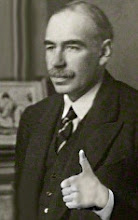
This is part 4 of notes and trivia on Keynes’s early life.
Part 3 is here, which is drawn from D. E. Moggridge’s
Maynard Keynes: An Economist’s Biography (London, 1992), and Robert Skidelsky’s
John Maynard Keynes: Hopes Betrayed 1883–1920 (vol. 1; London, 1983).
Biographical details of interest and trivia:
(1) On 1 August 1914, Germany declared war on Russia; Britain declared war on Germany on 4 August 1914. Keynes, according to Skidelsky (1983: 295), had no great anti-war feeling, was not a pacifist, but wished to do something for Britain’s war effort, even though he himself did not enlist. Nor was he interested in the political origins of the conflict (Skidelsky 1983: 295).
(2) The UK had the following Prime Ministers in the war years: Herbert Henry Asquith
1908–1915
1915–1916, coalition government
David Lloyd George
1916–1922, coalition government.
Both politicians are relevant to Keynes’s subsequent career and public service. Indeed, during the First World War, Keynes came to socialise with Prime Ministers and officials at the highest level of the British government.
(3) On 18 January 1915, Keynes stared work at the treasury as assistant to Sir George Paish (Skidelsky 1983: 297). Keynes attended an allied war conference in Paris from 2–5 February on the financing of the war, and helped design the system of British credits to the other allies held at the Bank of England. After May 1915, Keynes became a “member of the Treasury’s No. 1 Division, centrally concerned with the financial direction of the war” (Skidelsky 1983: 303).
(4) From June to July 1915 Keynes was seriously ill with appendicitis and pneumonia (Skidelsky 1983: 303).
(5) From 1916 Keynes believed that the war should be ended by a compromise peace treaty (Skidelsky 1983: 307).
(6) Keynes appeared to be opposed to the military conscription introduced in Britain in January 1916. He applied for exemption both on the grounds of doing work of national importance (at the Treasury) and on the grounds of conscientious objection (Skidelsky 1983: 317–318).
(7) Keynes published The Economic Consequences of the Peace on 12 December 1919. It became a best seller, being translated into German, Dutch, Italian, Russian, Japanese and other languages (Skidelsky 1983: 394). It made Keynes internationally famous.
(8) Other publications of Keynes in these years included the following: Keynes, J. M. 1915. “The Works and Life of Walter Bagehot. by Russell Barrington” (Review), The Economic Journal 25.99 (Sep.): 369–375.
Keynes, J. M. 1915. “The Economics of War in Germany,” The Economic Journal 25.99 (Sep.): 443–452.
Keynes, J. M. 1920. “Currency and Credit. by R. G. Hawtrey” (Review), The Economic Journal 30.119 (Sep.): 362–365.
Keynes, J. M. 1920. “Indian Finance and Banking. by G. Findlay Shirras,” The Economic Journal 30.119 (Sep.): 396–397.
LINKS
John Maynard Keynes – Timeline.
John Maynard Keynes, Wikipedia.
BIBLIOGRAPHY
Keynes, W. Milo (ed.). 1975.
Essays on John Maynard Keynes, Cambridge University Press, London.
Moggridge, D. E. 1992.
Maynard Keynes: An Economist’s Biography, Routledge, London.
Skidelsky, R. J. A. 1983.
John Maynard Keynes: Hopes Betrayed 1883–1920 (vol. 1), Macmillan, London.