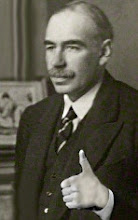
A four part interview with James Galbraith, which covers quite a few issues.
Tuesday, November 15, 2011

Monday, November 14, 2011
Another Keynes versus Hayek Debate
I have written already about the first debate between George Selgin and Robert Skidelsky in an earlier post.
But now I have just seen a new “Keynes versus Hayek” debate held in New York on November 8, and moderated by Sir Harold Evans (Reuters editor-at-large) that can be viewed here:
There is a nice introductory talk by Nicholas Wapshott, the author of Keynes Hayek: The Clash That Defined Modern Economics. I have to say this debate is not as good as the previous one. I will review the speakers’ comments below.
I. James Galbraith’s Opening Remarks
James Galbraith makes some good points about the changes in Hayek’s views in the first minutes of his talk. As I have pointed out myself, Hayek later approved of monetary stabilisation and even limited fiscal policy.
Hayek even thought that political considerations justified government interventions to prevent the type of deflationary depression in Weimar Germany in 1932–1933. Galbraith makes the point that Keynes’s economics is still very much relevant for today.
II. Edmund Phelps’s Opening Remarks
Edmund Phelps defends the monetary interventions of the Fed in 2008–2009. Frankly, I don’t see much in Phelps’s subsequent remarks criticising Keynesianism derived from Hayek. Instead, Phelps just worries about excessive public debt and the effectiveness of stimulus.
III. John Cassidy’s Remarks
Cassidy tips his hat to Hayek over the socialist calculation debate, but goes on to dismiss Hayek’s other economic theories. Cassidy mentions the Austrian business cycle theory, which is Hayek’s major economic contribution, and dismisses it, though not with a proper critique. For critiques of the Austrian business cycle theory, see my posts here:
Steve Moore claims that Keynesianism hasn’t worked, defending that by merely pointing to the fact that the US stimulus has not reduced unemployment significantly and created a great boom. That shows simple ignorance of the level of stimulus needed to do this, and of course the current problem of debt deflation and the issue of balance sheet recessions. Moore then makes the ridiculous claim that Reaganomics was the opposite of Keynesianism: the truth is that Reaganomics was nothing but a conservative version of Keynesianism.
V. John Cassidy’s Refutation
Cassidy points out that Obama’s stimulus was only about $780 billion, not large relative to the size of the US economy. He also refutes Moore’s claim that Reaganomics was not Keynesianism.
VI. Sylvia Nasar’s Remarks
Sylvia Nasar remarks were the most interesting in the whole debate. Nasar challenges the view that Hayek predicted the 1929 crash. She cites a German biographer of Hayek (does anyone know who this is?) who looked over Hayek’s “monthly forecasts” issued in Austria in 1929. In April 1929, Hayek’s forecasts hinted at the “unpleasant consequences” because of credit growth. In October 1929, however, Hayek wrote something very different in the newsletter, as follows:
Nasar also states that Hayek was opposed to interest rate cuts in the early 1930s.
VII. Diana Furchtgott-Roth’s Remarks
Diana Furchtgott-Roth shows utter ignorance when she points to the size of the deficit as a percentage of GDP, in her claims that these high deficits somehow show that Keynesianism doesn’t work. The fact is that a government can be running a deficit and actually be engaging in contractionary fiscal policy. For example, Ireland has also been running large deficits as a percentage of GDP for some years, one of the largest in the Eurozone, but it was not practising Keynesian stimulus. Why? The reason is that Keynesian stimulus requires increases in discretionary spending to offset the contraction in private consumption and investment spending and spending by foreigners on a nation’s exports. Ireland and other nations have deficits because their tax revenues severely collapsed. They have in fact cut government spending. That is not Keynesian stimulus. This is the reverse: contractionary fiscal policy. The US also has a large deficit as a percentage of GDP because its tax revenue has collapsed, not because the government engaged in massive increases in discretionary spending.
VIII. Steve Rattner’s Remarks
Rattner reviews the auto rescue program, and then the financial sector. Rattner makes a mistake in defending the crony capitalist bailout of the financial sector, in my view.
IX. Lawrence White’s Remarks
White drags up the moribund Austrian business cycle theory. He states that Keynesians have no theory of the boom or bust; that is nonsense. He utterly ignores Minsky’s financial instability hypothesis. Lawrence White refers to Hayek’s Prices and Production, and claims that Hayek there wanted to maintain nominal spending. I see no such evidence of this. Hayek supported monetary stabilisation and limited fiscal policy later in life, but not in Prices and Production.
But now I have just seen a new “Keynes versus Hayek” debate held in New York on November 8, and moderated by Sir Harold Evans (Reuters editor-at-large) that can be viewed here:
“Conversations with Harry Evans: Keynes vs. Hayek: An Economics Debate,” November 8, 2011.Speaking for the Keynesian side were James Galbraith, John Cassidy, Sylvia Nasar, and Steve Rattner. The Hayekians were Edmund Phelps, Lawrence White, Diana Furchtgott-Roth and Steve Moore.
There is a nice introductory talk by Nicholas Wapshott, the author of Keynes Hayek: The Clash That Defined Modern Economics. I have to say this debate is not as good as the previous one. I will review the speakers’ comments below.
I. James Galbraith’s Opening Remarks
James Galbraith makes some good points about the changes in Hayek’s views in the first minutes of his talk. As I have pointed out myself, Hayek later approved of monetary stabilisation and even limited fiscal policy.
Hayek even thought that political considerations justified government interventions to prevent the type of deflationary depression in Weimar Germany in 1932–1933. Galbraith makes the point that Keynes’s economics is still very much relevant for today.
II. Edmund Phelps’s Opening Remarks
Edmund Phelps defends the monetary interventions of the Fed in 2008–2009. Frankly, I don’t see much in Phelps’s subsequent remarks criticising Keynesianism derived from Hayek. Instead, Phelps just worries about excessive public debt and the effectiveness of stimulus.
III. John Cassidy’s Remarks
Cassidy tips his hat to Hayek over the socialist calculation debate, but goes on to dismiss Hayek’s other economic theories. Cassidy mentions the Austrian business cycle theory, which is Hayek’s major economic contribution, and dismisses it, though not with a proper critique. For critiques of the Austrian business cycle theory, see my posts here:
“Austrian Business Cycle Theory: The Various Versions and a Critique,” June 21, 2011.IV. Steve Moore’s Remarks
“Austrian Business Cycle Theory (ABCT) and the Natural Rate of Interest,” June 18, 2011.
“Robert P. Murphy on the Sraffa-Hayek Debate,” July 19, 2011.
“Vaughn on Mises’s Trade Cycle Theory,” June 29, 2011.
“Hayek on the Flaws and Irrelevance of his Trade Cycle Theory,” June 29, 2011.
“ABCT and Full Employment,” July 1, 2011.
Steve Moore claims that Keynesianism hasn’t worked, defending that by merely pointing to the fact that the US stimulus has not reduced unemployment significantly and created a great boom. That shows simple ignorance of the level of stimulus needed to do this, and of course the current problem of debt deflation and the issue of balance sheet recessions. Moore then makes the ridiculous claim that Reaganomics was the opposite of Keynesianism: the truth is that Reaganomics was nothing but a conservative version of Keynesianism.
V. John Cassidy’s Refutation
Cassidy points out that Obama’s stimulus was only about $780 billion, not large relative to the size of the US economy. He also refutes Moore’s claim that Reaganomics was not Keynesianism.
VI. Sylvia Nasar’s Remarks
Sylvia Nasar remarks were the most interesting in the whole debate. Nasar challenges the view that Hayek predicted the 1929 crash. She cites a German biographer of Hayek (does anyone know who this is?) who looked over Hayek’s “monthly forecasts” issued in Austria in 1929. In April 1929, Hayek’s forecasts hinted at the “unpleasant consequences” because of credit growth. In October 1929, however, Hayek wrote something very different in the newsletter, as follows:
“there is no reason to expect a sudden breakdown of the New York stock exchange.” [He added:] “A pronounced crisis need not be feared.”If true, this is a savage blow against the “predictive” power of Hayek. It bears further investigation.
Nasar also states that Hayek was opposed to interest rate cuts in the early 1930s.
VII. Diana Furchtgott-Roth’s Remarks
Diana Furchtgott-Roth shows utter ignorance when she points to the size of the deficit as a percentage of GDP, in her claims that these high deficits somehow show that Keynesianism doesn’t work. The fact is that a government can be running a deficit and actually be engaging in contractionary fiscal policy. For example, Ireland has also been running large deficits as a percentage of GDP for some years, one of the largest in the Eurozone, but it was not practising Keynesian stimulus. Why? The reason is that Keynesian stimulus requires increases in discretionary spending to offset the contraction in private consumption and investment spending and spending by foreigners on a nation’s exports. Ireland and other nations have deficits because their tax revenues severely collapsed. They have in fact cut government spending. That is not Keynesian stimulus. This is the reverse: contractionary fiscal policy. The US also has a large deficit as a percentage of GDP because its tax revenue has collapsed, not because the government engaged in massive increases in discretionary spending.
VIII. Steve Rattner’s Remarks
Rattner reviews the auto rescue program, and then the financial sector. Rattner makes a mistake in defending the crony capitalist bailout of the financial sector, in my view.
IX. Lawrence White’s Remarks
White drags up the moribund Austrian business cycle theory. He states that Keynesians have no theory of the boom or bust; that is nonsense. He utterly ignores Minsky’s financial instability hypothesis. Lawrence White refers to Hayek’s Prices and Production, and claims that Hayek there wanted to maintain nominal spending. I see no such evidence of this. Hayek supported monetary stabilisation and limited fiscal policy later in life, but not in Prices and Production.
Subscribe to:
Posts (Atom)