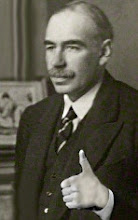
In a fascinating passage from Alfred Marshall’s
The Economics of Industry (1879) (which he wrote with his wife Mary Marshall):
“The connexion between a fall of prices and a suspension of industry requires to be further worked out.
There is no reason why a depression of trade and a fall of prices should stop the work of those who can produce without having to pay money on account of any Expenses of production. For instance a man who pays no wages, who works with his own hands, and produces what raw material he requires, cannot lose anything by continuing to work. It does not matter to him how low prices have fallen, provided that the prices of his goods have not fallen more in proportion than those of others. When prices are low, he will get few coins for his goods; but if he can buy as many things with them as he could with the greater number of coins he got when prices were high, he will not be injured by the fall of prices. He would be a little discouraged if he thought that the price of his goods would fall more than the prices of others; but even then he would not be very likely to stop work.
And in the same way a manufacturer, though he has to pay for raw material and wages would not check his production on account of a fall in prices, if the fall affected all things equally, and were not likely to go further. If the price which he got for his goods had fallen by a quarter, and the prices which he had to pay for labour and raw material had also fallen by a quarter, the trade would be as profitable to him as before the fall. Three sovereigns would now do the work of four, he would use fewer counters in measuring off his receipts against his outgoings; but his receipts would stand in the same relation to his outgoings as before. His net profits would be the same percentage of his total business. The counters by which they are reckoned would be less by one quarter, but they would purchase as much of the necessaries, comforts, and luxuries of life as they did before.
It however very seldom happens in fact that the expenses which a manufacturer has to pay out fall as much in proportion as the price which he gets for his goods. For when prices are rising, the rise in the price of the finished commodity is generally more rapid than that in the price of the raw material, always more rapid than that in the price of labour; and when prices are falling, the fall in the price of the finished commodity is generally more rapid than that in the price of the raw material, always more rapid than that in the price of labour. And therefore when prices are falling the manufacturer's receipts are sometimes scarcely sufficient even to repay him for his outlay on raw material, wages, and other forms of Circulating capital; they seldom give him in addition enough to pay interest on his Fixed capital and Earnings of Management for himself.
Even if the prices of labour and raw material fall as rapidly as those of finished goods, the manufacturer may lose by continuing production if the fall has not come to an end. He may pay for raw material and labour at a time when prices generally have fallen by one-sixth; but if, by the time he comes to sell, prices have fallen by another sixth, his receipts may be less than is sufficient to cover his outlay.
We conclude then that manufacturing cannot be carried on except at a low rate of profit, or at a loss, when the prices of finished goods are low relatively to those of labour and raw material; or when prices are falling, even if the prices of all things are falling equally.
§6. Thus a fall in prices lowers profìts and impoverishes the manufacturer: while it increases the purchasing power of those who have fixed incomes. So again it enriches creditors at the expense of debtors. For if the money that is owing to them is repaid, this money gives them a great purchasing power; and if they have lent it at a fixed rate of interest, each payment is worth more to them than it would be if prices were high. But for the same reasons that it enriches creditors and those who receive fixed incomes, it impoverishes those men of business who have borrowed capital; and it impoverishes those who have to make, as most business men have, considerable fixed money payments for rents, salaries, and other matters. When prices are ascending, the improvement is thought to be greater than it really is; because general opinion with regard to the prosperity of the country is much influenced by the authority of manufacturers and merchants. These judge by their own experience, and in time of ascending prices their fortunes are rapidly increased; in a time of descending prices their fortunes are stationary or dwindle. But statistics prove that the real income of the country is not very much less in the present time of low prices, than it was in the period of high prices that went before it. The total amount of the necessaries, comforts and luxuries which are enjoyed by Englishmen is but little less in 1879 than it was in 1872.” (Marshall and Marshall 1879: 155–157).
So already in the 1870s Marshall says that wages are liable to be inflexible downwards, or at least there is a lag between price deflation and nominal wage cuts that reduces profits and causes business pessimism.
Also very striking is that Marshall is well aware of the essence of debt deflation, but not, I think, how damaging debt deflation can be, and how business pessimism arising from deflation, debt deflation and profit deflation can reduce the aggregate level of investment and hence the aggregate wealth and employment of a nation, for the reasons outlined by
Keynes in Chapter 19 of the General Theory. An equally serious flaw is that Marshall also continued to defend Say’s law in the form expressed by John Stuart Mill (Marshall and Marshall 1879: 154).
However, Marshall thinks that mild to modest inflation actually increases the confidence of business people because their profits are rising, a not unreasonable idea at all, and he was right to stress the role of business confidence as a driving force of capitalism and investment (Marshall and Marshall 1879: 154–155).
These issues are very interesting because during the great deflation of 1873 to 1896 it seems clear that business expectations became pessimistic and people at the time spoke of a “profit deflation” that sapped business confidence.
Marshall himself spoke of this in his evidence before the UK “Royal Commission on the Value of Gold and Silver” instituted in 1887.
Alfred Marshall stated:
“[Henry Chaplin, MP:] Do you share the general opinion that during the last few years we have been passing through a period of severe depression? …
[Marshall]: 9823. Yes, of severe depression of profits.
[Henry Chaplin, MP:] 9824. And that has been during a period of abnormally low prices? …
[Marshall]: A severe depression of profits and of prices. I have read nearly all the evidence that was given before the Depression of Trade and Industry Commission, and I really could not see that there was any very serious attempt to prove anything else than a depression of prices, a depression of interest, and a depression of profits; there is that undoubtedly. I cannot see any reason for believing that there is any considerable depression in any other respect.”
Final Report of the Royal Commission Appointed to Inquire into the Recent Changes in the Relative Values of the Precious Metals; With Minutes of Evidence and Appendixes. Eyre and Spottiswoode, London, 1888. Appendix, Minutes of Evidence taken before the Royal Commission on Gold and Silver, pp. 21–22.
The evidence would then suggest that downwards nominal wage stickiness was the cause of a “severe depression of profits” and along with debt deflation the cause of business pessimism in these years.
And even if wages did adjust after considerable lags, the nominal fall in money profits may well have been sufficient to cause business pessimism, since business people were probably more focussed on nominal values than the real, inflation-adjusted value of profits (or what neoclassicals call the “money illusion”). And even with wage adjustments in the long-run, businesses were still probably hit by debt deflation.
A final and very interesting question to my mind is this: did the aggregate level of investment in Europe and America fall as the great deflation of 1873 to 1896 unfolded?
S. B. Saul in his book
The Myth of the Great Depression, 1873–1896 thought so, and argued that lower industrial investment was a characteristic of this period (Saul 1985: 41, 53).
Further Reading
“The Profit Deflation of the 1890s,” June 13, 2013.
“Alfred Marshall’s Judgement on the “Depression” of 1873–1896,” June 13, 2013.
“S. B. Saul on the Profit Deflation of the 1873–1896 Period,” June 14, 2013.
“Alfred Marshall on the Deflation of 1873–1896,” October 14, 2014.
“Alfred Marshall’s Interest Rate Theory,” November 3, 2014.
BIBLIOGRAPHY
Final Report of the Royal Commission Appointed to Inquire into the Recent Changes in the Relative Values of the Precious Metals; With Minutes of Evidence and Appendixes. Eyre and Spottiswoode, London, 1888
Marshall, A. and Marshall, M. P. 1879.
The Economics of Industry. Macmillan, London.
Saul, S. B. 1985.
The Myth of the Great Depression, 1873–1896 (2nd edn.). Macmillan, London.