Showing posts with label New Keynesianism. Show all posts

Saturday, June 30, 2012

Price Rigidity in New Keynesianism and Post Keynesianism

An empirical observation of real world economies is that the prices of a considerable number of goods respond slowly or incompletely to changes in demand. According to empirical studies in the Western economies, firms only rarely change their prices, perhaps on average once a year (Melmiès 2010: 450).

The genesis of New Keynesian economics was in fact an attempt to establish empirical support for price stickiness, even though the New Classicals argued that the existence of price stickiness allegedly lacked microeconomic foundations in view of their rational expectations theory (Melmiès 2012: 452).

The New Keynesians proposed various explanations of real world price stickiness, including the following factors:
(1) Menu costs
(2) Implicit contracts
(3) Nominal contracts
(4) Coordination failure
(5) Cost-based pricing
(6) Constant marginal cost
(7) Non-price competition
(8) Pricing threshold
(9) Link between quality and price. (Melmiès 2012: 453).
More empirical work established that businesses themselves viewed the implicit contract, nominal contract, coordination failure, and cost-based pricing factors as the most important in affecting price rigidity (Melmiès 2012: 453; Blinder 1998). Most notably, the New Keynesian menu costs, nonprice competition, and costly information ideas did not receive much support (Melmiès 2010: 453).

Furthermore, the New Keynesian idea is fundamentally one of constrained price stickiness: firms wish to change their prices, but are constrained by factors from doing so (Melmiès 2012: 454).

By contrast, Post Keynesians would say that many firms quite deliberately set prices. Firms act to ensure their survival and grow their business and market share. By looking more at the long term state of demand, the price of many products is often not affected by short term changes in demand. The most important cause of price adjustments are changes in the costs of factor inputs and wages. Thus the pricing policies of firms are quite conscious and deliberate acts of price administration and setting, and this action results in a deliberately-caused price stickiness in the market. A consequence of this is that profit margins are also stable, and such margins are needed for internal financing of investment.

It is important to distinguish between the New Keynesian view of price rigidity and that of Post Keynesianism.

New Keynesians believe that, if only prices were perfectly flexible, then economies would adjust rapidly to full employment equilibrium. Post Keynesians, following Keynes himself, reject the view that perfectly flexible wages, prices and perfect competition would lead to full employment equilibrium. Even if there were perfectly flexible wages and prices, there could still be failures of aggregate demand (Davidson 1992).

In Post Keynesianism, therefore, price rigidity is not the fundamental cause of demand affecting output (Melmiès 2012: 456).


BIBLIOGRAPHY

Blinder, A. S. et al. (eds.). 1998. Asking About Prices: A New Approach to Understanding Price Stickiness, Russell Sage Foundation, New York.

Davidson, P. 1992. “Would Keynes be a New Keynesian?,” Eastern Economic Journal 18.4: 449–463.

Melmiès, J. 2010. “New-Keynesians Versus Post-Keynesians on the Theory of Prices,” Journal of Post Keynesian Economics 32.3: 445-466.

Melmiès, J. 2012. “Price Rigidity,” in J. E. King, The Elgar Companion to Post Keynesian Economics (2nd edn.). Edward Elgar, Cheltenham. 452–456.

Saturday, May 7, 2011

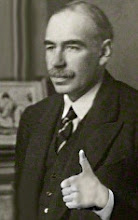
Skidelsky on “The Relevance of Keynes”

Robert Skidelsky has a very good essay on Keynes’s thought and how it applies to the financial crisis of 2008 and the state we find ourselves in today:
Robert Skidelsky, “The Relevance of Keynes,” January 17, 2011, www.skidelskyr.com.
This has also been published as an article:
Robert Skidelsky, “The Relevance of Keynes,” Cambridge Journal of Economics 35.1 (2011): 1–13.
Skidelsky is Keynes’s biographer and his interpretation of Keynes is in fact very close to that of the Post Keynesian school, which is why his work is important. The interested reader looking for something more substantial can also read Skidelsky’s new book Keynes: The Return of the Master (Allen Lane, 2009). A reasonably good summary can be found here:
Keynes: The Return of the Master, Wikipedia.org.
The reaction to this book shows us the schism that runs through modern New Keynesian macroeconomics. First, we have quite positive reviews of Skidelsky’s book by the liberal New Keynesians Krugman and Stiglitz:
Paul Krugman, “Keynes: The Return of the Master by Robert Skidelsky,” Guardian, 30 August 2009.

Joseph Stiglitz, “The Non-Existent Hand,” London Review of Books 32.8, 22 April 2010.
(this also has a letter by the Post Keynesian Paul Davidson clarifying Keynes’s views on uncertainty).
In contrast, we have the conservative New Keynesian N. Gregory Mankiw in a remarkably cold review in the Wall Street Journal:
N. Gregory Mankiw, “Back In Demand,” Wall Street Journal, September 21, 2009.
Mankiw asserts that Keynesianism “is based in part on the premise that wages and prices do not adjust to levels that ensure full employment.” In fact, Keynes also showed that even if wages and prices were flexible, there would still be involuntary unemployment and failures of aggregate demand. The so-called New Keynesian tradition developed by Mankiw and others (which is rather different from the New Keynesianism of Krugman and Stiglitz) is actually a travesty of Keynes’ thought, and part of the problem plaguing modern economics.

Wednesday, July 7, 2010

What Type of Keynesian is Paul Krugman?

In a recent post I reviewed the three varieties of Keynesian economics (see Neoclassical Synthesis Keynesianism, New Keynesianism and Post Keynesianism: A Review). A question raised by this post is this: what kind of Keynesian is Paul Krugman?

Paul Krugman is an outstanding liberal economist and won the Nobel Memorial Prize in Economics in 2008. I admire Krugman's work very much. Krugman began his career as a New Keynesian, but he is sometimes regarded as an “Old Keynesian” (i.e., more like a post-WWII neoclassical synthesis Keynesian such as James Tobin). However, calling Krugman an “Old Keynesian” is probably misleading. Krugman in early 2009 made this comment on his blog after reading Hyman Minsky:

I really am gravitating toward a Keynes-Fisher-Minsky view of macro, although of the three I’d much rather read Keynes.

Paul Krugman, “Actually existing Minsky,” May 19, 2009, http://krugman.blogs.nytimes.com/2009/05/19/actually-existing-minsky/

However, as of October 2009, Krugman still declared himself an economist basically using New Keynesian macroeconomic foundations:

I … quarrel with designating me a “radical Keynesian.” I’m just a Keynesian, willing to follow the logic of my analysis. A perfectly standard New Keynesian model, with intertemporal optimization and all that — the kind of model that is standard in freshwater courses — says that under current conditions fiscal stimulus should be very strong, much stronger than what we’re actually doing.

Paul Krugman, “Samuel Brittan’s recipe for recovery,” October 16, 2009,
http://krugman.blogs.nytimes.com/2009/10/16/samuel-brittans-recipe-for-recovery/


Krugman rejects the idea that he is a “radical” Keynesian, and his use of a New Keynesian model supports this.

Nevertheless, Post Keynesian economists have pointed out that Krugman seems to share similarities with their macroeconomics: he apparently emphasises changes in liquidity preference as a cause of unemployment, has refuted the New Keynesian idea that price and wage stickiness is the fundamental cause of involuntary unemployment, and rejects Say’s law. If this is the case, these ideas make him much closer to Post Keynesian macroeconomics than he perhaps realises (see Felipe Rezende, Keynes’s Relevance and Krugman’s Economics, August 18, 2009, New Economic Perspectives Blog).