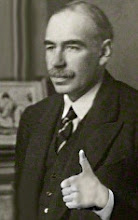
Joseph E. Stiglitz speaks here on “Macroeconomics in Crisis: An Agenda for Rejuvenating the Discipline,” in a talk given on 4 January, 2013 at the University of Hyderabad, India. Stiglitz gives his “New Keynesian” perspective on what is wrong with modern mainstream economics.
Showing posts with label Joseph Stiglitz. Show all posts
Showing posts with label Joseph Stiglitz. Show all posts
Wednesday, December 11, 2013

Wednesday, November 27, 2013
Joseph Stiglitz’s Review of Skidelsky’s Keynes: The Return of the Master
The review below is actually a very good read and has a letter from Paul Davidson at the end:
Joseph Stiglitz, “The Non-Existent Hand” (review of Robert Skidelsky, Keynes: The Return of the Master), London Review of Books 32.8 (22 April), 2010: 17–18.Joseph Stiglitz is a New Keynesian and his interpretation of Skidelsky is interesting, not least of all for his insights into debt deflation.
Saturday, May 7, 2011
Skidelsky on “The Relevance of Keynes”
Robert Skidelsky has a very good essay on Keynes’s thought and how it applies to the financial crisis of 2008 and the state we find ourselves in today:
Robert Skidelsky, “The Relevance of Keynes,” January 17, 2011, www.skidelskyr.com.This has also been published as an article:
Robert Skidelsky, “The Relevance of Keynes,” Cambridge Journal of Economics 35.1 (2011): 1–13.Skidelsky is Keynes’s biographer and his interpretation of Keynes is in fact very close to that of the Post Keynesian school, which is why his work is important. The interested reader looking for something more substantial can also read Skidelsky’s new book Keynes: The Return of the Master (Allen Lane, 2009). A reasonably good summary can be found here:
Keynes: The Return of the Master, Wikipedia.org.The reaction to this book shows us the schism that runs through modern New Keynesian macroeconomics. First, we have quite positive reviews of Skidelsky’s book by the liberal New Keynesians Krugman and Stiglitz:
Paul Krugman, “Keynes: The Return of the Master by Robert Skidelsky,” Guardian, 30 August 2009.In contrast, we have the conservative New Keynesian N. Gregory Mankiw in a remarkably cold review in the Wall Street Journal:
Joseph Stiglitz, “The Non-Existent Hand,” London Review of Books 32.8, 22 April 2010.
(this also has a letter by the Post Keynesian Paul Davidson clarifying Keynes’s views on uncertainty).
N. Gregory Mankiw, “Back In Demand,” Wall Street Journal, September 21, 2009.Mankiw asserts that Keynesianism “is based in part on the premise that wages and prices do not adjust to levels that ensure full employment.” In fact, Keynes also showed that even if wages and prices were flexible, there would still be involuntary unemployment and failures of aggregate demand. The so-called New Keynesian tradition developed by Mankiw and others (which is rather different from the New Keynesianism of Krugman and Stiglitz) is actually a travesty of Keynes’ thought, and part of the problem plaguing modern economics.
Subscribe to:
Posts (Atom)