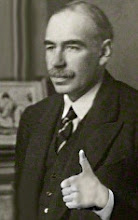
Sir John Hicks’s book
Capital and Growth (Oxford, 1965) has an important discussion of the history of fixprices.
The significance of that discussion is described by the Austrian Ludwig Lachmann in a review of article of
Capital and Growth:
“Two other matters of great significance are dealt with in the first part of the book. As others have done before him, Professor Hicks finds it necessary to stress, in his chapter on Marshall’s method, that our world differs from that which Marshall took for granted in that we live in a world of prices ‘administered’ by manufacturers, ‘but in those days even manufactured goods usually passed along a chain of wholesalers and retailers, each of whom was likely to have some independent price-making opportunity.’ (55) Again, like others before him, our author attributes the cause of this change to the virtual disappearance of the wholesale merchant and his price-setting function after 1900. Formerly ‘the initiative would come from the wholesaler or shopkeeper, who would offer higher prices in order to get the goods which, even at the higher price, he could re-sell at a profit. Similarly, when demand fell, it would be the wholesaler who would offer a lower price. The manufacturer would have to accept that price if he could get no better.’ (56) Hence, while Marshall’s was a world of flexible prices, even though not of ‘perfect competition,’ ours is a ‘fixprice world’ with prices set on a ‘cost plus’ basis and wage rates as ultimate price determinants.
The analytical significance of this historical change lies, on the one hand, in the fact that the ‘Temporary Equilibrium Method’ which Hicks himself, following Lindahl, used in Value and Capital in 1939, has lost much of its validity. ‘The fundamental weakness of the Temporary Equilibrium method is the assumption, which it is obliged to make, that the market is in equilibrium—actual demand equals desired demand, actual supply equals desired supply—even in the very short period.’ (76) Hence we have to look for another method of dynamic analysis. To find it we must move nearer to Keynes and his successors who are here given credit for having understood, earlier than others, that a fixprice world requires a fixprice method of analysis.” (Lachmann 1977: 238–239).
Lachmann was well aware of the significance of fixprices, and discussed them in
The Market as an Economic Process (Oxford, 1986), pp. 122–136.
Lachmann stated:
“Those who glibly speak of ‘market clearing prices’ tend to forget that over wide areas of modern markets it is not with this purpose in mind that prices are set. They seem unaware of the important insights into the process of price formation, an Austrian responsibility, of which they deprive themselves by clinging to a level of abstraction so high that on it most of what matters in the real world vanishes from sight.” (Lachmann 1986: 134).
Lachmann even concluded that his own fellow Austrians had badly neglected the task of studying real world price formation (Lachmann 1986: 130–131).
That is a failing that most Austrians are guilty of to his day, despite some discussion of the issue in Reisman (1996), pp. 414–417, where Reisman does not consider the implications of cost of production plus profit mark-up pricing for Austrian theories of economic coordination.
Links
“Lachmann and Post Keynesianism on Prices,” August 1, 2012.
“Mises versus Lachmann on Equilibrium Prices,” December 17, 2012.
“Caldwell on Lachmann on Equilibrium Prices,” November 6, 2012.
“Kaldor on Economics without Equilibrium,” March 9, 2013.
BIBLIOGRAPHY
Hicks, John Richard. 1965.
Capital and Growth. Oxford University Press, Oxford.
Lachmann, Ludwig M. 1966. “Sir John Hicks on Capital and Growth,”
South African Journal of Economics 34: 113–123.
Lachmann, Ludwig M. 1977.
Capital, Expectations, and the Market Process: Essays on the Theory of the Market Economy (ed. Walter E. Grinder). Sheed Andrews and McMeel, Kansas City.
Lachmann, L. M. 1986.
The Market as an Economic Process. Basil Blackwell. Oxford.
Reisman, George. 1996.
Capitalism: A Treatise on Economics. Jameson Books, Ottawa, Ill. and Chicago.