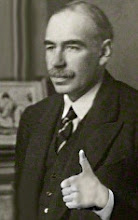
In 1943, Alvin Hansen had a chapter published in a book called Postwar Economic Problems (McGraw-Hill, New York and London, 1943), the same book in which Samuelson’s famous comments on the post-1945 US economy appeared (Samuelson 1943).
Here is Alvin Hansen predicting the post-1945 boom:
“The fact is that many people dread to think of what is coming. Businessmen, wage earners, white-collar employees, professional people, farmers—all alike expect and fear a postwar collapse: demobilization of armies, shutdowns in defense industries, unemployment, deflation, bankruptcy, hard times. Some are hoping for a postwar boom. We got that after the First World War. Not improbably we may get it again. If the war lasts several years, we may have at the end of the war sufficient accumulated shortages in residential housing, in durable consumers’ good such as automobiles, and in the plant and equipment required to supply peacetime consumption demands, to give us a vigorous private investment boom. Indeed, we need to be on the alert to prevent a possible postwar inflation. If in fact we do experience a strong postwar boom, there is, however, the gravest danger that it will lull us to sleep. Sooner or later such a boom will end in a depression unless we are prepared. If appropriate action is taken, there is no necessity for a postwar collapse.” (Hansen 1943: 12–13).I concede that Hansen’s prediction was a cautious one (“Not improbably we may get it again”). But it was an important prediction nonetheless.
Hansen correctly foresaw that a surge in private investment and consumption owing to the release of demand pent up during the war would drive the post-1945 economy.
He also correctly foresaw that this boom would end in a slump. That did occur from November 1948 to October 1949.
The US government stepped in after 1948 to provide macroeconomic stability, as Hansen said it would. Truman’s budget surplus of 4.6% of GDP in fiscal year 1948 fell to 0.2% in fiscal year 1949, as spending went from $29.8 billion in 1948 to $38.8 billion in 1949, as automatic stabilizers kicked in. In fiscal year 1950 (July 1, 1949 to June 30 1950), the budget went into an actual deficit of 1.1% of GDP. Moreover, Congress had pushed through a tax cut in 1948, which boosted private spending in 1949.
What we have here is classic Keynesian countercyclical fiscal policy. Some of the increases from 1950–1953 were, of course, related to the Korean war, but also to new social, welfare and military programs enacted under Truman. Government spending in both absolute terms and as a percentage of GDP surged from 1948 to 1953, fell slightly from 1953–1954 as the Korean war ended, but remained between about 25% and 30% of GDP throughout the classic era of Keynesian economics (1945–1973) – an unprecedented level to that point in American history. And the economy boomed.
The Austrian Thomas E. Woods tells us that “Keynesian economists everywhere [sc. were] predicting disaster and depression [sc. after 1945].” Everywhere? That is tommyrot.
In 1943, Keynes was giving a lecture at the Federal Reserve and was asked by Abba Lerner about the possible economic problems of the post-war period. Keynes also predicted a post war boom:
“Keynes harshly rejected the risk of post-war stagnation, holding that because of Social security there would be a large reduction in private saving and so that would be no problem.” (Colander and Landreth 1996: 202).But it is no surprise that the opinions of Keynes himself, Hansen and also Richard M. Bissell (actually cited in Samuelson 1943: 53, n. 1) are airbrushed out of the grossly distorted Austrian view of this period.
BIBLIOGRAPHY
Colander, D. C. and H. Landreth (eds). 1996. The Coming of Keynesianism to America: Conversations with the Founders of Keynesian Economics, E. Elgar, Cheltenham.
Hansen, Alvin A. 1943. “The Postwar Economy,” in Seymour E. Harris (ed.), Postwar Economic Problems, McGraw-Hill, New York and London. 9–26.
Samuelson, Paul A. 1943. “Full Employment after the War,” in Seymour E. Harris (ed.), Postwar Economic Problems, McGraw-Hill, New York and London. 27–53.