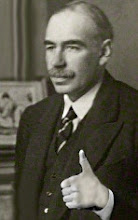
Curiously, even some Institutionalist economists have failed to understand it. For example, even Gardiner C. Means – the American Institutionalist who developed administered price theory – was unclear about what Keynes’ fundamental arguments were in the General Theory, and whether the theory depended on inflexible wages and prices.
This is illustrated by a fascinating piece of forgotten history told by Means himself: his visit to John Maynard Keynes in July 1939:
“In the summer of 1939, on my way to a holiday in Norway, I made it a point to visit Keynes with the specific purpose of asking him to what extent his explanation of persistent unemployment rested on an assumption of wage-rate or price inflexibility. His answer was a categorical: ‘Not at all.’ I asked the question in several different ways in order to make sure there was no failure of minds to meet and the answer was always the same. I said, ‘Suppose that prices and wage-rates met the classical assumption of perfect flexibility so that, if there were excessive unemployment, the price-wage level would fall frictionlessly. Then with the nominal money stock remaining constant, wouldn’t the rise in the real value of the money stock create added demand which would tend to absorb unemployed workers?’ But still the answer was no. Once interest rates had fallen to their limit there would be no further corrective. We were in complete agreement that, in practice, neither prices nor wage-rates were as flexible as classical theory assumed, but he insisted that his theory of unemployment did not depend at all on this fact.” (Means 1976: 61–62).You couldn’t have a clearer statement by Keynes himself about what the essence of his theory was. But, despite these emphatic statements by Keynes, Means was dissatisfied with Keynes’ replies.
Later, Means (1976) defended the neoclassical synthesis interpretation of the General Theory contrary to the explicit answers Keynes had given to him in 1939, because Means continued to believe in the efficacy of the real balances effect (Means 1976: 63), which only goes to show how even some Institutionalists – as well as neoclassical Keynesians – failed to understand the fundamental message of the General Theory.
BIBLIOGRAPHY
Means, Gardiner C. 1976. “Which was the True Keynesian Theory of Employment?,” Challenge 19.3 (July/August): 61–63.