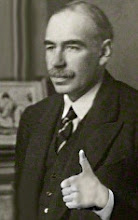
While one can argue that Keynes’s General Theory of Employment, Interest, and Money (1936) was one of the most important and influential attacks on marginalism in modern economics, nevertheless there remain curious oddities about Keynes’ relationship to marginalist theory.
Modern Post Keynesians contend that the essential insight of the General Theory is that aggregate demand drives output and employment, rather than the supply-side factors emphasised by neoclassical marginalism (King 2002: 13). In Chapter 12 of the General Theory, Keynes stressed the role of uncertainty in causing instability in the aggregate level of investment in market economies, and also in thwarting any reliable mechanism by which investment is equated with saving (King 2002: 13). Keynes thus denied the loanable funds interpretation of the interest rate, and instead argued that interest is a monetary – not a “real” – phenomenon determined by liquidity preference, not the “real” forces of productivity and thrift (King 2002: 13).
But King (2002: 12) points out that Keynes still equated the real wage with the marginal product of labour* (Keynes’ “first classical postulate”), and in Chapter 18 of the General Theory summarised his ideas in a way that glossed over the role of fundamental uncertainty, and allowed subsequent marginalists to reformulate the General Theory as a general equilibrium system where the rate of interest has a crucial equilibrating role (King 2002: 14).
In much the same way, Keynes’s “marginal efficiency of capital” idea (and arguably the “own rates” concept) is a legacy of marginalism that may well inadvertently smuggle in the Wicksellian natural rate of interest (King 2002: 209) into his theory – something which Keynes had repudiated.
The subsequent history of the emergence of Post Keynesianism as a school is of course complicated but, fundamentally, involves rejecting the last mistaken marginalist ideas of Keynes, along with superior theories of capital, prices and distribution.
Note
* Though in Keynes (1939), he seems to repudiate this marginalist idea.
BIBLIOGRAPHY
Keynes, J. M. 1939. “Relative Movements of Real Wages and Output,” Economic Journal 49: 34–51.
Keynes, J. M. 1964 [1936]. The General Theory of Employment, Interest, and Money. Harvest/HBJ Book, New York and London.
King, J. E. 2002. A History of Post Keynesian Economics since 1936, Edward Elgar Publishing, Cheltenham, UK and Northampton, MA.
Showing posts with label marginal efficiency of capital. Show all posts
Showing posts with label marginal efficiency of capital. Show all posts
Tuesday, November 5, 2013

Sunday, January 1, 2012
Keynes’s Marginal Efficiency of Capital: A Mistake?
It is very interesting to note what Joan Robinson thought of Keynes’s notion of the marginal efficiency of capital:
BIBLIOGRAPHY
Barens, I. and V. Caspari, 1997. “Own-Rates of Interest and Their Relevance for the Existence of Underemployment Equilibrium Positions,” in G. C. Harcourt and P. A. Riach (eds.), A “Second Edition” of The General Theory (Vol. 1), Routledge, London. 283–303.
Harcourt, G. C. and P. A. Riach. 1997. A “Second Edition” of The General Theory (Vol. 1), Routledge, London.
King, J. E. 2002. A History of Post Keynesian Economics since 1936, Edward Elgar Publishing, Cheltenham, UK and Northampton, MA.
Lawlow, M. S. 1994. “The Own-Rates Framework as an Interpretation of the General Theory: A Suggestion for Complication the Keynesian Theory of Money,” in J. B. Davis (ed.). The State of Interpretation of Keynes, Kluwer Academic, Boston and London. 39–90.
Robinson, J. 1979. “Garegnani on Effective Demand,” Cambridge Journal of Economics 3: 179–180.
Uhr, C. G. 1994. “Knut Wicksell – A Centennial Evaluation,” in J. Cunningham (ed.), Knut Wicksell: Critical Assessments (vol. 3), Routledge, London. 72–103.
Wicksell, K. 1934. Lectures on Political Economy (trans. E. Classen), Routledge & Kegan Paul, London.
“[sc. Keynes] made a fatal mistake in offering a quasi-long-period definition of the inducement to invest as the ‘marginal efficiency of capital’, that is, the profit that will be realised on the increment to the stock of capital that results from current investment and, still worse, identified the profitability of capital with its social utility. This was an element in the old doctrine from which he failed to escape. He had an alternative concept of the inducement to invest as the expected future return on sums of finance to be devoted to investment. Minsky (1976) points out that he did not seem to recognise the difference between the two formulations. If he had stuck to his short-period brief, he would have used only the second.” (Robinson 1979: 179–180).I have seen other criticisms of the marginal efficiency of capital idea, on the grounds that Keynes, in developing it, failed to free himself from the neoclassical marginal productivity of capital (King 2002: 209). Keynes was also influenced by Sraffa’s own rates of interest concept (Barens and Caspari 1997: 294). In fact, Knut Wicksell’s natural interest rate concept, by one of his definitions, appears rather similar to the marginal efficiency of capital:
“The rate of interest at which the demand for loan capital and the supply of savings exactly agree, and which more or less corresponds to the expected yields on the newly created real capital, will then be the normal or natural rate. It is essentially variable. If the prospects of employment of capital become more promising, demand will increase and will at first exceed supply; interest rates will then rise as the demand from entrepreneurs contracts until a new equilibrium is reached at a slightly higher rate of interest. At the same time equilibrium must ipso facto obtain—broadly speaking, and if it is not disturbed by other causes—in the market for goods and services, so that wages and prices remain unchanged” (Wicksell 1934: 193).The natural rate or “the expected yields on the newly created real capital” is the analogue of the marginal efficiency of capital (Uhr 1994: 94). But Keynes’s marginal efficiency of capital is arguably not a “real” concept: the marginal efficiency of capital is a rate expressed in terms of money.
BIBLIOGRAPHY
Barens, I. and V. Caspari, 1997. “Own-Rates of Interest and Their Relevance for the Existence of Underemployment Equilibrium Positions,” in G. C. Harcourt and P. A. Riach (eds.), A “Second Edition” of The General Theory (Vol. 1), Routledge, London. 283–303.
Harcourt, G. C. and P. A. Riach. 1997. A “Second Edition” of The General Theory (Vol. 1), Routledge, London.
King, J. E. 2002. A History of Post Keynesian Economics since 1936, Edward Elgar Publishing, Cheltenham, UK and Northampton, MA.
Lawlow, M. S. 1994. “The Own-Rates Framework as an Interpretation of the General Theory: A Suggestion for Complication the Keynesian Theory of Money,” in J. B. Davis (ed.). The State of Interpretation of Keynes, Kluwer Academic, Boston and London. 39–90.
Robinson, J. 1979. “Garegnani on Effective Demand,” Cambridge Journal of Economics 3: 179–180.
Uhr, C. G. 1994. “Knut Wicksell – A Centennial Evaluation,” in J. Cunningham (ed.), Knut Wicksell: Critical Assessments (vol. 3), Routledge, London. 72–103.
Wicksell, K. 1934. Lectures on Political Economy (trans. E. Classen), Routledge & Kegan Paul, London.
Subscribe to:
Posts (Atom)