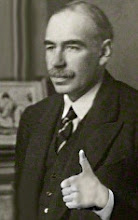
Another video of Robert Skidelsky, a British economic historian and the author of the best biography of John Maynard Keynes in existence. Skidelsky’s Keynesian economic ideas have also converged with Post Keynesian economics over the years.
Here he gives lecture 1 of a series at the University of Warwick on economics. This lecture is an analysis of the financial crisis of 2008 and how orthodox neoclassical economics brought the world to this catastrophe.
Showing posts with label financial crisis. Show all posts
Showing posts with label financial crisis. Show all posts
Wednesday, January 27, 2016

Wednesday, December 14, 2011
Palley versus Foster and McChesney: The Causes of the Crisis
I raised the issue of the Right Marxists or “Keynesian Marxists” in the last post. There is an interesting debate here between the Post Keynesian Thomas I. Palley and the Marxists John Bellamy Foster and Robert W. McChesney on the origins and causes of the financial crisis of 2008:
Footnotes
(1) Thomas I. Palley, “America’s Exhausted Growth Paradigm,” Chronicle of Higher Education (April 11, 2008); and Thomas I. Palley, “America’s Exhausted Paradigm: Macroeconomic Causes of the Financial Crisis and the Great Recession,” New America Foundation (July 22, 2009), http://newamerica.net
(2) John Bellamy Foster and Robert W. McChesney, “Monopoly-Finance Capital and the Paradox of Accumulation,” Monthly Review 61.5 (October, 2009), 1–20.
(3) David M. Kotz, “The Financial and Economic Crisis of 2008,” Review of Radical Political Economics 41.3 (2009): 305–317.
Thomas I. Palley, “The Limits of Minsky’s Financial Instability Hypothesis as an Explanation of the Crisis,” Monthly Review 61.11 (April, 2010).In his article, Thomas Palley reviews four explanations of the crisis, as follows:
John Bellamy Foster and Robert W. McChesney, “Listen Keynesians, It’s the System! Response to Palley,” Monthly Review 61.11 (April, 2010).
(1) Minsky’s financial instability hypothesis (as argued by Jan Kregel, Charles Whalen, and L. Randall Wray);Palley’s “structural Keynesian” view also incorporates the Minsky’s financial instability hypothesis, but looks at longer economic factors from the 1970s that have encouraged neoliberal bubble economics. Once we consider the dynamics of debt deflation as argued by Steve Keen and Richard Koo, Palley’s view of the crisis is an interesting interpretation.
(2) the structural Keynesian view of Palley himself(1);
(3) the new Marxist view of Foster and McChesney(2), and
(4) the social structure of accumulation (SSA) view of Kotz(3).
Footnotes
(1) Thomas I. Palley, “America’s Exhausted Growth Paradigm,” Chronicle of Higher Education (April 11, 2008); and Thomas I. Palley, “America’s Exhausted Paradigm: Macroeconomic Causes of the Financial Crisis and the Great Recession,” New America Foundation (July 22, 2009), http://newamerica.net
(2) John Bellamy Foster and Robert W. McChesney, “Monopoly-Finance Capital and the Paradox of Accumulation,” Monthly Review 61.5 (October, 2009), 1–20.
(3) David M. Kotz, “The Financial and Economic Crisis of 2008,” Review of Radical Political Economics 41.3 (2009): 305–317.
Saturday, June 4, 2011
Randall Wray Interview
Here is an interesting interview with Randall Wray on the Real News network. Lots of good stuff here.
In essence, many countries are mired in an underemployment disequilibrium and serious problems with private sector balance sheets, just as Japan was in the 1990s. Fiscal policy is the only thing stopping deep debt deflation and recession/depression. The financial sector needs cleaning up and proper regulation, and much of the private debt needs to be written off or restructured. Randall Wray gives his ideas on a modern monetary theory (MMT) jobs program for the US.
In essence, many countries are mired in an underemployment disequilibrium and serious problems with private sector balance sheets, just as Japan was in the 1990s. Fiscal policy is the only thing stopping deep debt deflation and recession/depression. The financial sector needs cleaning up and proper regulation, and much of the private debt needs to be written off or restructured. Randall Wray gives his ideas on a modern monetary theory (MMT) jobs program for the US.
Friday, May 20, 2011
The Swedish Solution: Sweden’s Bank Bailout versus Japan’s and the US’s
Asset bubbles are a perennial curse in unregulated or poorly regulated financial markets. They are a plague on modern capitalism. But such bubbles, especially ones financed by excessive private debt, were minimized in the period from 1945–1979 when most countries had an effective system of financial regulation.
With the advent of neoliberal/revived neoclassical financial deregulation and liberalization over the past 30 years, asset bubbles and debt deflation have become serious problems again all over the world.
The first major victim was Japan, where ill-advised financial deregulation in the 1980s set Japan up for its massive property bubble that burst in 1991, leading to the lost decade. The US and other countries have now been hit by a similar disaster: bursting housing bubbles financed by high private debt, and leading to debt deflation and private sector balance sheets in a terrible state.
The bailouts in 2008 in the US and the UK and other nations have been widely criticised, and a far better type of bailout was employed by the Swedish government for its financial crisis in 1992. In Sweden, financial deregulation in the 1980s caused a flurry of real estate lending by Swedish banks, and when the bubble finally popped in 1991 and 1992 there was a major economic contraction. Bank failures and a financial crisis occurred. The Swedish solution? Here it is as described in the New York Times:
More information on this can be found here:
With the advent of neoliberal/revived neoclassical financial deregulation and liberalization over the past 30 years, asset bubbles and debt deflation have become serious problems again all over the world.
The first major victim was Japan, where ill-advised financial deregulation in the 1980s set Japan up for its massive property bubble that burst in 1991, leading to the lost decade. The US and other countries have now been hit by a similar disaster: bursting housing bubbles financed by high private debt, and leading to debt deflation and private sector balance sheets in a terrible state.
The bailouts in 2008 in the US and the UK and other nations have been widely criticised, and a far better type of bailout was employed by the Swedish government for its financial crisis in 1992. In Sweden, financial deregulation in the 1980s caused a flurry of real estate lending by Swedish banks, and when the bubble finally popped in 1991 and 1992 there was a major economic contraction. Bank failures and a financial crisis occurred. The Swedish solution? Here it is as described in the New York Times:
“Sweden told its banks to write down their losses promptly before coming to the state for recapitalization … later in the decade, Japan made the mistake of dragging this process out, delaying a solution for years …. By the end of the crisis, the Swedish government had seized a vast portion of the banking sector, and the agency had mostly fulfilled its hard-nosed mandate to drain share capital before injecting cash. When markets stabilized, the Swedish state then reaped the benefits by taking the banks public again …. Soon after the plan was announced, the Swedish government found that international confidence returned more quickly than expected, easing pressure on its currency and bringing money back into the country.”This type of bailout and cleaning of the financial system was far superior to Japan’s failed bailouts in the 1990s and the US bailout of 2008.
Carter Dougherty, “Stopping a Financial Crisis, the Swedish Way,” New York Times, September 22, 2008.
More information on this can be found here:
Peter Thal Larsen and Chris Giles, “Self-assembly solution,” FT.com, March 18, 2009.
Monday, October 18, 2010
Austrian Business Cycle Theory: Its Failure to explain the Crisis of 2008
The Austrian business cycle theory (ABCT) is a credit-based explanation of the business cycle used by Austrian economists. ABCT has, however, come in different forms and was developed over many years by Mises, Hayek, Rothbard and more recently by modern Austrians like Roger Garrison. It is not monolithic, and some Austrians like Israel M. Kirzner have even criticised Hayek’s development of ABCT as not entirely consistent with Mises’ exposition in 1912. Here are some of the major works by Austrians where different forms of the ABCT are expounded:
In this post I will analyse what appears to me to be the most important form of ABCT: the form postulating distortions in the capital goods sector (for a good summary of this form of ABCT, see Garrison 1997: 23–27), and how this simply cannot be invoked as a serious or fundamental explanation of the US housing boom in the 2000s and financial crisis of 2008.
In his popular pamphlet Economic Depressions: Their Cause and Cure written in 1969, Rothbard sets out a form of ABCT which seems typical of the general form of it . He points to malinvestments in capital goods by businesses as the fundamental cause of recessions:
In this case, we can already see that Rothbard’s version of ABCT cannot be a serious explanation of the housing bubble in the 2000s and the financial crisis of 2008.
It is claimed by some that Austrians economists predicted the crisis, and while it is true that some Austrians correctly identified the housing bubble, they were hardly alone. J. Tempelman in the Quarterly Journal of Austrian Economics states
Moreover, Dirk Bezemer, Professor of Economics at the University of Groningen (Netherlands), has also done a survey of economists and economic commentators trying to establish who predicted the crisis by looking at those with (1) a serious economic model that was used in analysis, (2) predictions that went beyond identifying the property bubble to the implications for the real economy, (3) predictions on the public record, and (4) correct estimates of the timing of the crisis (see Dirk Bezemer, “‘No One Saw This Coming’: Understanding Financial Crisis Through Accounting Models,” Groningen University, 16 June 2009). Here is Bezemer’s list:
The claim that Austrians were the only ones to predict the crisis of 2008 is pure nonsense. Moreover, just because some Austrians correctly called the housing bubble, it simply does not follow that ABCT has been vindicated. Many other economists from different schools also called the housing bubble and a financial crisis. Are we, for example, to say that because Fred Harrison correctly predicted a housing bubble that his actual Georgist economics is therefore proven right? This simply does not follow, nor does it follow that Austrian economics is correct, merely because some Austrians identified the housing bubble as Harrison did.
In 2001–2008, excessive debt and reckless lending to individuals in a system of ineffective financial regulation was a major factor. This has nothing to do with entrepreneurs making malinvestments in capital goods that shift output into the more remote future, as in ABCT.
In the housing bubble, loans were made to people who clearly were unlikely to pay them back. Debt was used bid up asset prices in property, allowing yet more debt (via refinancing) for purchasing of commodities (whether durable or non-durable). ABCT in the form examined above does not explain this process. Another fundamental factor in the crisis of 2008 was the emergence of exotic financial instruments like collateralised debt obligations (CDOs), including asset backed securities and mortgage backed securities.
When the housing bubble collapsed, defaults on mortgages rose, causing losses to investment banks and other financial institutions holding mortgage backed securities. The financial crisis of 2008 led to a freezing up of interbank lending and a liquidity crisis, which then went global. The resulting effects spread to the real economy severely exacerbating the US recession that had already begun in December 2007. This series of events is best explained by the Keynesian Hyman Minsky’s financial instability hypothesis.
ABCT in the form examined above with its emphasis on malinvestments in the real capital goods sector is not an even remotely relevant explanation of 2000s boom and bust, and the 2008 global financial crisis.
BIBLIOGRAPHY
Batemarco, R. J. 1998. “Austrian Business Cycle Theory,” in P. J. Boettke (ed.), The Elgar Companion to Austrian Economics, Elgar, Cheltenham, UK. 216–336.
Cowen, T. 1997 Risk and Business Cycles: New and Old Austrian Perspectives, Routledge, London.
Garrison, R. W. 1997. “Austrian Theory of Business Cycles,” in D. Glasner and T. F. Cooley (eds), Business Cycles and Depressions: An Encyclopedia, Garland Pub., New York. 23–27.
Garrison, R. W. 2000. Time and Money: The Macroeconomics of Capital Structure, Routledge, London and New York.
Hayek, F. A. von, 1931. Prices and Production, G. Routledge & Sons, Ltd, London.
Hayek, F. A. von, 1935. Prices and Production (2nd edn), Routledge and Kegan Paul.
Hayek, F. A. von, 1939. Profits, Interest and Investment, Routledge and Kegan Paul, London.
Hülsmann, J. G. 2001. “Garrisonian Macroeconomics,” Quarterly Journal of Austrian Economics, 4.3: 33–41.
Kaldor, N. 1939. “Capital Intensity and the Trade Cycle,” Economica n.s. 6.21: 40–66.
Kaldor, N. 1940. “The Trade Cycle and Capital Intensity: A Reply,” Economica n.s. 7.25: 16–22.
Kaldor, N. 1942. “Professor Hayek and the Concertina-Effect,” Economica n.s. 9.36: 359–382.
Kirzner, I. M. 1994. Classics in Austrian Economics: A Sampling in the History of a Tradition, William Pickering, London.
Lachmann, L. M. 1978.Capital and its Structure, S. Andrews and McMeel, Kansas City.
Mises, L. von, 1953, The Theory of Money and Credit (trans. H.E. Batson), J. Cape, London.
Mises, L. 1996 [1949]. Human Action: A Treatise on Economics (4th rev. edn), Fox and Wilkes, San Francisco.
Mises, L. 1998 [1949]. Human Action: A Treatise on Economics, Ludwig von Mises Institute, Auburn, Ala.
Rothbard, M. N. 2004 [1962]. Man, Economy, and State: A Treatise on Economic Principles, Ludwig von Mises Institute, Auburn, Ala.
Rothbard, M. 2008 [1985]. What has Government done to our Money? Ludwig von Mises Institute, Auburn, Ala.
Rothbard, M. 2009 [1969]. Economic Depressions: Their Cause and Cure, Ludwig von Mises Institute, Auburn, Ala.
Schumpeter, J. A., 1939. Business Cycles (2 vols), McGraw-Hill, New York.
Skousen, M. 1990. The Structure of Production, New York University Press, New York.
Sraffa, P. 1932. “Dr. Hayek on Money and Capital,” Economic Journal 42: 42–53.
Tempelman, J. 2010. “Austrian Business Cycle Theory and the Global Financial Crisis: Confessions of a Mainstream Economist,” 13.1: 3–15.
Vaughn, K. I. 1994. Austrian Economics in America: The Migration of a Tradition, Cambridge University Press, Cambridge and New York.
(1) The version of Mises in Human Action: A Treatise on Economics (Auburn, Ala., 1998), pp. 568–583.It should be noted that ABCT is not monolithic. But the historical essence of the theory is fairly clear:
(2) Hayek’s first version of ABCT in Prices and Production (London, 1931). After Nicholas Kaldor’s attack on it in “Capital Intensity and the Trade Cycle” (Economica n.s. 6.21 (1939): 40–66), Hayek had to re-write his theory.
(3) Hayek’s second version of ABCT in Profits, Interest and Investment (London, 1939).
(4) M. Skousen’s new interpretation in The Structure of Production (New York, 1990).
(5) Gerald P. O’Driscoll and Mario J. Rizzo in The Economics of Time and Ignorance (Oxford, UK, 1985), pp. 198–213.
(6) More recent developments of ABCT, as in Roger Garrison’s Time and Money: The Macroeconomics of Capital Structure (London and New York, 2000).
“ABCT is unique in including real capital goods among its elements in a manner which does not assume away their essential heterogeneity ... The theory demonstrates the connection between this structure of capital and monetary policy by way of Wicksell’s natural rate of interest theory and Mises’s integration of money into general economic theory” (Batemarco 1998: 216)However, both Ludwig Lachmann and Joseph Schumpeter did not think that Hayek’s business cycle theory could be used to explain all business cycles (Batemarco 1998: 222). More importantly, Israel M. Kirzner has also made the following remarks on Hayek’s theory:
KIRZNER: I've never felt that the Hayekian business cycle theory was essentially Austrian. In fact, Mises, who was the originator of this whole idea in 1912, didn't see it as particularly Austrian either. There are passages where he notes that people call it the Austrian theory, but he says it's not really Austrian. It goes back to the Currency School and Knut Wicksell. It's certainly not historically Austrian. Further, I would claim that, as developed by Hayek, there are many aspects of it that are non-Austrian. I don't believe that to be an Austrian you have to buy into the Hayekian view of business cycles …. I think the way Hayek developed it was not quite consistent with the way Mises laid it out in 1912 (see “An Interview with Israel M. Kirzner,” Austrian Economics Newsletter, vol. 17.1, 1997).Kirzner believed that Hayek’s own version of ABCT was “not quite consistent” with Mises’ own theory from his 1912 book The Theory of Money and Credit. So clearly we have to careful about which form of ABCT we are criticising.
In this post I will analyse what appears to me to be the most important form of ABCT: the form postulating distortions in the capital goods sector (for a good summary of this form of ABCT, see Garrison 1997: 23–27), and how this simply cannot be invoked as a serious or fundamental explanation of the US housing boom in the 2000s and financial crisis of 2008.
In his popular pamphlet Economic Depressions: Their Cause and Cure written in 1969, Rothbard sets out a form of ABCT which seems typical of the general form of it . He points to malinvestments in capital goods by businesses as the fundamental cause of recessions:
“And there is a third universal fact that a theory of the cycle must account for. Invariably, the booms and busts are much more intense and severe in the “capital goods industries”—the industries making machines and equipment, the ones producing industrial raw materials or constructing industrial plants—than in the industries making consumers’ goods” (Rothbard 2009 [1969]: 32–33).In this short book, Rothbard says nothing about reckless lending by banks to people for mortgages, nothing about asset bubbles, and nothing about financial crises. The crisis that Rothbard postulates begins with a bust in “producers’ goods industries.” Rothbard also discussed ABCT in Man, Economy, and State (2004 [1962]: 994–1008). In a most extraordinary passage in Man, Economy, and State, Rothbard says this:
“But what happens when the rate of interest falls, not because of lower time preferences and higher savings, but from government interference that promotes the expansion of bank credit? …. What happens is trouble. For businessmen, seeing the rate of interest fall, react as they always would and must to such a change of market signals: They invest more in capital and producers’ goods. Investments, particularly in lengthy and time-consuming projects, which previously looked unprofitable now seem profitable, because of the fall of the interest charge. In short, businessmen react as they would react if savings had genuinely increased: They expand their investment in durable equipment, in capital goods, in industrial raw material, in construction as compared to their direct production of consumer goods” (Rothbard 2009 [1969]: 32–33).
“The problem comes as soon as the workers … begin to spend the new bank money that they have received in the form of higher wages. For the time-preferences of the public have not really gotten lower; the public doesn’t want to save more than it has. So the workers set about to consume most of their new income, in short to reestablish the old consumer/saving proportions. This means that they redirect the spending back to the consumer goods industries, and they don’t save and invest enough to buy the newly-produced machines, capital equipment, industrial raw materials, etc. This all reveals itself as a sudden sharp and continuing depression in the producers’ goods industries. Once the consumers reestablished their desired consumption/investment proportions, it is thus revealed that business had invested too much in capital goods and had underinvested in consumer goods” (Rothbard 2009 [1969]: 34–35).
“What happens, however, when the increase in investment is not due to a change in time preference and saving, but to credit expansion by the commercial banks? …. What are the consequences? The new money is loaned to businesses.110 These businesses, now able to acquire the money at a lower rate of interest, enter the capital goods’ and original factors’ market to bid resources away from the other firms. At any given time, the stock of goods is fixed, and the [new money is] … therefore employed in raising the prices of producers’ goods. The rise in prices of capital goods will be imputed to rises in original factors. The credit expansion reduces the market rate of interest. This means that price differentials are lowered, and … lower price differentials raise prices in the highest stages of production, shifting resources to these stages and also increasing the number of stages. As a result, the production structure is lengthened. The borrowing firms are led to believe that enough funds are available to permit them to embark on projects formerly unprofitable.After this, Rothbard (2004 [1962]: 996–1004) expounds ABCT in its usual form. But his footnote has profound significance: “[to] the extent that the new money is loaned to consumers rather than businesses, the cycle effects discussed in this section do not occur.” In other words, the mechanisms causing recession or depression as postulated by his version of ABCT did not occur if the money is mainly loaned to consumers! ABCT assumes that newly created credit money is mainly loaned out to businesses (causing malinvestments in capital goods), and not to consumers to a significant degree.
[footnote]
110 To the extent that the new money is loaned to consumers rather than businesses, the cycle effects discussed in this section do not occur. (Rothbard 2004 [1962]: 995–996).
In this case, we can already see that Rothbard’s version of ABCT cannot be a serious explanation of the housing bubble in the 2000s and the financial crisis of 2008.
It is claimed by some that Austrians economists predicted the crisis, and while it is true that some Austrians correctly identified the housing bubble, they were hardly alone. J. Tempelman in the Quarterly Journal of Austrian Economics states
“[to] be sure, a financial crisis of sorts had also been forecast by many non-Austrian economists, such as Nouriel Roubini and Stephen Roach ... [William R. White] and other Austrians, on the other hand, were more precise in predicting that a crisis would be triggered by a collapse of an asset bubble, specifically the real estate bubble” (Tempelman 2010: 5).The idea that Austrians were the only ones holding a “more precise” view just isn’t true. There were also heterodox and Post Keynesian economists who were just as “precise” as some Austrians in predicting a financial crisis caused by a housing bubble and excessive debt. The most obvious example is the Post Keynesian Steve Keen of the University of Western Sydney (Australia), who from 2006 was predicting a major financial crisis (see Steve Keen, “‘No-one saw this coming’ Balderdash!” July 15th, 2009, Debtwatch.com).
Moreover, Dirk Bezemer, Professor of Economics at the University of Groningen (Netherlands), has also done a survey of economists and economic commentators trying to establish who predicted the crisis by looking at those with (1) a serious economic model that was used in analysis, (2) predictions that went beyond identifying the property bubble to the implications for the real economy, (3) predictions on the public record, and (4) correct estimates of the timing of the crisis (see Dirk Bezemer, “‘No One Saw This Coming’: Understanding Financial Crisis Through Accounting Models,” Groningen University, 16 June 2009). Here is Bezemer’s list:
Forecast date: 2005Now of these eleven commentators and economists:
Fred Harrison, UK, Economic commentator
Forecast date: 2006
Dean Baker, US, Co-director, Center for Economic and Policy Research (in August 2002, he also appears to have predicted the housing bubble);
Michael Hudson, US, Professor, University of Missouri;
Steve Keen, Australia, Associate professor, University of Western Sydney;
Jakob Brøchner Madsen, Denmark, Professor, Copenhagen University;
Robert Shiller, US, Professor, Yale University;
Nouriel Roubini, US, Professor, New York University;
Kurt Richebächer, US, Private consultant and investment newsletter writer;
Forecast date: 2007
Wynne Godley, US, Distinguished scholar, Levy Economics Institute of Bard College;
Eric Janszen, US, Investor and iTulip commentator;
Peter Schiff, US, Stock broker, investment adviser and commentator.
(1) Five (45%) are Post Keynesians (Baker, Godley, Hudson, Keen, Sorenson);So in other words eight (72%) of the eleven made accurate predictions about the bubble and crisis and were non-Austrians. The largest group (45%) were actually Post Keynesians.
(2) Two (18%) are basically maverick neoclassicals (Roubini and Shiller);
(3) Two (18%) are in the Austrian tradition (Richebächer and Schiff).
(4) One (Fred Harrison) calls himself as a Georgist (a follower of Henry George)
(5) One is a combination of Austrian and Post Keynesian (Janszen).
(on the classifications, see Barkley Rosser, J. “Did Heterodox Economists Do Better At "Calling It" Than Mainstream Ones? August 28, 2009).
The claim that Austrians were the only ones to predict the crisis of 2008 is pure nonsense. Moreover, just because some Austrians correctly called the housing bubble, it simply does not follow that ABCT has been vindicated. Many other economists from different schools also called the housing bubble and a financial crisis. Are we, for example, to say that because Fred Harrison correctly predicted a housing bubble that his actual Georgist economics is therefore proven right? This simply does not follow, nor does it follow that Austrian economics is correct, merely because some Austrians identified the housing bubble as Harrison did.
In 2001–2008, excessive debt and reckless lending to individuals in a system of ineffective financial regulation was a major factor. This has nothing to do with entrepreneurs making malinvestments in capital goods that shift output into the more remote future, as in ABCT.
In the housing bubble, loans were made to people who clearly were unlikely to pay them back. Debt was used bid up asset prices in property, allowing yet more debt (via refinancing) for purchasing of commodities (whether durable or non-durable). ABCT in the form examined above does not explain this process. Another fundamental factor in the crisis of 2008 was the emergence of exotic financial instruments like collateralised debt obligations (CDOs), including asset backed securities and mortgage backed securities.
When the housing bubble collapsed, defaults on mortgages rose, causing losses to investment banks and other financial institutions holding mortgage backed securities. The financial crisis of 2008 led to a freezing up of interbank lending and a liquidity crisis, which then went global. The resulting effects spread to the real economy severely exacerbating the US recession that had already begun in December 2007. This series of events is best explained by the Keynesian Hyman Minsky’s financial instability hypothesis.
ABCT in the form examined above with its emphasis on malinvestments in the real capital goods sector is not an even remotely relevant explanation of 2000s boom and bust, and the 2008 global financial crisis.
BIBLIOGRAPHY
Batemarco, R. J. 1998. “Austrian Business Cycle Theory,” in P. J. Boettke (ed.), The Elgar Companion to Austrian Economics, Elgar, Cheltenham, UK. 216–336.
Cowen, T. 1997 Risk and Business Cycles: New and Old Austrian Perspectives, Routledge, London.
Garrison, R. W. 1997. “Austrian Theory of Business Cycles,” in D. Glasner and T. F. Cooley (eds), Business Cycles and Depressions: An Encyclopedia, Garland Pub., New York. 23–27.
Garrison, R. W. 2000. Time and Money: The Macroeconomics of Capital Structure, Routledge, London and New York.
Hayek, F. A. von, 1931. Prices and Production, G. Routledge & Sons, Ltd, London.
Hayek, F. A. von, 1935. Prices and Production (2nd edn), Routledge and Kegan Paul.
Hayek, F. A. von, 1939. Profits, Interest and Investment, Routledge and Kegan Paul, London.
Hülsmann, J. G. 2001. “Garrisonian Macroeconomics,” Quarterly Journal of Austrian Economics, 4.3: 33–41.
Kaldor, N. 1939. “Capital Intensity and the Trade Cycle,” Economica n.s. 6.21: 40–66.
Kaldor, N. 1940. “The Trade Cycle and Capital Intensity: A Reply,” Economica n.s. 7.25: 16–22.
Kaldor, N. 1942. “Professor Hayek and the Concertina-Effect,” Economica n.s. 9.36: 359–382.
Kirzner, I. M. 1994. Classics in Austrian Economics: A Sampling in the History of a Tradition, William Pickering, London.
Lachmann, L. M. 1978.Capital and its Structure, S. Andrews and McMeel, Kansas City.
Mises, L. von, 1953, The Theory of Money and Credit (trans. H.E. Batson), J. Cape, London.
Mises, L. 1996 [1949]. Human Action: A Treatise on Economics (4th rev. edn), Fox and Wilkes, San Francisco.
Mises, L. 1998 [1949]. Human Action: A Treatise on Economics, Ludwig von Mises Institute, Auburn, Ala.
Rothbard, M. N. 2004 [1962]. Man, Economy, and State: A Treatise on Economic Principles, Ludwig von Mises Institute, Auburn, Ala.
Rothbard, M. 2008 [1985]. What has Government done to our Money? Ludwig von Mises Institute, Auburn, Ala.
Rothbard, M. 2009 [1969]. Economic Depressions: Their Cause and Cure, Ludwig von Mises Institute, Auburn, Ala.
Schumpeter, J. A., 1939. Business Cycles (2 vols), McGraw-Hill, New York.
Skousen, M. 1990. The Structure of Production, New York University Press, New York.
Sraffa, P. 1932. “Dr. Hayek on Money and Capital,” Economic Journal 42: 42–53.
Tempelman, J. 2010. “Austrian Business Cycle Theory and the Global Financial Crisis: Confessions of a Mainstream Economist,” 13.1: 3–15.
Vaughn, K. I. 1994. Austrian Economics in America: The Migration of a Tradition, Cambridge University Press, Cambridge and New York.
Sunday, November 15, 2009
Financial Deregulation and Origin of the Financial Crisis of 2008
Many neoliberals, New Classical economists and other defenders of free market economics argue that financial deregulation was not a fundamental cause of the crisis of 2008.
One recent aspect of the debate has been the assertion of Eugene Fama, who is from the University of Chicago and father of the “efficient market hypothesis,” that financial deregulation and international capital flows led to “a period of extraordinary growth” from the early 1980s in the developed world and some parts of the developing world.
Paul Krugman has demonstrated how utterly false this idea is in his New York Times blog.
Financial deregulation is not correlated with better or faster growth. In fact, in the wake of financial deregulation in the 1980s, average GDP growth rates in the Western world fell sharply, as compared with the extraordinary period of post-WWII prosperity now known as the Golden Age of capitalism (1945–1973). This period was the Bretton Woods era of Keynesianism, social democracy, and financial regulation.
Angus Maddison, Emeritus Professor at the Faculty of Economics at the University of Groningen, is widely recognized as a leading scholar on the history of rates of economic growth. In 1995, Maddison published a study called Monitoring the World Economy 1820–1992 (OECD Development Centre, Paris, 1995), the first authoritative study on the effects of globalization and neoliberalism on growth rates in the developing and developed world, as compared with the Bretton Woods era. He compared growth rates both in GDP and per capita GDP in seven major regions of the world from 1950 to 1973 with those in the early era of globalization (1974-1992). He found that there were significant declines in the average annual growth rates in six of the seven areas: in fact the average annual rate of growth of world GDP was only half of what it had been under Bretton Woods. That is, world economic growth was about 50% lower than in the Bretton Woods era.
The only region that showed an increase was East Asia, precisely the region dominated by the protectionist state-led model of industrialization, led by Japan, South Korea, Taiwan, and (from the early 1990s) China.
Maddison’s study was updated by the Centre for Economic Policy Research (CEPR) in 2001 in the Scorecard on Globalization 1980–2000: 20 Years of Diminished Progress (July 2001).
Since the full effects of the collapse of Bretton Woods were not really felt until after 1979, their updated version which studies economic growth rates from 1980 to 2000 gives us a much more accurate measure of the consequences of orthodox neoliberalism or globalization on the world economy. The era of globalization was a disaster for much of the Third World. In Latin America (where the adoption of neoliberalism was somewhat later than in the West), real capita GDP grew by 82 percent from 1960–1980. But from 1980–2000, per capita GDP grew by only 9 percent.
However, it is correct that global poverty has fallen over the last 20 years: but the overwhelming number of such people are in China and India, where governments largely reject the policy prescriptions of globalization/neoliberalism. In India and China, for instance, there are still capital controls that prevent “hot money” from flowing in and out and destabilizing the economy.
But the devastating proof of the failure of globalization is the fact that those countries that have followed the rules – in Africa, the Caribbean, Latin America, and the former Soviet Union – have seen growth rates collapse to a level lower than the Bretton Woods era, and in some areas poverty rates have got worse.
The era of globalisation between about 1980 and the early 2000s was characterized by extreme financial liberalization in comparison with the 1945–1980 period of tight and effective financial regulation.
One simply cannot deny that in comparison with the 1945-1980 period, the last 20 years have characterized by a major trend towards deregulation.
For instance, from about the 1930s to the 1980s, many countries had policies of financial regulation that included many of the following:
In the case of the US, we can point to a number of important acts of financial deregulation that were the direct causes of the crisis:
Some commentators blame Basel I and II as a major cause of the financial collapse.
But if Basel I and II led inevitably to asset bubbles and financial collapse, then why has this not occurred in Canada?
The answer is fairly simple: Canada, unlike many other Western countries, still has tight and effective banking regulation.
That the role of Basel I and II in the present crisis is exaggerated is suggested by the fact that
All in all, this crisis was clearly caused by a spectacular failure of regulation.
Bill Mitchell of Billy Blog, a neochartalist economist in the post Keynesian tradition, has proposed set of new financial regulations that command respect. He proposes the following:
– commercial banks should only lend directly to borrowers: all loans would have to be shown and kept on their balance sheets
– an end to third-party commission deals which might involve banks acting as “brokers” and on-selling loans or other financial assets for profit
– banks should not be allowed to accept any financial asset as collateral to support loans. The collateral should be the estimated value of the income stream on the asset for which the loan is being advanced
– banks should be banned from having “off-balance sheet” assets
– banks should be banned from trading in credit default insurance.
Billy Blog, Asset Bubbles and the Conduct of Banks, 2 October, 2009
These policies should be the starting point of any sensible response to the financial crisis of 2008.
BIBLIOGRAPHY
Ito, H. 2009. “Financial Repression,” in K. A. Reinert, R. S. Rajan et al. (eds), Princeton Encyclopedia of the World Economy, Princeton University Press, Oxford and Princeton, N.J.
Wade, R., 2008, “Financial Regime Change?” New Left Review 53 (September-October), http://www.newleftreview.org/?page=article&view=2739
Stiglitz, J. E., 2009, “Capitalist Fools,” Vanity Fair (January)
http://www.vanityfair.com/magazine/2009/01/stiglitz200901
Weissman, R., 2009, “Reflections on Glass-Steagall and Maniacal Deregulation” (November 13), http://www.zmag.org/zspace/commentaries/4042
One recent aspect of the debate has been the assertion of Eugene Fama, who is from the University of Chicago and father of the “efficient market hypothesis,” that financial deregulation and international capital flows led to “a period of extraordinary growth” from the early 1980s in the developed world and some parts of the developing world.
Paul Krugman has demonstrated how utterly false this idea is in his New York Times blog.
Financial deregulation is not correlated with better or faster growth. In fact, in the wake of financial deregulation in the 1980s, average GDP growth rates in the Western world fell sharply, as compared with the extraordinary period of post-WWII prosperity now known as the Golden Age of capitalism (1945–1973). This period was the Bretton Woods era of Keynesianism, social democracy, and financial regulation.
Angus Maddison, Emeritus Professor at the Faculty of Economics at the University of Groningen, is widely recognized as a leading scholar on the history of rates of economic growth. In 1995, Maddison published a study called Monitoring the World Economy 1820–1992 (OECD Development Centre, Paris, 1995), the first authoritative study on the effects of globalization and neoliberalism on growth rates in the developing and developed world, as compared with the Bretton Woods era. He compared growth rates both in GDP and per capita GDP in seven major regions of the world from 1950 to 1973 with those in the early era of globalization (1974-1992). He found that there were significant declines in the average annual growth rates in six of the seven areas: in fact the average annual rate of growth of world GDP was only half of what it had been under Bretton Woods. That is, world economic growth was about 50% lower than in the Bretton Woods era.
The only region that showed an increase was East Asia, precisely the region dominated by the protectionist state-led model of industrialization, led by Japan, South Korea, Taiwan, and (from the early 1990s) China.
Maddison’s study was updated by the Centre for Economic Policy Research (CEPR) in 2001 in the Scorecard on Globalization 1980–2000: 20 Years of Diminished Progress (July 2001).
Since the full effects of the collapse of Bretton Woods were not really felt until after 1979, their updated version which studies economic growth rates from 1980 to 2000 gives us a much more accurate measure of the consequences of orthodox neoliberalism or globalization on the world economy. The era of globalization was a disaster for much of the Third World. In Latin America (where the adoption of neoliberalism was somewhat later than in the West), real capita GDP grew by 82 percent from 1960–1980. But from 1980–2000, per capita GDP grew by only 9 percent.
However, it is correct that global poverty has fallen over the last 20 years: but the overwhelming number of such people are in China and India, where governments largely reject the policy prescriptions of globalization/neoliberalism. In India and China, for instance, there are still capital controls that prevent “hot money” from flowing in and out and destabilizing the economy.
But the devastating proof of the failure of globalization is the fact that those countries that have followed the rules – in Africa, the Caribbean, Latin America, and the former Soviet Union – have seen growth rates collapse to a level lower than the Bretton Woods era, and in some areas poverty rates have got worse.
The era of globalisation between about 1980 and the early 2000s was characterized by extreme financial liberalization in comparison with the 1945–1980 period of tight and effective financial regulation.
One simply cannot deny that in comparison with the 1945-1980 period, the last 20 years have characterized by a major trend towards deregulation.
For instance, from about the 1930s to the 1980s, many countries had policies of financial regulation that included many of the following:
1. Interest rate ceilingsThese were abolished as financial liberalization and capital account liberalization became widely adopted in the 1980s and 1990s.
2. Liquidity ratio requirements
3. Higher bank reserve requirements
4. Capital Controls (that is, restrictions on capital account transactions)
5. Restrictions on market entry into the financial sector
6. Credit ceilings or restrictions on the directions of credit allocation
7. Separation of commercial from investment (“speculative”) banks
8. Government ownership or domination of the banks.
(Ito 2009: 431–433).
In the case of the US, we can point to a number of important acts of financial deregulation that were the direct causes of the crisis:
(1) Repeal of the Glass-Steagall Act (1999)One major confirmation of the effectiveness of financial regulation is the state of Canada’s banking system. In 2008, the World Economic Forum ranked Canada's banking system as the soundest in the world. The US system was ranked at number 40, and Germany and Britain ranked 39 and 44. Canada’s banks required no direct government bailouts.
In the US, the Glass-Steagall Act, initially created in the wake of the Stock Market Crash of 1929, prohibited banks from both accepting deposits and underwriting securities. This led to segregation of investment banks from commercial banks. Glass-Steagall was effectively repealed for many large financial institutions by the Gramm-Leach-Bliley Act in 1999.
Joseph Stigliz has argued that
“The most important consequence of the repeal of Glass-Steagall was indirect—it lay in the way repeal changed an entire culture. Commercial banks are not supposed to be high-risk ventures; they are supposed to manage other people’s money very conservatively. It is with this understanding that the government agrees to pick up the tab should they fail. Investment banks, on the other hand, have traditionally managed rich people’s money—people who can take bigger risks in order to get bigger returns” (Stiglitz 2009).
Deposit insurance does make sense when it protects a commercial banking sector prevented from making highly speculative and risky investments.
(2) Hiding Liabilities on Off-Balance Sheet Accounting
Banks used off-balance sheet operations called special purpose entities (SPEs) or special purpose vehicles (SPVs) to take on toxic asset-backed securities. This allowed banks to escape even the weak regulation of Basel I and II. It is estimated that the top 4 U.S. depository banks put around $5.2 trillion into SIVs.
(3) Commodities Futures Modernization Act (CFMA), 2000
This exempted financial derivatives, including credit default swaps, from regulation.
(4) The SEC’s Voluntary Regulation Regime for Investment Banks, 2004-2008
The SEC's Consolidated Supervised Entity (CSE) regime was introduced in 2004. It allowed investment banks to engage in their own net capital requirements in accordance with the standards of the Basel Committee on Banking Supervision. It was voluntarily administered, and the result was that investment banks pushed borrowing ratios to as high as 40 to 1, as in the case of Merrill Lynch.
Some commentators blame Basel I and II as a major cause of the financial collapse.
But if Basel I and II led inevitably to asset bubbles and financial collapse, then why has this not occurred in Canada?
The answer is fairly simple: Canada, unlike many other Western countries, still has tight and effective banking regulation.
That the role of Basel I and II in the present crisis is exaggerated is suggested by the fact that
“Canadian banks were the first in the world to adopt risk-management approaches under the new international Basel II capital framework, which sets out rigorous requirements to ensure a bank holds adequate capital reserves appropriate to the risk it is exposed to through its lending and investment practices. Canada's banks offer haven in turbulent sea, Vancouver Sun, Saturday, September 27, 2008Furthermore, neither investment banks nor hedge funds (essentially the shadow banking sector) were really subject to Basel rules, yet these were the sectors of the financial system where the crisis originated: thus it was the investment banks Bear Stearns and Lehman Brothers that first collapsed in 2008. Furthermore, even commercial banks could evade Basel by creating SIVs, which were not subject to Basel I and II capital regulations.
All in all, this crisis was clearly caused by a spectacular failure of regulation.
Bill Mitchell of Billy Blog, a neochartalist economist in the post Keynesian tradition, has proposed set of new financial regulations that command respect. He proposes the following:
– commercial banks should only lend directly to borrowers: all loans would have to be shown and kept on their balance sheets
– an end to third-party commission deals which might involve banks acting as “brokers” and on-selling loans or other financial assets for profit
– banks should not be allowed to accept any financial asset as collateral to support loans. The collateral should be the estimated value of the income stream on the asset for which the loan is being advanced
– banks should be banned from having “off-balance sheet” assets
– banks should be banned from trading in credit default insurance.
Billy Blog, Asset Bubbles and the Conduct of Banks, 2 October, 2009
These policies should be the starting point of any sensible response to the financial crisis of 2008.
BIBLIOGRAPHY
Ito, H. 2009. “Financial Repression,” in K. A. Reinert, R. S. Rajan et al. (eds), Princeton Encyclopedia of the World Economy, Princeton University Press, Oxford and Princeton, N.J.
Wade, R., 2008, “Financial Regime Change?” New Left Review 53 (September-October), http://www.newleftreview.org/?page=article&view=2739
Stiglitz, J. E., 2009, “Capitalist Fools,” Vanity Fair (January)
http://www.vanityfair.com/magazine/2009/01/stiglitz200901
Weissman, R., 2009, “Reflections on Glass-Steagall and Maniacal Deregulation” (November 13), http://www.zmag.org/zspace/commentaries/4042
Subscribe to:
Posts (Atom)