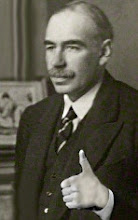
In a talk on April 9, 1975 that Hayek gave to the American Enterprise Institute in Washington DC, he made the following comment on the nature of the business cycle:
“These discrepancies of demand and supply in different industries, discrepancies between the distribution of demand and the allocation of the factors of production, are in the last analysis due to some distortion in the price system that has directed resources to false uses. It can be corrected only by making sure, first, that prices achieve what, somewhat misleadingly, we call an equilibrium structure, and second, that labor is reallocated according to these new prices.
Lacking such price readjustment and resource reallocation, the original unemployment may then spread by means of the mechanism I have discussed before, the “secondary contraction,” as I used to call it. In this way, unemployment may eventually become general.
The primary cause of the appearance of extensive unemployment, however, is a deviation of the actual structure of prices and wages from its equilibrium structure. Remember, please: that is the crucial concept. The point I want to make is that this equilibrium structure of prices is something which we cannot know beforehand because the only way to discover it is to give the market free play; by definition, therefore, the divergence of actual prices from the equilibrium structure is something that can never be statistically measured.” (Hayek 1975: 6–7).
This passage is recycled ad nauseum by certain Rothbardians such as “Bob Roddis,” with the astonishing comment that it contains
“simple basic [sc. Austrian] concepts that … all the other anti-Austrians refuse to comprehend.” Speaking of this very quotation, that same Rothbardian declares:
“Like every other non-Austrian, you guys just do not understand the essential concept of economic calculation or the concept of the equilibrium price structure that does not yet exist.”
“[t]here is no essential dispute between Hayek, Mises, Rothbard, Lew Rockwell or me regarding the following which states the basic Austrian understanding of the economic galaxy” [my emphasis – LK].
But, on reading the Hayek quotation, one is struck by the fact that the central concept is the notion of a tendency to a price vector that will clear all markets (with flexible wages clearing the labour market). This is not an “Austrian” idea at all: it is a Walrasian or neo-Walrasian neoclassical idea, straight from general equilibrium theory. The Austrians did not invent this, but simply borrowed it from Walrasian neoclassicals.
A fundamental theoretical point of Post Keynesian economics – and indeed much heterodox economics in general – is the rejection of the notion of a market tendency to general equilibrium, with extensive arguments why there is no such tendency, owing to the presence of fundamental uncertainty, subjective expectations, the failure of Say’s law, the non-neutrality of money, and the falsity of the gross substitution axiom.
Here we have the most astonishing sight of vulgar internet Austrians complaining that the critics do not understand “basic Austrian” concepts, yet these same Austrians are unaware that the very concepts in question they invoke are nothing but
mainstream neoclassical equilibrium fictions, which are held by all orthodox economists such as New Classicals, monetarists and (to some extent) even the New Keynesians.
And, more seriously, certain Austrians such as the radical subjectivists do even accept that idea of market tendency to general equilibrium. Other Austrians such as Rizzo and O’Driscoll have substituted the notion of “pattern coordination” for general equilibrium theory.
If this does not prove how absurd and ignorant is this type of internet Austrian, with their endless carping about “not understanding basic Austrian concepts,” then frankly nothing will.
BIBLIOGRAPHY
Hayek, Friedrich A. von. 1975.
A Discussion with Friedrich A Von Hayek. American Enterprise Institute, Washington.