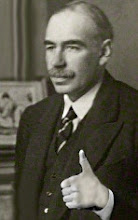
These strange characterisations of Keynes and Keynesian theory seem to stem from an inability to separate micro from macro phenomena.
On the micro level (that is, in terms of the individual) did Keynes hate saving? I doubt it. Even though one does find talk in Keynes’s writing of the hoarding of money as an immoral thing (Keynes called money saved but not spent on capital goods investments “idle funds” or “hoards”), this was really about the macroeconomic effects of aggregate saving of money without investment (if anyone can find references in Keynes’s work to individual saving/hoarding as bad or immoral per se I would like to see such references).
But most obvious way to approach the question whether Keynes hated saving in terms of the individual act is to ask: did Keynes spend his life as a spendthrift, spending every pound he ever earned? Did he die a pauper with no, or little, savings?
Not exactly: Keynes’s net worth in 1945 was £411,238 (Moggridge 1992: 585) and according to Skidelsky (2000: 479) after his death (on 21 April, 1946) his net wealth was £479,529, about £400,000 in securities alone.
In inflation-adjusted 2011 pounds (in terms of goods and services) £400,000 would be roughly the equivalent of £13,745,000. After 1929, Keynes’s investments included car company shares, gold shares, American utilities and aircraft stock.
Was a man who died with a net worth of about 13 million pounds a person who hated saving? Clearly not.
Meanwhile, there is no doubt that Keynes was concerned about the macroeconomic effects of saving when it was not matched by an equal amount of investment. This was his criticism of neoclassical economics (what he called the “classical theory”): Keynes questioned the neoclassical belief that savings and investment are automatically equilibrated.
He saw negative effects on output and employment from an increase in savings unmatched by sufficient investment.
There is no contradiction in saying that saving is good and beneficial to individuals (at the micro level) and that people will clearly need to save in the course of their lives, but at the same time that saving can possibly be deleterious in its macroeconomic effects in some circumstances.
The macroeconomic reality is that strong government spending to create and maintain full employment and economic prosperity actually helps many individuals to save for the future. That is to say, saving as a micro phenomenon of benefit to individuals will be strongly aided and increased by Keynesianism, not hindered.
It is rather easy to prove this. All we have to do is look at the historical data for the US personal saving rate:
http://research.stlouisfed.org/fred2/series/PSAVERT/The data in this graph begins in 1959. During the last years of classic Keynesianism in the US (1946–1973) the saving rate seems to have been increasing. At any rate, the historical average for the 1946–1973 period was between about 8–10%; certainly the savings rate was stable in this period, not falling.
Then after full employment and Keynesianism were abandoned in the late 1980s and the revived neoclassical economics infected policy makers and central banks, the savings rate plunged – and spectacularly so in the 1990s – as people were driven into private debt as real wages fell under neoliberalism, and the plague of speculative asset bubbles hit the economy.
Why did the savings rate fall so sharply after about 1985? The reason, I think, is that the effects of the fall in real wages that began in the 1970s (itself a function of neoliberal policies) started to be felt and people had to dip into their savings to maintain living standards. But this is not the only reason, of course. Part of the reason might be reduced income uncertainty as married women entered the workforce from the 1970s and 1980s (and families had more security from having two incomes, although this was itself partly a function of the fall in real wages).
But the most important reason in my view was the explosion in the availability of easy credit as financial institutions were deregulated after about 1980. Lending standards fell, and it became much easier for households to run up debt for consumption, and as a solution to their money problems. But this created the perverse effects that savings could be drawn down even more for spending (in the expectation of more credit to deal with the debt load) and then as an effect of the need to service a much greater burden of personal debt.
The neoliberal economic model was one that substituted private debt for Keynesian public spending as the engine of growth in Western economies.
The results are now here for all to see:
(1) the huge unsustainable asset bubbles in the 1990s and 2000s,So, if we want to blame anything for the collapse of the US personal saving rate after about 1985, it is neoliberalism, not Keynesian economics.
(2) the vast private debt to GDP ratios,
(3) the financial crisis of 2008,
(4) the subsequent crisis of deleveraging and debt deflation (or what Richard Koo calls the “balance sheet recession”), and
(5) the continuing and general economic malaise with high unemployment, because not enough has been done to fix the private debt crisis. Furthermore, the need for large-scale public investment spending to help the private sector delever (and to provide employment and income) is unmet.
Keynesianism actually allowed a stable – possibly even a rising – personal savings rate.
And Keynes – far from hating saving – saved a lot of money in his time!
BIBLIOGRAPHY
Moggridge, D. E. 1992. Maynard Keynes: An Economist’s Biography. Routledge, London.
Skidelsky, R. J. A. 2000. John Maynard Keynes: Fighting for Freedom, 1937–1946 (vol. 3), Penguin Books, London.