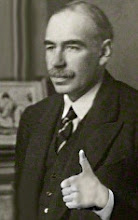
The context is as follows: in an interview with the leftist British journalist Kingsley Martin (1897–1969) in the New Statesman of January 1939, Keynes – commenting on the need for a new interventionist economic system and at the same time the need to avoid the authoritarianism of the Fascist and communist states – said this:
“The question is whether we are prepared to move out of the nineteenth-century laissez faire state into an era of liberal socialism, by which I mean a system where we can act as an organized community for common purposes and to promote social and economic justice, whilst respecting and protecting the individual—his freedom of choice, his faith, his mind and its expression, his enterprise and his property.” (Moggridge 1982: 500 = Keynes and Martin 1939: 123).What Keynes calls “socialism” here is not Marxism of course, but what we would now call a social democratic state: a capitalist economy but with strong government interventions for macroeconomic stability and full employment, effective regulation and government interventions to address social and other problems. Above all, it is a system where all the best values of Classical liberalism – such as democracy, constitutional government, freedom of speech, freedom of the press, freedom of (and from!) religion, civil liberties, and reasonable property rights – are preserved.
Contrast Keynes’ ideas with Engels’ vision of the transitional socialist/communist state:
“A revolution is certainly the most authoritarian thing there is; it is the act whereby one part of the population imposes its will upon the other part by means of rifles, bayonets and cannon — authoritarian means, if such there be at all; and if the victorious party does not want to have fought in vain, it must maintain this rule by means of the terror which its arms inspire in the reactionists. Would the Paris Commune have lasted a single day if it had not made use of this authority of the armed people against the bourgeois? Should we not, on the contrary, reproach it for not having used it freely enough?Engels was fairly frank, and the historical attempts to implement Marxism fully confirm that this is how Communism works out – not only in theory but also in practice.
Friedrich Engels, “On Authority,” 1874
https://www.marxists.org/archive/marx/works/1872/10/authority.htm
A rational and humane person should prefer Keynes’ liberal vision of the just society – and not the cult of Marxism and Communism, which has been a blot on the Left in much the same way that Fascism has been a blot on the Right.
BIBLIOGRAPHY
Engels, Friedrich. “On Authority,” 1874
https://www.marxists.org/archive/marx/works/1872/10/authority.htm
Keynes, John Maynard and Kingsley Martin. 1939. “Democracy and Efficiency,” New Statesman and Nation 17.414 (January 28): 121–123.
Moggridge, D. E. (ed.). 1982. The Collected Writings of John Maynard Keynes. Volume 21. Macmillan, London.