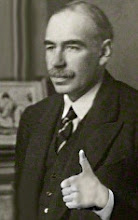
I have written up some biographical details of interest below:
(1) The Keynes family might have been descended from a Norman called William de Cahaignes (c. 1035–?) who came to England with William the Conqueror in 1066. The Norman surname Cahaignes was derived either from the Late Latin casnus (“oak”) or from Latin catanus (“juniper bush”; Skidelsky 1983: 2). The young Keynes, while in his last years at Eton, did genealogical research on his family, and traced his dynastic origins to this Norman baron. According to Skidelsky (1983: 2), Keynes even constructed a family tree back to William de Cahaignes, but whether this was really true or merely wishful thinking is not clear (Skidelsky [1992: 3] refers to problems linking the 17th century Keyneses with the 18th century ones, like Richard Keynes [who died in 1720] from whom Maynard Keynes really was descended*).Timeline of Keynes’s Early Life
(2) Keynes’s immediate ancestors came from Wiltshire: Keynes’s paternal grandfather was John Keynes (1805–1878) of Salisbury, a businessman who made his money in flower nurseries, and then banking and other business (Skidelsky 1983: 5). John Keynes’s second marriage was to Anna Maynard Neville, who was from an Essex farming family (Skidelsky 1983: 5). Their son was Keynes’s father, John Neville Keynes (31 August 1852–15 November 1949).
(3) Keynes’s mother was Florence Ada Brown (1861–1958). John Neville Keynes and Florence had three children:
(i) John Maynard Keynes (1883–1946)
(ii) Geoffrey Keynes (1887–1982)
(iii) Margaret Neville Keynes (1885–1974)
John Neville Keynes died at the age of 97, and actually outlived John Maynard Keynes. For a useful family tree, see here (at the end of the article). Amongst Keynes’s indirect descendants is the actor Skandar Keynes.
(4) John Neville Keynes was a conventional Liberal in politics. First, he was a supporter of the Liberal politician William Ewart Gladstone, but later opposed Gladstone’s first Home Rule Bill for Ireland (1886). Neville Keynes had become a Liberal Unionist by the 1890s (Skidelsky 1983: 56–57).
(5) John Maynard Keynes was born on 5 June 1883 at 6 Harvey Road in Cambridge, the family home. At the time, the British Empire was a superpower, and the Prime Minister in the year of Keynes’s birth was William Ewart Gladstone (in his second premiership from 1880–1885). It was the year after the British occupation of Egypt (1882), and the year before the 1884 Reform Act, which gave around six million the vote in British parliamentary elections.
(6) Keynes was known as Maynard Keynes or Keynes; his father used the name “Maynard,” and only his mother preferred the name John (the name of Keynes’s father), which she used in her correspondence until about 1901 (Moggridge 1992: 22; Skidelsky 1983: 1, n.).
(7) The young John Maynard Keynes lived at 6 Harvey Road in Cambridge. His father John Neville Keynes was an administrator at Cambridge University and held a lectureship in Moral Science from 1883 to 1911. In those days, economics was held to be a branch of the Moral Sciences, a term coined by John Stuart Mill in 1843, and used to describe history, law, economics (better known as Political Economy in the 19th century), psychology, anthropology and ethics. Economics was taught as part of the Moral Sciences Tripos at Cambridge, and it was not until 1903 under the initiative of Alfred Marshall that an independent Economics and Political Tripos (that is to say, a Bachelor’s Degree with honours) was established at Cambridge (Skidelsky 1983: 45).
(8) Keynes began playing golf with his father John Neville Keynes in the 1890s, but Maynard Keynes was terrible at golf, and C. R. Fay held Keynes to be amongst the “world’s worst players” (Moggridge 1992: 21).
(9) From the time when he was 6 years old, Maynard was convinced he was “remarkably ugly,” a felling which continued into adulthood (Skidelsky 1983: 45, 86). Skidelsky (1983: 45) speculates on the psychological implications of this: perhaps it caused him to be a rather more intellectual, “cerebral” child, and may have contributed to his periods of depression.
(10) Keynes had two German governesses in the 1890s, who, according to Skidelsky (1983: 55), gave him a “good grounding in German,” and might explain Keynes’s pro-German feelings later in life.
(11) the young Keynes excelled at mathematics (Moggridge 1992: 27), and this was the key to his success in the Eton College Scholarship Examinations he underwent in July 1897 (Moggridge 1992: 28). Keynes began his education at Eton in September 1897 (Skidelsky 1983: 74) when he was 14, as one of Eton’s “Collegers” (or King’s Scholars), as opposed to the “Oppidans,” fee-paying students, usually from wealthier or upper-class backgrounds. In July 1901, Keynes won the “Tomline,” an Eton mathematical prize, and in January 1901 was elected to the Eton “College Pop,” a debating society.
(12) Maynard thought of himself as firmly middle class, and some early opinions persisted later in life: aristocrats he found ridiculous and the proletariat boorish (Skidelsky 1983: 84–85); he dismissed religion, even refuting arguments for the existence of god held by his friends (Skidelsky 1983: 86). In 1899 while at Eton, on the 80th birthday of Queen Victoria, Keynes wrote a student essay called “Victorian Achievements.” In it, he evinces a somewhat poor view of workers and labour rights:“It is very well to encourage a labourer to think for himself … but when his little knowledge leads to strikes, it must be admitted that it is a dangerous thing.” (quoted in Skidelsky 1983: 88).Of course, Keynes was only 16 when he wrote these words.
Keynes was anti-war before the Boer War (11 October 1899 until 31 May 1902), but once the conflict started supported Britain’s effort (Skidelsky 1983: 88). Nevertheless, his patriotism did not extend to joining the “Volunteers” at Eton, despite the social pressure to do so (Skidelsky 1983: 88; 90; Moggridge 1992: 42).
(13) Keynes’s curriculum at Eton consisted mainly of Classics (that is, ancient Greek and Latin and the literature of the ancient Greeks and Romans), mathematics, history and French.
(14) In July 1902, Keynes came first in the Higher Certificate Examination, and decided on attending King’s College, Cambridge, where he would study mathematics and Classics (Skidelsky 1983: 98–99; Moggridge 1992: 46).
– born on 5 June, 1883 at 6 Harvey Road in Cambridge;
– Keynes began study at Eton in September 1897;
– educated at Eton from 1897–1902;
– educated at King’s College, Cambridge from 1902–1905; Keynes received a first class B.A. in mathematics in May 1904. In June 1905, he underwent the Tripos examinations (the equivalent of obtaining an Honours degree), and was ranked in twelfth place.
NOTE
* The genealogical line mentioned by Skidelsky (1983: 3) is as follows:
Alexander Keynes (16 century)
~~~~|
Henry Keynes
~~~~?
Richard Keynes of Wareham (? –1720)
~~~~|
Richard Keynes
~~~~|
Richard Keynes
~~~~|
Richard Keynes
~~~~|
John Keynes
~~~~|
John Keynes (1805–1878)
~~~~|
John Neville Keynes (1852–1949)
~~~~|
John Maynard Keynes (1883–1946).
LINKS
John Maynard Keynes – Timeline.
John Maynard Keynes, Wikipedia.
BIBLIOGRAPHY
Keynes, W. Milo (ed.). 1975. Essays on John Maynard Keynes, Cambridge University Press, London.
Moggridge, D. E. 1992. Maynard Keynes: An Economist’s Biography, Routledge, London.
Skidelsky, R. J. A. 1983. John Maynard Keynes: Hopes Betrayed 1883–1920 (vol. 1), Macmillan, London.