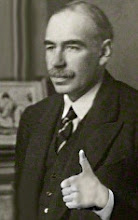
Here Skidelsky gives lecture 2 of a series at the University of Warwick on economics. This lecture is a discussion of central banks and monetary policy, especially before the crisis of 2008.
Showing posts with label monetary policy. Show all posts
Showing posts with label monetary policy. Show all posts
Thursday, January 28, 2016

Friday, January 24, 2014
A Gulf Separates Milton Friedman and most Austrians
And this video shows why.
Milton Friedman understood perfectly well that central banks are vital in modern market economies to stabilise fractional reserve banking, and he rightly blamed the Federal Reserve for not intervening properly from 1929 to 1933 to stop the financial collapse.
But, of course, for most Austrians – with the exception of the GMU Austrians and (probably) the radical subjectivists – central banks are an unmitigated “evil” and should not even exist.
The “liquidationism” of such Austrians actually entails not only that central banks should do nothing during recessions, but also that they abolish themselves.
In light of this, it is indeed no surprise that Rothbardian Austrians loathe Friedman.
Why is this of interest? Because over at Free Advice Robert Murphy posts a video of Arnold Schwarzenegger singing a paean to Milton Friedman in an attempt to show that all the “non-interventionist stuff in Friedman … is inconsistent with his fine-tuning monetary policy ideas.”
But it is no such thing. Milton Friedman had (from his own perspective) a coherent economic theory that accepted fractional reserve banking as part and parcel of capitalism (unlike Rothbardians), and that such a system needed a central bank to stabilise it.
There is no contradiction involved in followers of Friedman praising his Free to Choose (1980) book and television series and ideas on personal liberty, but accepting the need for a central bank and even some type of monetary policy, as Friedman did.
Milton Friedman understood perfectly well that central banks are vital in modern market economies to stabilise fractional reserve banking, and he rightly blamed the Federal Reserve for not intervening properly from 1929 to 1933 to stop the financial collapse.
But, of course, for most Austrians – with the exception of the GMU Austrians and (probably) the radical subjectivists – central banks are an unmitigated “evil” and should not even exist.
The “liquidationism” of such Austrians actually entails not only that central banks should do nothing during recessions, but also that they abolish themselves.
In light of this, it is indeed no surprise that Rothbardian Austrians loathe Friedman.
Why is this of interest? Because over at Free Advice Robert Murphy posts a video of Arnold Schwarzenegger singing a paean to Milton Friedman in an attempt to show that all the “non-interventionist stuff in Friedman … is inconsistent with his fine-tuning monetary policy ideas.”
But it is no such thing. Milton Friedman had (from his own perspective) a coherent economic theory that accepted fractional reserve banking as part and parcel of capitalism (unlike Rothbardians), and that such a system needed a central bank to stabilise it.
There is no contradiction involved in followers of Friedman praising his Free to Choose (1980) book and television series and ideas on personal liberty, but accepting the need for a central bank and even some type of monetary policy, as Friedman did.
Friday, September 28, 2012
More Fake History of the Great Depression
I refer readers to this post by Robert P. Murphy:
Here is what Lionel Robbins said:
He then asserts that in the 1929–1933 contraction “we have changed all that.” Yet Robbins is wrong, certainly with respect to the United States.
For the Federal Reserve banks had regularly lowered rates and engaged in substantial bond buying programs to fight the 1920s recessions before 1929. The Fed cut rates in 1921, 1924 and 1926–1927 to fight recessions, and cut rates and bought bonds in 1924 and 1926–1927.
Here is a list of 1920s recessions:
Let us look at the bond buying program:
From July 1929 to late 1931, Fed holdings of treasuries increased about fivefold, and this was in a period of over two years.
Yet in the year from 1923-1924, Federal Reserve holdings increased from $91 million in October 1923 to $585 million by October 1924. That was a six-fold increase over about a year, much more radical than the 1929-1931 program and in a shorter time too!
Next the discount rate:
The rate came down to 1.5% by July 1931. This was a low rate, but we are dealing with quantity, not a qualitative difference, for the use of discount rate cuts had perfectly good precedents in 1924 and 1927.
We might also note that in 1931 the New York Fed raised the discount rate to 3.5% by October from 1.5%: right in the midst of the worst depression ever seen. Now, if anything, that was a “qualitatively different” policy measure from previous 1920s policy!
Conclusion
Murphy is dead wrong in thinking that the Fed policy in 1929–1933 “was a complete reversal of traditional central bank doctrine” – it was nothing but a development of already existing policy actions.
It is also utterly absurd to say that “central banks in the early 1930s were actively trying to ease credit (by lowering interest rates, setting up special asset purchases or loan programs, etc.) when they had never done things like this in earlier crises” – in the case of the Federal Reserve banks, they had done precisely these policy interventions from 1923–1924 and 1926–1927.
If it is any consolation to Murphy, I have now bought a copy of his book The Politically Incorrect Guide to the Great Depression and the New Deal...
BIBLIOGRAPHY
Murphy, Robert. 2009. The Politically Incorrect Guide to the Great Depression and the New Deal. Regnery Publishing, Inc. Washington, DC.
Robbins, Lionel Charles Robbins. 1935. The Great Depression. Macmillan, London.
Wheelock, David C. 1992. “Monetary Policy in the Great Depression: What the Fed Did, and Why,” Federal Reserve Bank of St. Louis Review 2: 3–27.
http://research.stlouisfed.org/publications/review/92/03/Depression_Mar_Apr1992.pdf
Robert P. Murphy, “Does Anyone Deny That There Were Unprecedented Credit Stimulus Policies During Hoover Administration?,” 27 September.Here is Murphy’s question to Keynesians:
“In my book on the Great Depression [Murphy 2009 – LK], I quote Lionel Robbins saying (I think in 1934) that central banks around the world had tried unprecedented measures to stimulate a recovery through cheap credit, and that this was a complete reversal of traditional central bank doctrine. ….First the issue of Lionel Robbins.
But I’m asking, do you [sc. Keynesians – LK] agree with Robbins, Hayek, and the random Joes writing letters to the NYT, who at the time were claiming that the central banks of the world were fighting the downturn differently from how things were handled in previous crises?
Note well, I’m speaking here in absolute terms, not in a Sumnerian view whereby the Fed–by definition–has been ‘tight’ the last few years because NGDP is below trend. Rather, I’m asking (for example) if it’s true that central banks in the early 1930s were actively trying to ease credit (by lowering interest rates, setting up special asset purchases or loan programs, etc.) when they had never done things like this in earlier crises?”
Here is what Lionel Robbins said:
“Now in the pre-war [viz. pre-WWI – LK] business depression a very clear policy had been developed to deal with this situation. The maxim adopted by central banks for dealing with financial crises was to discount freely on good security, but to keep the rate of discount high.Robbins asserts that the pre-WWI central bank policy had been to keep discount rates high and only “discount freely on good security.”
Similarly in dealing with the wider dislocations of commodity prices and production no attempt was made to bring about artificially easy conditions. The results of this were simple. Firms whose position was fundamentally sound obtained what was necessary. Having confidence in the future, they were prepared to foot the bill. But the firms whose position was fundamentally unsound realised that the game was up and went into liquidation. After a short period of distress the stage was once more set for business recovery.
In the present depression we have changed all that. We eschew the sharp purge. We prefer the lingering disease. Everywhere, in the money market, in the commodity markets and in the broad field of company finance and public indebtedness, the efforts of Central Banks and Governments have been directed to propping up bad business positions.
We can see this most vividly in the sphere of Central Banking policy. The moment the boom broke in 1929, the Central Banks of the world, acting obviously in concert, set to work to create a condition of easy money, quite out of relation to the general conditions of the money market. This policy was backed up by vigorous purchases of securities in the open market in the United States of America. From October 1929 to December 1930 no less than $410 millions was pumped into the market in this way. The result was as might have been expected. The process of liquidation was arrested. New loans were floated.” (Robbins 1935: 72–73).
He then asserts that in the 1929–1933 contraction “we have changed all that.” Yet Robbins is wrong, certainly with respect to the United States.
For the Federal Reserve banks had regularly lowered rates and engaged in substantial bond buying programs to fight the 1920s recessions before 1929. The Fed cut rates in 1921, 1924 and 1926–1927 to fight recessions, and cut rates and bought bonds in 1924 and 1926–1927.
Here is a list of 1920s recessions:
1920s RecessionsLet us look at the policy responses of the Fed to the 1920s recessions:
Recession | Duration Months
January 1920–July 1921 | 18
May 1923–July 1924 | 14
October 1926–November 1927 | 13.
http://www.nber.org/cycles.html
(1) 1920–1921 RecessionWhen we come to 1929–1933, we can see that monetary policy actions were not “qualitatively different” (the expression Murphy uses here in this comment) from previous policy – they differed merely in quantity, not quality: lower rate cuts and some more bond purchases than previously.
Here are the Fed cuts to the discount rate during the recession of 1920-1921:Discount Rate of the Federal Reserve Bank of New YorkAlthough the rate was raised to 7% in June 1920, the rate was cut from 7% in 1921 to 5.5% by July, and a further cut to 5% in September as the recovery had begun, and then to 4.5% in November.
Date | Rate
1920
May | 6%
June | 7%
Dec. | 7%
1921
Jan. | 7%
Apr. | 7%
May. | 6.5%
Jun. | 6%
Jul. | 5.5%
Sep. | 5%
Nov. | 4.5%
1922
Jan. | 4.5%
Jun. | 4%.
http://fraser.stlouisfed.org/download-page/page.pdf?pid=38&id=1477
(2) 1923–1924 Recession
Let us start with bond purchases:Bond PurchasesBy early 1924, the Federal reserve banks began a bond buying program. Federal Reserve holdings increased from $91 million in October 1923 to $585 million by October 1924. That was increase of $494 million over about a year. In other words, a six-fold increase in the course of a year.
Date | Fed government security holdings
1923
Apr. | $229
July | $97
Oct. | $91
1924
Jan. | $118
Apr. | $274
Jul. | $467
Oct. | $585
1925
Jan. | $464.
(Wheelock 1992: 22).
By April 1924, the Fed bought $156 million in bonds in the period from January, and by July 1924 had bought about another $193 in bonds to fight the recession.
Next, the discount rate:Discount Rate of the Federal Reserve Bank of New YorkIn 1924, the rate was brought down from 4.5% to 3% – a reasonable cut.
Date | Rate
1923
Apr. | 4.5%
Jul. | 4.5%
Oct. | 4.5%
1924
Jan. | 4.5%
Apr. | 4.5%
Jul. | 3.5%
Oct. | 3.0%
1925
Jan. | 3.0%.
(Wheelock 1992: 22).
So here we have quite clear evidence that the Fed fought the 1923–1924 recession with both discount rate cuts and a bond buying program. The bond buying program, in particular, was large and comparable to that done by the Fed between late 1929 and 1930.
(3) 1926–1927 Recession
First, the bond purchases:Bond PurchasesFrom October 1926 to October 1927, the Fed increased its government security holdings by $200 million.
Date | Fed government security holdings
1926
Oct. | $306
1927
Jan. | $310
Apr. | $341
Jul. | $381
Oct. | $506
1928
Jan. | $512.
(Wheelock 1992: 22).
Next, the discount rate:Discount Rate of the Federal Reserve Bank of New YorkHere the discount rate cut was not very large, but bond buying program was hardly insignificant.
Date | Rate
1926
Oct. | 4.0%
1927
Jan. | 4.0%
Apr. | 4.0%
Jul. | 4.0%
Oct. | 3.5%
1928
Jan. | 3.5%.
(Wheelock 1992: 22).
Again, both rate cuts and asset purchasing were the norm.
Let us look at the bond buying program:
Bond PurchasesFar from being unprecedented, the similar program from 1923–1924 provides a good precedent.
Date | Fed government security holdings
1929
Jul. | $147
Oct. | $154
1930
Jan. | $485
Apr. | $530
Jul. | $583
Oct. | $602
1931
Jan. | $647
Apr. | $600
Jul. | $674
Oct. | $733.
(Wheelock 1992: 22).
From July 1929 to late 1931, Fed holdings of treasuries increased about fivefold, and this was in a period of over two years.
Yet in the year from 1923-1924, Federal Reserve holdings increased from $91 million in October 1923 to $585 million by October 1924. That was a six-fold increase over about a year, much more radical than the 1929-1931 program and in a shorter time too!
Next the discount rate:
Discount Rate of the Federal Reserve Bank of New YorkHere the discount rate was quite high in late 1929, but the cuts were certainly sharper than in previous recessions.
Date | Rate
1929
Jul. | 5.0%
Oct. | 6.0%
1930
Jan. | 4.5%
Apr. | 3.5%
Jul. | 2.5%
Oct. | 2.5%
1931
Jan. | 2.0%
Apr. | 2.0%
Jul. | 1.5%
Oct. | 3.5%. (Wheelock 1992: 22).
The rate came down to 1.5% by July 1931. This was a low rate, but we are dealing with quantity, not a qualitative difference, for the use of discount rate cuts had perfectly good precedents in 1924 and 1927.
We might also note that in 1931 the New York Fed raised the discount rate to 3.5% by October from 1.5%: right in the midst of the worst depression ever seen. Now, if anything, that was a “qualitatively different” policy measure from previous 1920s policy!
Conclusion
Murphy is dead wrong in thinking that the Fed policy in 1929–1933 “was a complete reversal of traditional central bank doctrine” – it was nothing but a development of already existing policy actions.
It is also utterly absurd to say that “central banks in the early 1930s were actively trying to ease credit (by lowering interest rates, setting up special asset purchases or loan programs, etc.) when they had never done things like this in earlier crises” – in the case of the Federal Reserve banks, they had done precisely these policy interventions from 1923–1924 and 1926–1927.
If it is any consolation to Murphy, I have now bought a copy of his book The Politically Incorrect Guide to the Great Depression and the New Deal...
BIBLIOGRAPHY
Murphy, Robert. 2009. The Politically Incorrect Guide to the Great Depression and the New Deal. Regnery Publishing, Inc. Washington, DC.
Robbins, Lionel Charles Robbins. 1935. The Great Depression. Macmillan, London.
Wheelock, David C. 1992. “Monetary Policy in the Great Depression: What the Fed Did, and Why,” Federal Reserve Bank of St. Louis Review 2: 3–27.
http://research.stlouisfed.org/publications/review/92/03/Depression_Mar_Apr1992.pdf
Tuesday, January 31, 2012
Louis-Philippe Rochon on What Should Central Banks Do?
I have posted a video below of the Post Keynesian Louis-Philippe Rochon, talking on the various views of central bank and monetary policy within Post Keynesianism. Louis-Philippe Rochon has also been co-editor of some recent Post Keynesian studies (see Rochon and Vernengo 2001; Rochon and Rossi 2003).
There is a legitimate argument here about the extent of the effectiveness of monetary policy and its (negative/positive) effects on real output. Rochon distinguishes between two traditions within Post Keynesian economics:
BIBLIOGRAPHY
Moore, B. J. 1988. Horizontalists and Verticalists: The Macroeconomics of Credit Money, Cambridge University Press, Cambridge and New York.
Rochon, Louis-Philippe and Matias Vernengo (eds.). 2001. Credit, Interest Rates, and the Open Economy: Essays on Horizontalism, Edward Elgar Pub., Northampton, MA.
Rochon, Louis-Philippe and Sergio Rossi (eds.). 2003. Modern Theories of Money: The Nature and Role of Money in Capitalist Economies, Edward Elgar Pub, Cheltenham.
There is a legitimate argument here about the extent of the effectiveness of monetary policy and its (negative/positive) effects on real output. Rochon distinguishes between two traditions within Post Keynesian economics:
(1) the activist Post Keynesians (Basil Moore [1988], Giuseppe Fontana, Thomas Palley), who, instead of an inflation target, wish to use activist monetary policy to target output, investment or capacity utilization;These approaches are derived from the Keynes and Kaldor endogenous money tradition; they reject neoclassical, new consensus inflation targeting.
(2) the group Rochon calls the “parking it” Post Keynesians, who contend the fiscal policy is the main tool to target output, employment and investment, while monetary policy comes with disturbing side effects on real variables. The relationship between interest rates and output is complex and not linear: the monetary transmission between interest rates and real economic variables is unreliable and complicated. The interest rate should be parked at a given level and fiscal policy should be employed. They are three further subdivisions within the “parking it” Post Keynesians:(i) the Smithin rule: the real rate of interest should be very low, close to zero (John Smithin);
(ii) the Kansas city rule: the nominal rate of interest should be zero, possibly negative real rates of interest (Wray, Matthew Forstater, Pavlina Tcherneva).
(iii) the Pasinetti rule/Fair Rate rule: the real rate of interest should be equal to the rate of growth of labour productivity (Pasinetti).
BIBLIOGRAPHY
Moore, B. J. 1988. Horizontalists and Verticalists: The Macroeconomics of Credit Money, Cambridge University Press, Cambridge and New York.
Rochon, Louis-Philippe and Matias Vernengo (eds.). 2001. Credit, Interest Rates, and the Open Economy: Essays on Horizontalism, Edward Elgar Pub., Northampton, MA.
Rochon, Louis-Philippe and Sergio Rossi (eds.). 2003. Modern Theories of Money: The Nature and Role of Money in Capitalist Economies, Edward Elgar Pub, Cheltenham.
Friday, May 6, 2011
Post Keynesians Reject the Liquidity Trap
As I have pointed out before, Keynesianism comes in 3 forms:
It should be noted that the expression “liquidity trap” is also used loosely or in a weak sense by New Keynesians like Krugman to mean that interest rates cannot fall below zero and that monetary policy can become impotent in some situations, which is perfectly true. That rather different definition of the “liquidity trap” is not objectionable. But it is the original neoclassical synthesis concept I am talking about here.
Keynes’ General Theory of Employment, Interest and Money (1936) gives us a theory of real world capitalist economies, where we have a monetary production economy, fundamental uncertainty, subjective expectations, contracts, inflexible or “sticky” wages, and money with a zero or very small elasticity of production, and money and financial assets with zero elasticity of substitution with producible commodities. But in fact Keynes did not regard the original liquidity trap idea as a real world phenomenon. Paul Davidson explains:
QE was a radical monetary policy justified by mainstream economics. It is the New Consensus macroeconomics, monetarism and conservative New Keynesianism that emphasises the use of monetary policy, while neglecting the role of fiscal policy. In contrast, liberal New Keynesians and Post Keynesians emphasise the role of fiscal policy and the ineffectiveness of monetary policy.
BIBLIOGRAPHY
Davidson, P. 2002. Financial Markets, Money, and the Real World, Edward Elgar, Cheltenham.
Keynes, J. M. 2008 [1936]. General Theory of Employment, Interest and Money, Atlantic Publishers, New Delhi.
(1) Neoclassical synthesis Keynesians (= Old Keynesians);Post Keynesian economics is what this blog advocates, and most people do not understand that Post Keynesianism rejects the neoclassical synthesis idea of the liquidity trap. In the original formulation of the concept, a liquidity trap is the existence of an infinitely elastic or a horizontal demand curve for money at some positive level of interest rates.
(2) New Keynesians;
(3) Post Keynesians.
See “Neoclassical Synthesis Keynesianism, New Keynesianism and Post Keynesianism: A Review,” July 7, 2010.
It should be noted that the expression “liquidity trap” is also used loosely or in a weak sense by New Keynesians like Krugman to mean that interest rates cannot fall below zero and that monetary policy can become impotent in some situations, which is perfectly true. That rather different definition of the “liquidity trap” is not objectionable. But it is the original neoclassical synthesis concept I am talking about here.
Keynes’ General Theory of Employment, Interest and Money (1936) gives us a theory of real world capitalist economies, where we have a monetary production economy, fundamental uncertainty, subjective expectations, contracts, inflexible or “sticky” wages, and money with a zero or very small elasticity of production, and money and financial assets with zero elasticity of substitution with producible commodities. But in fact Keynes did not regard the original liquidity trap idea as a real world phenomenon. Paul Davidson explains:
“…Old Keynesians claimed that, at some low, but positive, interest rate, the demand curve for speculative money balances become infinitely elastic (horizontal). This horizontal segment of the speculative demand curve was designated the liquidity trap by Old Keynesians such as Paul Samuelson and James Tobin. These mainstream Old Keynesians made the liquidity trap the hallmark of what Samuelson labeled Neoclassical Synthesis Keynesianism. If the economy is enmeshed in the liquidity trap, then Old Keynesians argued that the Monetary Authority is powerless to lower the rate of interest to stimulate the economy no matter how much the central bank exogenously increased the supply of money. This view of the impotence of monetary policy was succinctly summarized in the motto ‘you can't push on a string.’ The liquidity trap implied that monetary policy would be powerless to stimulate the economy if it fell into recession. These Old Keynesians, therefore, proclaimed that deficit spending fiscal policy was the only policy action available to pull an economy out of a recession. This faith in deficit spending as the only solution for recession became the policy theme for ‘Keynesians’, even though Keynes's speculative motive analysis denies the existence of a ‘liquidity trap’....Keynes also conceived the speculative demand for money as a rectangular hyperbola (Davidson 2002: 94–95), and we can turn to the General Theory to confirm that Keynes did not think the liquidity trap existed in the real world:
In the decade after the Second World War, econometricians searched in vain to demonstrate the existence of a liquidity trap (that is, a horizontal segment of the speculative demand for moment) where monetary policy could not affect the interest rate. In a stunning volte face of the history of economy thought, Milton and his followers who accept the neutrality of money as an article of faith used this failure of econometricians as an attack on Keynes’s theory. Friedman’s motto ‘Money matters’ became an anti-Keynesian weapon. This may have been an effective argument against Old Keynesians who followed Samuelson’s lead in accepting the neutral money axiom. Keynes, however, explicitly declared that in his analysis money was never neutral, that is, that money matters in both the short run and the long run in the real world” (Davidson 2002: 95).
“There is the possibility, for the reasons discussed above, that, after the rate of interest has fallen to a certain level, liquidity-preference may become virtually absolute in the sense that almost everyone prefers cash to holding a debt which yields so low a rate of interest. In this event the monetary authority would have lost effective control over the rate of interest. But whilst this limiting case might become practically important in future, I know of no example of it hitherto. Indeed, owing to the unwillingness of most monetary authorities to deal boldly in debts of long term, there has not been much opportunity for a test. Moreover, if such a situation were to arise, it would mean that the public authority itself could borrow through the banking system on an unlimited scale at a nominal rate of interest” (Keynes 2008 [1936]: 187).The reason why monetary policy can be impotent and ineffective in recessions, depressions or periods of high involuntary unemployment where expectations have been shocked is that we have an economy with endogenous money, subjective expectations and shifting liquidity preference. A government can massively increase the private banks’ excess reserves by quantitative easing (QE), as seen in Japan from 2001 to 2006, and in the US and the UK from 2009, but that will not increase investment, spending or employment significantly, unless that money is injected into the economy by private debt. But it is precisely the collapse of expectations and confidence that destroys the demand for credit and the willingness of banks to extend credit. Banks may prefer to hold their excess reserves, and private individuals, households and businesses may be deleveraging (especially after an asset bubble and excessive private sector debt), and unwilling to take on new debt, while the economy is hit by debt deflation. The impotence of monetary policy in such circumstances is indeed a reality and the remedy is fiscal policy. But the neoclassical synthesis Keynesian idea of the liquidity trap is simply not needed to explain this phenomenon.
QE was a radical monetary policy justified by mainstream economics. It is the New Consensus macroeconomics, monetarism and conservative New Keynesianism that emphasises the use of monetary policy, while neglecting the role of fiscal policy. In contrast, liberal New Keynesians and Post Keynesians emphasise the role of fiscal policy and the ineffectiveness of monetary policy.
BIBLIOGRAPHY
Davidson, P. 2002. Financial Markets, Money, and the Real World, Edward Elgar, Cheltenham.
Keynes, J. M. 2008 [1936]. General Theory of Employment, Interest and Money, Atlantic Publishers, New Delhi.
Subscribe to:
Posts (Atom)