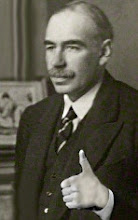
The mistakes and oversights that Keynes made in the General Theory are arguably as follows:
(1) the assumption of an exogenous money supply;Other possible problems include:
(2) the marginal efficiency of capital (MEC) idea. Keynes, in developing the MEC, failed to free himself from the neoclassical marginal productivity of capital (King 2002: 209):“[sc. Keynes] made a fatal mistake in offering a quasi-long-period definition of the inducement to invest as the ‘marginal efficiency of capital’, that is, the profit that will be realised on the increment to the stock of capital that results from current investment and, still worse, identified the profitability of capital with its social utility. This was an element in the old doctrine from which he failed to escape. He had an alternative concept of the inducement to invest as the expected future return on sums of finance to be devoted to investment. Minsky (1976) points out that he did not seem to recognise the difference between the two formulations. If he had stuck to his short-period brief, he would have used only the second.” (Robinson 1979: 179–180).The MEC seems to suggest that there exists a rate of interest which is low enough to induce full utilization of capital goods. But this is just smuggling in the Wicksellian natural rate of interest, when Keynes had wanted to abandon the natural rate.
A number of Post Keynesians reject the MEC, because it is based on the neoclassical or marginalist theory of distribution.
(3) Keynes did not sufficiently stress the role of uncertainty and expectations in undermining the coordinating role of interest rates (King 2002: 14). In Chapter 18 of the General Theory, Keynes played down the role of uncertainty (which he had stressed in Chapter 12) and, if he had really maintained the crucial role of uncertainty (as he did later in Keynes 1937), this would have “ruled out any stable functional relationship between investment and the interest rate” (King 2002: 14). The door was thereby left open for neoclassical synthesis Keynesians to reformulate the General Theory as a general equilibrium model where the interest rate has a pivotal role (King 2002: 14).
(4) In Chapter 2 of the General Theory, Keynes used the marginal productivity of labour concept. Later he was criticised by Lorie Tarshis and Dunlop, who invoked empirical evidence on pro-cyclical wages, and in Keynes (1939) he came to reject this marginalist idea, apparently giving some endorsement of Kalecki’s theories.
(1) Did Keynes properly understand the heterogeneous nature of capital goods? Possibly he did (see Hayes 2007), though the Cambridge capital debates were long after he died;LINKS
(2) Did Keynes understand the extent and significance of fixprice markets? One charge against Keynes is that the General Theory does not consider fixprice markets properly. By contrast, Michał Kalecki did understand fixprices, in his ideas on cost-determined pricing. Kalecki and later Post Keynesians understood that as long as excess capacity exists in fixprice market firms, then government stimulus produces direct increases in output and employment in the latter markets, not just inflation.
“Keynes’s Marginal Efficiency of Capital: A Mistake?,” January 1, 2012.
“Post Keynesian Policy on Interest Rates,” March 12, 2013.
“Interview with Bob Rowthorn,” March 4, 2012.
BIBLIOGRAPHY
Hayes, M. 2007. “Keynes’s Z-Function, Heterogeneous Output and Marginal Productivity,” Cambridge Journal of Economics 31.5: 741–753.
Keynes, J. M. 1937. “The General Theory of Employment,” Quarterly Journal of Economics 51: 209–223.
Keynes, J. M. 1939. “Relative Movements of Real Wages and Output,” Economic Journal 49: 34–51.
King, J. E. 2002. A History of Post Keynesian Economics since 1936. Edward Elgar Publishing, Cheltenham, UK and Northampton, MA.
Robinson, J. 1979. “Garegnani on Effective Demand,” Cambridge Journal of Economics 3: 179–180.