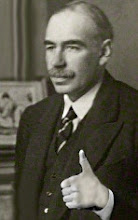
By this time, Keynes’s interests turned to economics. He started to read economics in June 1905, with Alfred Marshall’s Principles as a textbook, though Keynes was soon reading Jevons’s Theory of Political Economy. He also began to spend time with the Marshallian economist Arthur C. Pigou, who was now a lecturer (Moggridge 1992: 82). By 12 October 1905, Keynes applied to attend Marshall’s lectures (Moggridge 1992: 95). By November 1905, Keynes had decided he was good at economics, and Marshall was even asking him to become a professional economist (Moggridge 1992: 96). By December 1905, however, Keynes decided to concentrate on preparations for the Civil Service Examination, and abandon the Economics Tripos (Skidelsky 1983: 166).
Robert Skidelsky (1983: 166) actually points out a very interesting fact:
“[sc. Keynes] … never did take an economics degree. In fact, his total professional training came to little more than eight weeks. All the rest was learnt on the job.”The greatest economist of the 20th century (at least in my opinion) had no formal economics degree. Are there lessons from this?
Probably that truly great minds do not need formal university degrees to make contributions to the social or natural sciences.
Of course, Keynes also had (1) a great deal of contact with the greatest British economists of his day, (2) much practical experience of government, having worked at the British India Office and Treasury, and (3) a great deal of time to read and reflect on issues that interested him, both as a fellow of King’s College and from 1909 a lecturer in economics (funded by no less than Alfred Marshall, who had a high opinion of Keynes).
I would have liked to say that Keynes’s lack of a formal university degree in economics left his mind open to new ways of economic thinking, but, in the end, I am not really sure this is true. Keynes was imbued with the standard neoclassical theory of his day, mainly from Alfred Marshall. The story of his contribution to economic theory is the gradual emancipation of his mind from neoclassical thinking, which continued to the end of his life, and perhaps was never really complete.
But that does not subtract from the importance of that achievement (for a excellent summary of his work, see Davidson 2009).
BIBLIOGRAPHY
Davidson, Paul. 2009. John Maynard Keynes (rev. edn.), Palgrave Macmillan, Basingstoke.
Moggridge, D. E. 1992. Maynard Keynes: An Economist’s Biography, Routledge, London.
Skidelsky, R. J. A. 1983. John Maynard Keynes: Hopes Betrayed 1883–1920 (vol. 1), Macmillan, London.