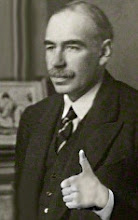
In this fascinating passage from a later reprint of the article in Giffen’s book Essays in Finance (3rd edn. 1890), he seems to be grasping at what we would now call the issues of expectations, profit deflation, and debt deflation as the causes of the business pessimism at that time:
“A third remark I have to make at the outset is that as trade depression may arise from very small changes in the total amount of production, while industrial organization is of such a nature that such changes need cause no surprise, it becomes equally no matter for surprise that changes in prices have so intimate a connection with the subject. The feeling of depression, judged by the realities of things, frequently appears to be either wholly unaccountable or to go far beyond what the facts warrant. And the explanation would seem to be that as there is a general rise of prices in prosperous times, and prices remain then at a high level, so in times of ‘depression,’ when production and consumption and saving are diminished by a small percentage as compared with what they are at other times, there is often a general fall of prices, and it is this fall of prices which produces much of the gloom. Merchants and capitalists are hit by it. At their stock-takings, with the same quantities of goods, or even with greater quantities, their nominal capital appears reduced. In falling markets their operations result steadily in loss for a considerable period. Many who have conducted operations with borrowed money are cleaned out, and fail. The community need be none the poorer. The goods themselves are not destroyed. Somebody gets the benefit of the lower prices. But the leaders of industrial enterprise, those who run the machine, are all poorer, and feel even poorer than they really are, as they are accustomed to look mainly at nominal values, and not at the quantities of the things themselves which they possess. The moral is that economists and public men should beware to some extent of the outcry from the market-place. Merchants and capitalists are not the whole community. Their interest in the long run is the same as that of all. No community can prosper steadily with its mercantile classes depressed. But the immediate interest of particular classes is often different from that of the community generally, and in this way it is not surprising that the gloom of the market-place in times of depression should appear altogether excessive in relation to the real circumstances of the community as a whole. Apart from exaggeration, which is also a factor to be reckoned with, the particular classes who cry out most from time to time about depression may suffer specially from evils which injuriously affect the community as a whole very little, or may even affect it momentarily for good.” (Giffen 1890: 5–6).Giffen understood that price deflation can tend to produce depressed expectations and pessimism amongst business people, as Alfred Marshall did, but on the whole thought this pessimism was unwarranted. He could not take the further step of seeing how business pessimism itself can reduce aggregate investment and employment. Also, quite fascinating is Giffen’s observation that business people are more interested in nominal values, rather than real values. Giffen also notes how the deflation was “diminishing the profits of capitalists” (Giffen 1890: 22), a trend also noted by Alfred Marshall in 1887 as one of “profit deflation.”
Giffen was also well aware that prices had begun a long-run downward trend from 1873 and connected this directly with depressed business expectations:
“The most disastrous characteristic of the recent fall of prices has been the descent all round to a lower range than that of which there had been any previous experience. It is this peculiarity which more than anything else has aggravated the gloom of merchants and capitalists during the last few years. Fluctuations of prices they are used to. Merchants know that there is one range of prices in a time of buoyancy and inflation, and quite another range in times of discredit. By the customary oscillations the shrewder business people are enabled to make large profits. But during the last few years the shrewder as well as the less shrewd have been tried. Operations they ventured on when prices were falling to the customary low level have failed disastrously because of a further fall which is altogether without precedent. Similarly, landowners and other capitalists who are usually beyond the reach of fluctuations have had their margins invaded; rents, which rose so steadily for twenty years before 1873, have consequently fallen heavily; the change is more like a revolution in prices than anything which usually happens in an ordinary cycle of prosperity and depression in trade.” (Giffen 1890: 14–15).Giffen, like other commentators at that time, was aware that there was something atypical and remarkable about the long-run deflationary trend from 1873, and that something like a price revolution was occurring.
“This is another way of putting the fact that merchants and capitalists have lately encountered a descent of prices below the customary level, which has greatly put them out and involved them in fresh and most unexpected difficulties. The minimum of the former period has almost become the maximum of the new, and operations based on the former customary levels have failed.” (Giffen 1890: 17–18).
Next, Giffen concludes that that there was some major underlying cause driving the deflation from 1873, and reviews the two proposed explanations at that time:
“The question then arises on these figures whether the depression at a time like the present may not be largely due to some permanent cause which has lately begun to operate; to which trade was not subject for many years after 1850, and which is now in full operation; and which has for its effect to prevent a rise of prices in good years to what was long considered the customary maximum, and to precipitate a fall in bad years to a point much below the customary minimum. That the answer must be in the affirmative appears to be very clear. There is no mystery at all about the actual course of prices, while the effect of the recent changes in diminishing the profits of capitalists, because the upward movement of prices is less than they expect, and the downward movement greater, is equally palpable. Merchants and capitalists all round have suffered. They have held stocks longer, or bought stocks sooner, than they would have done if they had not to some extent lost their bearings. Their gloom is great, because prices are obstinately low. Whatever may be the cause of so great a change, it is surely worth investigation.The two explanations Giffen mentions are:
Two causes only have been suggested. One is a great multiplication of commodities and diminution of the cost of production due to the progress of invention, improved facilities of communication, lower freights, international telegraphy, and the like circumstances. The other is, that the precious metal used for standard money—viz., gold—has become relatively scarcer than it was, its production being diminished on the one hand, and the demands for it on the other hand increased. The former of these causes was discussed quite lately by Mr. Fowler, in the Contemporary Review, and a greater weight assigned to it than to the latter cause. I am disposed to give the greater weight to the latter. To a large extent, however, the two causes are not in conflict. The question is of money prices—the relation of money to commodities. Whether it is commodities that multiply, or gold that diminishes or does not multiply in proportion, the relation between gold and the mass of commodities is equally changed. It is quite conceivable that if gold were to increase in quantity, and its cost of production to diminish, as other commodities increase in quantity and have their cost of production diminished, there would be no change of any kind in gold prices. Commodities would be more abundant, but the abundance would make itself felt in a rise of money wages, salaries, rents, and profits, and not in lower prices. That it is felt in lower prices now appears to be absolute proof that the relation between gold and commodities has changed, that they have not increased in quantity and had their cost of production diminished pari passu. In addition, however, while not denying that there has been a change on the commodities side of the balance, I would go farther and maintain that what has happened to gold in the way of diminished production and increased demands upon it, arising from other causes than the multiplication of commodities, must have had great effect.” (Giffen 1890: 22–23).
(1) falling prices owing to positive supply shocks and revolutionary technologies driving down prices, andGiffen (1890: 24–25) noted that as gold production fell off after 1875, actual demand for gold rose as nations like Germany, the US and Italy went on the gold standard (or in the case of the US returned to it).
(2) a quantity theory of money explanation, though not quite a modern neoclassical one, but one stemming more from the quantity tradition in Classical Economics, where the cost of production of gold was assumed to also influence changes in its “price”.
Giffen sees the influence of gold supply in relation to demand as the crucial factor:
“Looking at all the facts, therefore, it appears impossible to avoid the conclusion that the recent course of prices, so different from what it was just after the Australian and Californian gold discoveries, is the result in part of the diminished production and the increased extraordinary demands upon the supply of gold. It is suggested, indeed, that the increase of banking facilities and other economies in the use of gold may have compensated the scarcity. But the answer clearly is that in the period between 1850 and 1865, and down to 1873, the increase of banking facilities and similar economies was as great relatively to the arrangements existing just before as anything that has taken place since. The same reply may also be made to the suggestion that the multiplication of commodities accounts for the entire change that has occurred. There is no reason to suppose that the multiplication of commodities relatively to the previous production has proceeded at a greater rate since 1873 than in the twenty years before that. Yet before 1873 prices were rising, notwithstanding the multiplication of commodities; and since that date the tendency has been to decline. The one thing which has changed, therefore, appears to be the supply of gold and the demands upon it; and to that cause largely we must accordingly ascribe the change in the course of prices which has occurred.” (Giffen 1890: 27)The question of what the causes of the great deflation of 1873 to 1896 were remains a very interesting one, and we can see here how some economists at the time like Giffen explained it.
To sum up, we can also see how, despite modern libertarian myths to the contrary, the great deflation of 1873 to 1896 caused a great deal of consternation and business pessimism at the time. This was described in the both the business press and academic writings of the late 19th century (e.g., see Marshall 1887; Wells 1887a, 1887b, 1887c, 1887d).
Further Reading
“Alfred Marshall on Business Confidence,” December 3, 2014.
“Alfred Marshall on Wage Stickiness and Debt Deflation,” November 30, 2014.
“The Profit Deflation of the 1890s,” June 13, 2013.
“Alfred Marshall’s Judgement on the “Depression” of 1873–1896,” June 13, 2013.
“S. B. Saul on the Profit Deflation of the 1873–1896 Period,” June 14, 2013.
“Alfred Marshall on the Deflation of 1873–1896,” October 14, 2014.
“Alfred Marshall’s Interest Rate Theory,” November 3, 2014.
BIBLIOGRAPHY
Giffen, Robert. 1885. “Trade Depression and Low Prices,” The Contemporary Review 47 (June): 800–822.
Giffen, Robert. 1890. Essays in Finance (3rd edn.). George Bell and Sons, London.
Marshall, Alfred. 1887. “Remedies for Fluctuations of General Prices,” The Contemporary Review 51 (March): 355–375.
Wells, David A. 1887a. “The Fall of Prices,” The Contemporary Review 52 (1 July): 523–548.
Wells, David A. 1887b. “The Fall of Prices II,” The Contemporary Review 52 (1 July): 628–643.
Wells, David A. 1887c. “The Great Depression of Trade I,” The Contemporary Review 52 (1 July): 295.
Wells, David A. 1887d. “The Great Depression of Trade II,” The Contemporary Review 52 (1 July): 381.