In response to this a commentator on the last post remarks:
“In a commodity money standard, production would be increased with increased hiring in response to increased demand for labor.”In a country with no or minimal gold/silver production, such output will not increase in response to an increase in liquidity preference. Even in countries where gold is mined the effect on employment is trivial.
Under the gold standard, when money was a producible commodity, significant production was limited to certain countries and brief times. E.g., if the UK was hit by a deflationary depression in the 1880s, with a rising purchasing power for money as demand for it increased as a hedge against future uncertainty (that is, a rise in its value due to deflation), can UK businesses just hire unemployed workers to “produce” gold in the UK? Of course not.
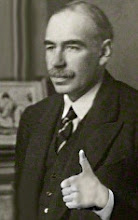
As Keynes said:
“… money has, both in the long and the short period, a zero, or at any rate a very small, elasticity of production, so far as the power of private enterprise is concerned, as distinct from the monetary authority;—elasticity of production meaning, in this context, the response of the quantity of labour applied to producing it to a rise in the quantity of labour which a unit of it will command. Money, that is to say, cannot be readily produced;—labour cannot be turned on at will by entrepreneurs to produce money in increasing quantities as its price rises in terms of the wage-unit. In the case of an inconvertible managed currency this condition is strictly satisfied. But in the case of a gold-standard currency it is also approximately so, in the sense that the maximum proportional addition to the quantity of labour which can be thus employed is very small, except indeed in a country of which gold-mining is the major industry.BIBLIOGRAPHY
Now, in the case of assets having an elasticity of production, the reason why we assumed their own-rate of interest to decline was because we assumed the stock of them to increase as the result of a higher rate of output. In the case of money, however—postponing, for the moment, our consideration of the effects of reducing the wage-unit or of a deliberate increase in its supply by the monetary authority—the supply is fixed. Thus the characteristic that money cannot be readily produced by labour gives at once some prima facie presumption for the view that its own-rate of interest will be relatively reluctant to fall; whereas if money could be grown like a crop or manufactured like a motor-car, depressions would be avoided or mitigated because, if the price of other assets was tending to fall in terms of money, more labour would be diverted into the production of money;—as we see to be the case in gold-mining countries, though for the world as a whole the maximum diversion in this way is almost negligible” (Keynes 1936: 230–231).
Keynes, J. M. 1936. The General Theory of Employment, Interest, and Money, Macmillan, London.