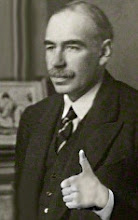
Tracking down the original source for this statement is tricky, but the earliest I can find is a treatise called Bulletin of the Commission to Study the Organization of Peace (Commission to Study the Organization of Peace, New York, 1941). I assume that Keynes wrote it (anyone who knows better please correct me).
It reads as follows:
“In short, the analogy with a national banking system is complete. No depositor in a local bank suffers because the balances, which he leaves idle, are employed to finance the business of someone else. Just as the development of national banking systems served to offset a deflationary pressure which would have prevented otherwise the development of modern industry, so by extending the same principle into the international field we may hope to offset the contractionist pressure which might otherwise overwhelm in social disorder and disappointment the good hopes of our modern world. The substitution of a credit mechanism in place of hoarding would have repeated in the international field the same miracle, already performed in the domestic field, of turning a stone into bread.” (Bulletin of the Commission to Study the Organization of Peace, p. 24).The phrase is obviously a piece of rhetoric, not meant to be taken seriously. No, it doesn’t mean that “credit expansion is the same thing as creating wealth.”
In fact, the phrase - properly understood - does not even refer to Keynesian stimulus at all: it refers to the ability of private fractional reserve capitalist banks to turn hoarded money (what we would now call money held as reserves) into credit for investment purposes (see Skidelsky 2000: 247). This is the miracle of stones into bread.
A private banking system that causes credit expansion by using idle money allowing loans for capital goods investment raises output and employment, and that latter process produces more wealth for the community. Credit is a means (or medium) by which these things are facilitated.
Moreover, Keynesian stimulus is about getting the private sector to create wealth by increasing capacity utilization and using idle resources (including labour) by increasing aggregate demand through expansionary fiscal policy, just as private investment, bank credit, and payment of wages to workers by a business can create the private spending that does the same thing.
Denying that is like denying that the sky is blue on a clear day.
BIBLIOGRAPHY
Bulletin of the Commission to Study the Organization of Peace, Commission to Study the Organization of Peace, New York, 1941.
Skidelsky, R. J. A. 2000. John Maynard Keynes: Fighting for Britain 1937–1946 (vol. 3), Macmillan, London.