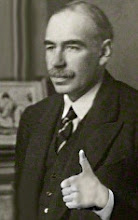
Michael Emmett Brady, “Comparing J.M. Keynes’s and F. Von Hayek’s Differing Definitions of Uncertainty as it Relates to Knowledge,” January 30, 2011.This examines and compares Keynes’s concept of uncertainty with that of Hayek.
Michael Emmett Brady argues that Hayek’s concept of uncertainty and the role of knowledge are quite distinct from that of fundamental uncertainty as defined by Frank Knight and Keynes:
“Uncertainty for Hayek means that each individual decision maker only has a small piece of the puzzle. However, as a whole, the aggregated set of all decision makers have a complete set of all relevant knowledge. There are no pieces missing, lacking or unavailable from the puzzle. Market prices organize and synthesize the aggregate amount of knowledge so that market price signals, understood only by savvy, knowledgeable entrepreneurs, [eliminate] … any uncertainty.” (p. 14)Brady charges that the “Austrian use of the term ... uncertainty actually means dispersed knowledge” (p. 16), which bears further investigation.
“Keynes, Knight and Schumpeter deny Hayek’s claim that the market generates price vectors which concentrate the knowledge so that savvy, knowledgeable entrepreneurs can act on this information and solve the problem of uncertainty. Uncertainty means vital important information is missing. Pieces from the puzzle are missing and will not turn up in the future” (p. 14).
“Hayek could not accept the standard concept of uncertainty as defined by Keynes, Knight and Schumpeter because it would then be impossible for market prices to concentrate knowledge that did not exist. In conclusion, nowhere in any of Hayek’s three articles on Knowledge in Economics in 1937, 1945 and 1947 does Hayek deal with the standard view that uncertainty means knowledge that is not there.” (p. 15).
One of Brady’s major conclusions is confirmed by other scholars who have also noted that the Austrian view of knowledge as fragmented and dispersed through market prices ignores the fact that a great deal of needed knowledge for investment decisions today does not yet exist (Hoogduin 1987: 61), and that the “market process” of Austrian theory is not capable of solving the knowledge problem, given that so much information about future relevant states has yet to be created when decisions are made in the present (Hoogduin 1987: 63). The inability of a decentralised market process to co-ordinate with reliable consistency what dispersed knowledge that does exist, when so much relevant knowledge does not exist with respect to a future that has yet to be created, is a fundamental insight of Post Keynesian economics (Dunn 2008: 140). The Hayekian view of the market as a co-ordinating mechanism in a type of evolutionary process that is capable of dealing with uncertainty and dispersed knowledge is therefore subject to serious criticism. Subjective expectations throw a spanner into the works of this view of the market, as does the non-existence at present of relevant information created in the future.
Brady also discusses G. L. S. Shackle’s break with Hayek over the issue of uncertainty, and points out Shackle saw that “Hayek’s discussion of uncertainty excluded by definition the existence of knowledge that would be unavailable to the entrepreneur.” (p. 8).
BIBLIOGRAPHY
Brady, Michael Emmett. “Comparing J.M. Keynes’s and F. Von Hayek’s Differing Definitions of Uncertainty as it Relates to Knowledge,” January 30, 2011.
Dunn, S. P. 2008. The ‘Uncertain’ Foundations of Post Keynesian Economics, Routledge, London.
Glickman, M. 2003. “Uncertainty,” in J. E. King (ed.), The Elgar Companion to Post Keynesian Economics, E. Elgar Pub., Cheltenham, UK and Northhampton, MA. 366–370.
Hayek, F. A. von. 1945. “The Use of Knowledge in Society,” American Economic Review 35.4: 519–530.
Hoogduin, L. 1987. “On the Difference between the Keynesian, Knightian and the ‘Classical’ Analysis of Uncertainty and the Development of a More General Monetary Theory,” De Economist 135.1: 52–65.
Schinckus, C. 2009. “Economic Uncertainty and Econophysics,” Physica A 388.20: 4415–4423.