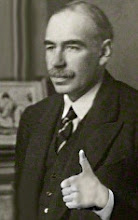
Booth (2001) provides a most fascinating study of the influence of Keynesian economics in the British government and amongst policy makers in the years after 1945.
In essence, Booth points to the “Economic Section” of the UK Treasury, which had been transferred from the Cabinet Office to the Treasury in 1953. The Economic Section was a stronghold of Keynesian economics after 1945, and certainly under its head Robert Lowe Hall (1901–1988) (Booth 2001: 288–289), who held this position until his retirement in 1961.
One important and early success of the Keynesians in the Economic Section was to defeat the attempt to liberalise the exchange rate in the 1950s (the so-called “Robot” plan) when this would have been at the expense of domestic employment stability (Booth 2001: 290–292).
Booth (2001: 295) concludes that monetary policy from the 1940s and 1950s onwards relied more on direct control of bank lending (a policy that had been favoured by Keynes and continued to be supported by Robert Hall) than on interest rate changes. The credit control policy is also favoured by modern Post Keynesians, and shows how monetary policy interventions in the post-WWII era in the UK were actually closer to heterodox Keynesianism than modern New Consensus macroeconomics.
Moreover, it can be noted that an early attempt in 1955 by the Treasury to ignore Keynesian advice and to engage in fiscal stimulus accompanied by mere reliance on interest rate policy to control inflation failed, and the failure provoked the famous Radcliffe committee (which was appointed in 1957) and its later rejection of the quantity theory (Booth 2001: 296–297). The report of the Radcliffe committee in 1959 represented a victory for British Keynesians and their victory over early misguided experiments with monetarism by the Treasury (Booth 2001: 297).
Booth (2001: 302) also points out that the occasional cautiousness of Robert Hall about fiscal policy and his concern for business confidence and the British balance of payments are perfectly consistent with the ideas of Keynes and Keynesian economics – despite the misunderstandings of some modern British historians who have re-assessed this period.
It is also fascinating that Robert Hall and the British Keynesians were, even if their advice was not always followed properly, very much concerned with incomes policy as a method for controlling inflation (Booth 2001: 303), which is now one central aspect of Post Keynesian inflation policy.
A final point of great interest to Post Keynesians is that Wynne Godley came to work in the Economic Section of the Treasury in 1956 when Robert Hall was still the head, and Godley received his early training as an economist in the Treasury under his seniors Jack Downie and Bryan Hopkin (Godley 2000: 232).
BIBLIOGRAPHY
Booth, Alan. 2001. “Britain in the 1950s: A ‘Keynesian’ Managed Economy?,” History of Political Economy 33: 283–313.
Godley, Wynne. 2000. “Wynne Godley,” in Philip Arestis and Malcolm Sawyer (eds.). A Biographical Dictionary of Dissenting Economists. Edward Elgar, Cheltenham. 232–240.
Showing posts with label 1950s. Show all posts
Showing posts with label 1950s. Show all posts
Tuesday, February 3, 2015

Saturday, January 22, 2011
Keynesianism in America in the 1940s and 1950s
I have recently seen a most peculiar Austrian argument to the effect that Keynesianism was not used after 1945 in the US, and that America pursued “austerity” measures in that era.
This bizarre claim is easily disposed of. First, the era of classic Keynesianism in the US ran from 1945 to about 1979. Neoclassical synthesis Keynesianism quickly came to dominate the US economics profession in the late 1930s and early 1940s. From the Post Keynesian perspective, however, the neoclassical Keynesians (like Paul Samuelson and Robert M. Solow) set themselves up for later theoretical problems by wedding their Keynesianism to a Neo-Walrasian neoclassical equilibrium model (see “Neoclassical Synthesis Keynesianism, New Keynesianism and Post Keynesianism: A Review”). But in these post-war years a more radical kind of Keynesianism was also developed by John Kenneth Galbraith, the American Institutionalist, and his supporters.
After WWII, the US presidency was held by the Democrat Harry S. Truman (1945–1953) and the Republican Dwight D. Eisenhower (1953–1961). Both presidents were certainly concerned with budget deficits and the threat of inflation, but both also presided over an economy that had been transformed by the New Deal. Once social security and other welfare measures had been introduced by Roosevelt and then extended by Truman, the US had a Keynesian system of automatic stabilizers which provided countercyclical fiscal policy in times of recession. It is important to stress that the US economy had an automatic fiscal mechanism that operated to counter recessions. The fact that both Truman and Eisenhower were concerned with balanced budgets was largely irrelevant given the automatic tendency for countercyclical fiscal policy to occur.
So was Keynesianism used in the US after 1945? The necessary data on the US budget in these years can be found here (as totals including both on-budget and off-budget amounts):
http://www.presidency.ucsb.edu/data/budget.php
We must remember that before 1977 the US fiscal year ran from July 1 to June 30 the next year.
The first post-WWII recession was that of February to October 1945, which was the result of the end of the war and the beginning of the conversion of the wartime US economy to a peacetime economy. The US recession of 1945 was not a normal recession in any sense of the term, and the surge in domestic demand for consumer goods which had pent up during the war lead to high private consumption and economic growth after 1945, especially after the 1945 tax cut of $6 billion passed in November. The post-war growth to 1948 was an entirely predictable development consistent with Keynesian economics.
Austrians appear to believe that the recovery that quickly began in 1945 in some way contradicts Keynesianism. Usually, they point to the fear that some Keynesians like Paul Samuelson (Samuelson 1944 and 1944a) had that the depression would return after the war.
Of course, what they don’t say is that opinion amongst Keynesians was divided, and Keynes himself predicted what would happen. In 1943, Keynes was giving a lecture at the Federal Reserve and was asked by Abba Lerner about the possible economic problems of the post-war period. Keynes’ reply is significant:
The second post-WWII recession extended from November 1948 to October 1949. As can be seen in the US federal budget data, Truman’s budget surplus of 4.6% of GDP in fiscal year 1948 fell to 0.2% in fiscal year 1949, as spending went from $29.8 billion in 1948 to $38.8 billion in 1949, as automatic stabilizers kicked in. In fiscal year 1950 (July 1, 1949 to June 30 1950), the budget went into an actual deficit of 1.1% of GDP (which was also partly the result of the beginning of the Korean war in June 1950). Moreover, Congress had pushed through a tax cut in 1948, which boosted spending in 1949. What we have here is classic Keynesian countercyclical fiscal policy.
The next recession ran from 1953 to 1954, and was caused by the end of the Korean war, inventory liquidation, and lower consumer demand (Sorkin 1997: 567). The recovery was again aided by automatic stabilizers and tax cuts in 1954.
The fourth recession lasted from 1957 to 1958, and was caused by inventory liquidation, shifts in investment and consumption, and a fall in exports in 1957 (Sorkin 1997: 567). While Eisenhower continue to favour a balanced budget and saw inflation as a more important threat than unemployment (Gosling 2008: 74), US fiscal policy was again Keynesian. To deal with the recession of 1957–1958, Congress passed a stimulus package in 1958, which Eisenhower supported (Benavie 1998: 42). The US budget remained in deficit in 1958 and 1959, the result of automatic stabilizers and discretionary spending for the stimulus.
But Eisenhower and his administration accepted higher unemployment as a check on inflation, and were criticised by liberal Keynesians like Paul Samuelson and John Kenneth Galbraith for lost growth, a real GDP less than potential GDP, and unnecessarily high unemployment (Gosling 2008: 75–76).
In fact, American economic policy-makers in the post-WWII period were essentially divided into conservative Keynesians and liberal Keynesians. The economic policy-makers in the Eisenhower administration were conservative Keynesians, but after John F. Kennedy became president liberal Keynesians became more influential.
The conversion of America’s policy-makers to neoclassical synthesis Keynesianism was famously described in a Time issue of December 31, 1965 in the cover article “The Economy: We Are All Keynesians Now.” Here the introduction of Keynesianism in the 1940s and 1950s is correctly described:
A final point is also worth noting. The business cycle after WWII down to 1990 was rather different from the pre-1933 business cycle. Recessions in this period were not caused by the familiar 19th-century and pre-1933 pattern of bursting asset bubbles, financial crises, bank runs and debt deflation.
As Sorkin argues, downturns were mostly “inventory recessions,” a phenomenon that people in the 1950s and 1960s themselves understood (see Life, 14 April 1961).
The absence of huge and damaging asset bubbles, financial crises, and bank runs after 1945 is undoubtedly related to the superior system of financial regulation and deposit insurance that existed in this era that minimised bubbles and reckless lending.
When that effective system was transformed into one that was fundamentally dysfunctional after 1980 and, in particular, in the 1990s, with the advent of New Classical economics, monetarism, and revived neoclassical macro-theory, we saw the return of huge asset bubbles, financial crises and debt deflation as significant causes of the business cycle.
BIBLIOGRAPHY
Benavie, A. 1998. Deficit Hysteria: A Common Sense Look at America’s Rush to Balance the Budget, Praeger, Westport, Conn. and London.
Colander, D. C. and H. Landreth (eds), 1996. The Coming of Keynesianism to America: Conversations with the Founders of Keynesian Economics, E. Elgar, Cheltenham.
Gosling, J. J. 2008. Economics, Politics, and American Public Policy, M.E. Sharpe, Armonk, N.Y.
Samuelson, P. A. 1944. “Unemployment Ahead: (I.) A Warning to the Washington Expert,” New Republic, September 11, 297-299.
Samuelson, P. A. 1944a. “Unemployment Ahead: (II.) The Coming Economic Crisis,” New Republic, September 18, 333-335.
Sorkin, A. L. 1997. “Recessions after World War II,” in D. Glasner and T. F. Cooley (eds), Business Cycles and Depressions: An Encyclopedia, Garland Pub., New York. 566–569.
Weatherford, M. S. and L. M. McDonnell, 1985. “Macroeconomic Policy Making Beyond the Electoral Constraint,” in G. C. Edwards, S. A. Shull, N. C. Thomas (eds), The Presidency and Public Policy Making, University of Pittsburgh Press, Pittsburgh, Pa. 95–113.
This bizarre claim is easily disposed of. First, the era of classic Keynesianism in the US ran from 1945 to about 1979. Neoclassical synthesis Keynesianism quickly came to dominate the US economics profession in the late 1930s and early 1940s. From the Post Keynesian perspective, however, the neoclassical Keynesians (like Paul Samuelson and Robert M. Solow) set themselves up for later theoretical problems by wedding their Keynesianism to a Neo-Walrasian neoclassical equilibrium model (see “Neoclassical Synthesis Keynesianism, New Keynesianism and Post Keynesianism: A Review”). But in these post-war years a more radical kind of Keynesianism was also developed by John Kenneth Galbraith, the American Institutionalist, and his supporters.
After WWII, the US presidency was held by the Democrat Harry S. Truman (1945–1953) and the Republican Dwight D. Eisenhower (1953–1961). Both presidents were certainly concerned with budget deficits and the threat of inflation, but both also presided over an economy that had been transformed by the New Deal. Once social security and other welfare measures had been introduced by Roosevelt and then extended by Truman, the US had a Keynesian system of automatic stabilizers which provided countercyclical fiscal policy in times of recession. It is important to stress that the US economy had an automatic fiscal mechanism that operated to counter recessions. The fact that both Truman and Eisenhower were concerned with balanced budgets was largely irrelevant given the automatic tendency for countercyclical fiscal policy to occur.
So was Keynesianism used in the US after 1945? The necessary data on the US budget in these years can be found here (as totals including both on-budget and off-budget amounts):
http://www.presidency.ucsb.edu/data/budget.php
We must remember that before 1977 the US fiscal year ran from July 1 to June 30 the next year.
The first post-WWII recession was that of February to October 1945, which was the result of the end of the war and the beginning of the conversion of the wartime US economy to a peacetime economy. The US recession of 1945 was not a normal recession in any sense of the term, and the surge in domestic demand for consumer goods which had pent up during the war lead to high private consumption and economic growth after 1945, especially after the 1945 tax cut of $6 billion passed in November. The post-war growth to 1948 was an entirely predictable development consistent with Keynesian economics.
Austrians appear to believe that the recovery that quickly began in 1945 in some way contradicts Keynesianism. Usually, they point to the fear that some Keynesians like Paul Samuelson (Samuelson 1944 and 1944a) had that the depression would return after the war.
Of course, what they don’t say is that opinion amongst Keynesians was divided, and Keynes himself predicted what would happen. In 1943, Keynes was giving a lecture at the Federal Reserve and was asked by Abba Lerner about the possible economic problems of the post-war period. Keynes’ reply is significant:
“Keynes harshly rejected the risk of post-war stagnation, holding that because of Social security there would be a large reduction in private saving and so that would be no problem” (Colander and Landreth 1996: 202).That Samuelson and others thought the economy would slide back into a depression after 1945 shows nothing more than that they were wrong, and Keynes was right.
The second post-WWII recession extended from November 1948 to October 1949. As can be seen in the US federal budget data, Truman’s budget surplus of 4.6% of GDP in fiscal year 1948 fell to 0.2% in fiscal year 1949, as spending went from $29.8 billion in 1948 to $38.8 billion in 1949, as automatic stabilizers kicked in. In fiscal year 1950 (July 1, 1949 to June 30 1950), the budget went into an actual deficit of 1.1% of GDP (which was also partly the result of the beginning of the Korean war in June 1950). Moreover, Congress had pushed through a tax cut in 1948, which boosted spending in 1949. What we have here is classic Keynesian countercyclical fiscal policy.
The next recession ran from 1953 to 1954, and was caused by the end of the Korean war, inventory liquidation, and lower consumer demand (Sorkin 1997: 567). The recovery was again aided by automatic stabilizers and tax cuts in 1954.
The fourth recession lasted from 1957 to 1958, and was caused by inventory liquidation, shifts in investment and consumption, and a fall in exports in 1957 (Sorkin 1997: 567). While Eisenhower continue to favour a balanced budget and saw inflation as a more important threat than unemployment (Gosling 2008: 74), US fiscal policy was again Keynesian. To deal with the recession of 1957–1958, Congress passed a stimulus package in 1958, which Eisenhower supported (Benavie 1998: 42). The US budget remained in deficit in 1958 and 1959, the result of automatic stabilizers and discretionary spending for the stimulus.
But Eisenhower and his administration accepted higher unemployment as a check on inflation, and were criticised by liberal Keynesians like Paul Samuelson and John Kenneth Galbraith for lost growth, a real GDP less than potential GDP, and unnecessarily high unemployment (Gosling 2008: 75–76).
In fact, American economic policy-makers in the post-WWII period were essentially divided into conservative Keynesians and liberal Keynesians. The economic policy-makers in the Eisenhower administration were conservative Keynesians, but after John F. Kennedy became president liberal Keynesians became more influential.
The conversion of America’s policy-makers to neoclassical synthesis Keynesianism was famously described in a Time issue of December 31, 1965 in the cover article “The Economy: We Are All Keynesians Now.” Here the introduction of Keynesianism in the 1940s and 1950s is correctly described:
“In World War II, Washington planners used Keynesian ideas to formulate their policies of deficit spending. Congress adopted the Keynesian course in 1946, when it passed the Employment Act, establishing Government responsibility to achieve ‘maximum employment, production and purchasing power.’ The act also created the Council of Economic Advisers, which for the first time brought professional economic thinking into close and constant touch with the President. Surprisingly it was Dwight Eisenhower’s not-notably-Keynesian economists who most effectively demonstrated the efficacy of Keynes’s antirecession prescriptions; to fight the slumps of 1953–54 and 1957–58, they turned to prodigious spending and huge deficits” (“The Economy: We Are All Keynesians Now,” Time, December 31, 1965).A. L. Sorkin also sums up the nature of the recessions and countercyclical nature of fiscal policy in the period down to 1961:
“[sc. Post-war] recessions can be characterized as ‘inventory recessions,’ that is, the business-cycle contractions were the result of excessive inventory accumulation and subsequent liquidation. Tax cuts, particularly those that occurred in 1948 and 1953–54, helped to stabilize personal income and consumption spending, tending to moderate these recessions. The automatic stabilizers and accompanying federal budget deficits helped move the economy toward the recovery phase of the cycle” (Sorkin 1997: 569).There is no doubt at all that post-WWII US policy was Keynesian.
A final point is also worth noting. The business cycle after WWII down to 1990 was rather different from the pre-1933 business cycle. Recessions in this period were not caused by the familiar 19th-century and pre-1933 pattern of bursting asset bubbles, financial crises, bank runs and debt deflation.
As Sorkin argues, downturns were mostly “inventory recessions,” a phenomenon that people in the 1950s and 1960s themselves understood (see Life, 14 April 1961).
The absence of huge and damaging asset bubbles, financial crises, and bank runs after 1945 is undoubtedly related to the superior system of financial regulation and deposit insurance that existed in this era that minimised bubbles and reckless lending.
When that effective system was transformed into one that was fundamentally dysfunctional after 1980 and, in particular, in the 1990s, with the advent of New Classical economics, monetarism, and revived neoclassical macro-theory, we saw the return of huge asset bubbles, financial crises and debt deflation as significant causes of the business cycle.
BIBLIOGRAPHY
Benavie, A. 1998. Deficit Hysteria: A Common Sense Look at America’s Rush to Balance the Budget, Praeger, Westport, Conn. and London.
Colander, D. C. and H. Landreth (eds), 1996. The Coming of Keynesianism to America: Conversations with the Founders of Keynesian Economics, E. Elgar, Cheltenham.
Gosling, J. J. 2008. Economics, Politics, and American Public Policy, M.E. Sharpe, Armonk, N.Y.
Samuelson, P. A. 1944. “Unemployment Ahead: (I.) A Warning to the Washington Expert,” New Republic, September 11, 297-299.
Samuelson, P. A. 1944a. “Unemployment Ahead: (II.) The Coming Economic Crisis,” New Republic, September 18, 333-335.
Sorkin, A. L. 1997. “Recessions after World War II,” in D. Glasner and T. F. Cooley (eds), Business Cycles and Depressions: An Encyclopedia, Garland Pub., New York. 566–569.
Weatherford, M. S. and L. M. McDonnell, 1985. “Macroeconomic Policy Making Beyond the Electoral Constraint,” in G. C. Edwards, S. A. Shull, N. C. Thomas (eds), The Presidency and Public Policy Making, University of Pittsburgh Press, Pittsburgh, Pa. 95–113.
Subscribe to:
Posts (Atom)