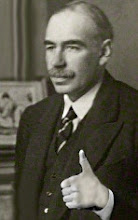
Below are biographical details of interest and other trivia:
(1) Keynes entered King’s College, Cambridge in 1902, and had taken rooms in King’s Lane by October 1902 (Moggridge 1992: 53). At this time, King’s had 30 fellows, 30 postgraduates, and around 130 undergraduates, and all of Cambridge only had about 3000 undergraduates (Skidelsky 1983: 107). Only Trinity and St. John’s Colleges had an academic and social status to rival King’s (Skidelsky 1983: 107). The academic term at Cambridge today runs from 1 October to 30 September, and has three terms and three vacations, as follows:Timeline of Keynes’s Early LifeMichaelmas Term (October to December; named after the feast of St Michael on 29 September)I assume (I may be wrong) that this was also the case in Keynes’s day.
Christmas Vacation
Lent term (January to March)
Easter Vacation
Easter term (April to June)
Long Vacation.
(2) On 28 February 1903, Keynes became a member of the Cambridge Apostles (the Cambridge Conversazione Society), a secretive debating society famous at Cambridge (Skidelsky 1983: 116) and founded in 1820. In Keynes’s time, this usually involved meetings on Saturday evenings where a member would give a talk on some topic, and this topic was then debated.
The society had a strong philosophical background. At the time when Keynes joined, and in the following years, either established or up-and-coming philosophers like John Ellis McTaggart, G. E. Moore, Bertrand Russell and Alfred Whitehead were members or older members (called “angels”). In the years from 1903 to 1908/1909, Keynes’s social and intellectual life seems to have increasingly revolved around this society (Skidelsky 1983: 118), although he did maintain his close friendships from Eton and with other undergraduates. By 1904, when Lytton Strachey became secretary of the Apostles, both Keynes and Strachey exercised an increasing role in its affairs (Moggridge 1992: 76), but relations between them briefly turned sour when they fell out over competition for the affections of Arthur Hobhouse, who became an Apostle in February 1905 (Moggridge 1992: 77). Keynes had an affair with Hobhouse that ended at some point after September 1905 (Moggridge 1992: 79). Amongst his other lovers in 1906 were Lytton Strachey and James Strachey (Moggridge 1992: 105, 107). The only known woman Keynes expressed some romantic interest in during this period was Rachel Costelloe, while he was on a tour in Italy (from March to April 1906) as the guest of her mother Mary Berenson (Skidelsky 1983: 171).
(3) The year of Keynes’s election to the Apostles was also when G. E. Moore published Principia Ethica. In May 1904 Keynes became Secretary of the Cambridge Union (Moggridge 1992: 71).
(4) While Keynes joined the Cambridge University Liberal Club (Skidelsky 1983: 114), he does not seem to have been much interested in political matters before the First World War, although he is on record opposing Home Rule for Ireland in May 1903, and defending free trade in a speech at the Cambridge Union on 24 November 1903 (Skidelsky 1983: 121). Skidelsky (1983: 121) contends that free trade was Maynard’s “only political cause before the First World War.”
(5) While he was an undergraduate at Cambridge Keynes attended lectures by John Ellis McTaggart on metaphysics and George E. Moore on ethics (Moggridge 1992: 65), although Moore left for an appointment in Edinburgh in autumn 1904 (Moggridge 1992: 65).
(6) In March 1904, Keynes took a trip to Germany, visiting Dresden and Berlin (Skidelsky 1983: 122).
(7) Keynes wrote an undergraduate essay on Edmund Burke, which won the Cambridge University Members Prize for English Essay in November 1904 (Skidelsky 1983: 151–152). While Keynes had a number of criticisms of Burke, Skidelsky (1983: 154) argues that Burke was something of a political hero to the young Keynes.
(8) Keynes took his Part I Tripos examinations (the equivalent of obtaining an Honours degree) in June 1905. He obtained the place of twelfth wrangler.
(9) After his Tripos, Keynes was able to continue at Cambridge for another year through his King’s scholarship (Moggridge 1992: 82). He began reading economics in June 1905, with Alfred Marshall’s Principles as a textbook, though Keynes was soon reading Jevons’s Theory of Political Economy. He also began to spend time with the Marshallian economist Arthur C. Pigou, who was now a lecturer (Moggridge 1992: 82). By 12 October 1905 Keynes applied to attend Marshall’s lectures, and saw this as a way of aiding his Civil Service Examination which was scheduled for August 1906 (Moggridge 1992: 95). By November 1905 Keynes had decided he was good at economics, and Marshall was even asking him to become a professional economist (Moggridge 1992: 96). By December 1905, however, Keynes decided to concentrate on preparations for the Civil Service Examination, and abandon the Economics Tripos (Skidelsky 1983: 166). Skidelsky comments:“[sc. Keynes] … never did take an economics degree. In fact, his total professional training came to little more than eight weeks. All the rest was learnt on the job.” (Skidelsky 1983: 166).On his return to Cambridge, Keynes was soon writing as an economic journalist as well.
“[sc. Keynes] … started on Adam Smith only in 1910, and never became erudite in the literature, as Foxwell was. His grasp of theory came not so much from reading about it as from working out the problems for himself, and discussing them with others.” (Skidelsky 1983: 206).
(10) Keynes underwent the Civil Service Examination in August 1906 (Moggridge 1992: 107), and came second when he heard the results in September that year. He took a position in the India Office, moving into a flat on St James Court in the Buckingham Palace Road (Moggridge 1992: 108). He began work on 16 October, 1906.
(11) Keynes worked as a junior clerk in the Military Department of the India Office, but was moved to the Revenue, Statistics and Commerce Department in March 1907. He had a salary of £200 a year, and started his daily work at 11 a.m. and finished at 5 p.m. (Skidelsky 1983: 175). Keynes refused a promotion twice in 1907 (in February and October) because he feared it would cut into his spare time, and particularly the work he was doing on his thesis on probability theory (Skidelsky 1983: 177).
(12) Keynes gained experience of government in these years, and on India, its economy and finances. I cannot resist quoting Keynes’s low opinion of the members of committee he observed in a letter to Lytton Strachey (7 March, 1907):“Yesterday I attended my first Committee of Council. The thing is simply government by dotardry; at least half those present showed manifest signs of senile decay, and the rest didn’t speak.” (Skidelsky 1983: 178).(13) Keynes’s interest in collecting paintings dates from March 1907 (Skidelsky 1983: 179).
(14) Keynes’s interest in probability stemmed from the intellectual issues raised by G. E. Moore’s Principia Ethica. Probability theory occupied much of his spare time between 1906 and 1914. His first discussion of the subject can be dated to 23 January 1904, in a paper called “Ethics in Relation to Conduct” read before the Apostles (Skidelsky 1983: 151–152). Keynes’s work in probability was originally an attempt to refute one of Moore’s ideas in the Principia Ethica (Moggridge 1992: 118).
(15) Keynes decided to return to Cambridge and quit his India Office job by September 1907. On 12 December 1907, he handed in his dissertation on probability, and it was examined by W. E. Johnson and Alfred North Whitehead (Skidelsky 1983: 182). Unfortunately, on the 17 March 1908 he was not elected to a fellowship at King’s, and experienced what Skidelsky calls the “worst academic blow Maynard ever suffered” (Skidelsky 1983: 184). But fortune soon smiled on Keynes: Alfred Marshall (who was close to retirement) offered Keynes a lectureship at Cambridge that Marshall himself had been personally funding (Skidelsky 1983: 182). Although Arthur C. Pigou succeeded Marshall on 30 May 1908 as Professor of Political Economy at Cambridge (which Pigou held until 1943), Keynes was offered one of two lectureships in economics (the other went to Walter Layton), with a salary of £100 a year (Skidelsky 1983: 185).
(16) Keynes resigned from his India Office job on 5 June 1908, but retained his connections with that office and government. In his time at the India office he had impressed his superiors, learned of India’s currency system, and would soon gain political contacts when he was called on to serve on the Royal Commission on Indian Currency and Finance (Skidelsky 1983: 186).
(17) He gave his first lecture at Cambridge on “money, credit and prices” on 19 January 1909 (Skidelsky 1983: 211).
(18) On 16 March 1909, Keynes was elected to a prize fellowship at King’s College, Cambridge (Skidelsky 1983: 204).
– educated at King’s College, Cambridge from 1902–1905.
– In June 1905 he underwent Part I of the Tripos examinations, and was ranked in twelfth place.
– from 1906–1908, Keynes worked at the India Office.
– in 1908 he was appointed to a lectureship in economics at Cambridge and in January 1909 began lecturing.
– early 1909, Keynes resubmits his thesis
– 16 March 1909, Keynes elected to prize fellowship at King’s College, Cambridge
LINKS
John Maynard Keynes – Timeline.
John Maynard Keynes, Wikipedia.
BIBLIOGRAPHY
Keynes, W. Milo (ed.). 1975. Essays on John Maynard Keynes, Cambridge University Press, London.
Moggridge, D. E. 1992. Maynard Keynes: An Economist’s Biography, Routledge, London.
Skidelsky, R. J. A. 1983. John Maynard Keynes: Hopes Betrayed 1883–1920 (vol. 1), Macmillan, London.