neutrality of money is the idea that a change in the stock of money affects only nominal variables in the economy such as prices, wages and exchange rates but no effect on real (inflation-adjusted) variables, like employment, real GDP, and real consumption.The macroeconomic theory called monetarism held that money is neutral “in the long run.” This essentially means that money is thought to have insignificant effects on real variables such as output, the level of employment and real GDP in the long term. The New Classical macroeconomics of Robert Lucas used rational expectations to argue that money is also neutral, both in the short and long run. According to this view, if the money supply is increased, then only nominal variables will be affected, rather than real variables like relative prices, output and employment, and prices and wages will simply adjust to their general equilibrium values (Horwitz 2000: 11). Austrians claim that they deny the neoclassical neutrality of money idea (Horwitz 2000: 11), but this is clearly disputable and Post Keynesians argue that in fact Austrian theory still relies on the neutral money axiom (Davidson 1989).
http://en.wikipedia.org/wiki/Neutrality_of_money
I want to focus here on a related idea: that money is just a veil over real activity.
Neoclassical analysis sees economic life in terms of a moneyless, ideal barter system. In this system, money exists but has been introduced merely to make trade easier. The exchange ratios between goods and services in bilateral transactions are still seen as fundamental. This means that economic life is just about the “real” exchange of goods and services: people produce commodities in order to exchange them for other commodities. In this view, all the important features of economics can be understood in terms of the barter exchange of goods and services. Money is just a thing that functions as a “neutral veil” that overcomes the inconveniences of direct barter. This emphasises money’s role as a “medium of exchange” and neglects its other functions.
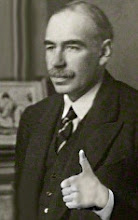
However, this type of “real analysis” is fundamentally flawed: money is not just a veil over a barter system. Proper analysis of modern economic systems requires monetary analysis (Smithin 2003: 2). John Maynard Keynes’ General Theory of Employment, Interest and Money (1936) argued that modern capitalist economies are pre-dominantly monetary systems. The starting point for any sensible economic theory must recognise that monetary factors are crucial to modern economic activity. Indeed, Keynes produced a “monetary theory of production” which shows how crucial money and credit are to production of output:
The general idea of monetary production is that the economic system under which we live, variously described as capitalism or the market economy, and which has existed in one form or another since the industrial revolution is, in fact,As a consequence of this, it can be also argued that, as long as resources are available for production of output in a way that does not cause inflation or significant inflation, then there is no need to “finance” investment for production out of loanable funds or a money supply where growth and availability of credit money is restricted by the supply of gold (or some other commodity).
pre-eminently a monetary system.
Those responsible for setting production in train, whether they are entrepreneurs or corporations, must first acquire monetary resources by borrowing, selling equity, or previous (financial) accumulation before they can do so. The ultimate proceeds of productive activity from the subsequent sale of goods and services are also sums of money. Intuitively therefore in such an environment, and contrary to the point of view that money does not matter, the functioning of the monetary system takes on major significance. In particular, the ‘terms on which’ ... the monetary resources for production are obtainable (that is, the rate of interest) would seem to be of vital importance (Smithin 2003: 3).
The Rothbardian branch of the Austrian school which developed the ideas of Hayek and Mises vehemently rejects fiat money and “fiduciary media” un-backed by commodity money. But, as I have shown in a previous post (see What is Money? A Short Analysis), this view is utterly unconvincing, and in fact classical gold standard capitalism ended in 1913 with paper currency and bank deposits accounting for 90% of overall currency circulation in the world, and actual gold itself for not much more than 10% (Triffin 1985: 152). Gold standard capitalism had invented more fiduciary media to accommodate the demand for money, although it was no doubt restricted by the need for a monetary base of gold.
A fiat monetary system is superior to a commodity standard because it accommodates the endogenous growth in demand for credit. However, the crucial point is that fiat money also needs a financial system that is properly regulated to channel credit to productive lines of investment and to prevent asset bubbles. Keynesian demand management through fiscal and monetary policy and incomes policy (e.g., centralized wage bargaining or arbitration) prevent excessive inflation. When an economy has inflationary pressures Keynesian fiscal and monetary policies contract demand to smooth the process out. A recession may or may not result, but, if recession occurs, it will be brief and a new cycle of growth will soon resume through stimulus. The belief that investment needs to have “funded” by previous private saving is an utter myth that hinders economic growth and the full use of resources to maximise growth, wealth and employment.
Addendum: Money as a Measure of the Subjective Value of Labour?
Using a “subjective labour theory of value,” the blogger Cynicus Economicus argues that money has this function:
the underlying purpose of money is very clear. It should only act as a medium through which the value of labour might be accounted, and is always representative of a store of value of labour, with an underlying contract that it might, at some future point in time, be exchanged for the value of labour of others.But the idea that money only acts as “a medium through which the value of labour might be accounted, and … always representative of a store of value of labour” appears to commit him to the view that money is also just a “veil” over a world of barter of subjective valuations of labour. This seems to commit the same error as the neoclassicals in thinking that money is just a veil over real activity, which it clearly is not.
http://cynicuseconomicus.blogspot.com/2009/07/reforming-money-fixed-fiat-currency.html
BIBLIOGRAPHY
Davidson, P. 1989. “The Economics of Ignorance or Ignorance of Economics?,” Critical Review 3.3/4: 467–487.
Horwitz, S. 2000. Microfoundations and Macroeconomics: An Austrian Perspective, Routledge, London and New York.
Smithin, J. 2003. Controversies in Monetary Economics, Edward Elgar, Cheltenham, UK and Northampton, MA.
Triffin, R. 1985. “Myth and Realities of the Gold Standard,” in B. Eichengreen and M. Flandreau (eds), The Gold Standard in Theory and History, Routledge, London and New York. 140–161.