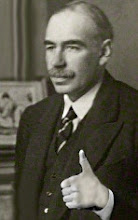
In 1930, Keynes published a short essay called “Economic Possibilities for our Grandchildren” in two parts in the journal
The Nation and Athenaeum (see Keynes 1930a and 1930b), which was later reprinted in
Essays in Persuasion (London, 1933).
There is a vast amount now written on what is a very short essay: e.g., there is even an edited collection of essays about this work of Keynes (Pecchi and Piga 2008).
Rather than delving extensively into what people have said about it, I prefer to go back to the essay itself and summarise it: let it largely speak for itself.
An online version is
here (though one has to scroll down to find it or use the search function in your web browser).
This essay was written in the second year of the Great Depression. Keynes refers in his opening words to the “bad attack of economic pessimism” that had accompanied the depression.
Ever the optimist, however, Keynes did not think that the pessimists of his era were right about the long term prospects for capitalism, and in that sense his essay is directed against both Marxists and some pessimistic conservatives.
It is notable that the Keynes of this essay is a pre-
General Theory Keynes: he is still a believer in the natural rate of interest, and he (curiously) seems to think that the unemployment of the depression is mainly structural unemployment caused by over-rapid technological change:
”We are suffering, not from the rheumatics of old age, but from the growing-pains of over-rapid changes, from the painfulness of readjustment between one economic period and another. The increase of technical efficiency has been taking place faster than we can deal with the problem of labour absorption; the improvement in the standard of life has been a little too quick; the banking and monetary system of the world has been preventing the rate of interest from falling as fast as equilibrium requires .”
But Keynes dismisses the pessimists and turns to the long-term future:
“What can we reasonably expect the level of our economic life to be a hundred years hence? What are the economic possibilities for our grandchildren?”
So, let it be borne in mind, Keynes is thinking of 2030: still a way off yet.
First, Keynes notes that the impressive economic growth that the West attained since the industrial revolution was the result of truly revolutionary technological development, accumulation of capital and compound interest.
But, above all, technology had a fundamental role in this:
“From the sixteenth century, with a cumulative crescendo after the eighteenth, the great age of science and technical inventions began, which since the beginning of the nineteenth century has been in full flood – coal, steam, electricity, petrol, steel, rubber, cotton, the chemical industries, automatic machinery and the methods of mass production, wireless, printing, Newton, Darwin, and Einstein, and thousands of other things and men too famous and familiar to catalogue.
What is the result? In spite of an enormous growth in the population of the world, which it has been necessary to equip with houses and machines, the average standard of life in Europe and the United States has been raised, I think, about fourfold. The growth of capital has been on a scale which is far beyond a hundredfold of what any previous age had known. And from now on we need not expect so great an increase of population.
If capital increases, say, 2 per cent per annum, the capital equipment of the world will have increased by a half in twenty years, and seven and a half times in a hundred years. Think of this in terms of material things – houses, transport, and the like. At the same time technical improvements in manufacture and transport have been proceeding at a greater rate in the last ten years than ever before in history. In the United States factory output per head was 40 per cent greater in 1925 than in 1919. In Europe we are held back by temporary obstacles, but even so it is safe to say that technical efficiency is increasing by more than 1 per cent per annum compound. There is evidence that the revolutionary technical changes, which have so far chiefly affected industry, may soon be attacking agriculture. We may be on the eve of improvements in the efficiency of food production as great as those which have already taken place in mining, manufacture, and transport. In quite a few years – in our own lifetimes I mean – we may be able to perform all the operations of agriculture, mining, and manufacture with a quarter of the human effort to which we have been accustomed.”
Unfortunately, after this Keynes takes a wrong turn and I think he was quite mistaken in his attempt to invoke “technological unemployment” as some sweeping explanation for the 1930s depression unemployment:
“For the moment the very rapidity of these changes is hurting us and bringing difficult problems to solve. Those countries are suffering relatively which are not in the vanguard of progress. We are being afflicted with a new disease of which some readers may not yet have heard the name, but of which they will hear a great deal in the years to come – namely, technological unemployment. This means unemployment due to our discovery of means of economising the use of labour outrunning the pace at which we can find new uses for labour.”
But then Keynes turns to more reasonable speculation:
“But this is only a temporary phase of maladjustment. All this means in the long run that mankind is solving its economic problem. I would predict that the standard of life in progressive countries one hundred years hence will be between four and eight times as high as it is today. There would be nothing surprising in this even in the light of our present knowledge. It would not be foolish to contemplate the possibility of afar greater progress still.”
In terms of 1990 international Geary-Khamis dollars, real per capita UK GDP in 1930 was $5,441, and in 2001 it stood at $20,127 (data from Maddison 2003): an increase of 269.91% or about 3.6 times 5,441.
I would assume that UK per capita GDP today has already fulfilled the lower end of Keynes’ prediction of it being “between four and eight times as high” in the future.
But here is Keynes’ major prediction:
“Now it is true that the needs of human beings may seem to be insatiable. But they fall into two classes – those needs which are absolute in the sense that we feel them whatever the situation of our fellow human beings may be, and those which are relative in the sense that we feel them only if their satisfaction lifts us above, makes us feel superior to, our fellows. Needs of the second class, those which satisfy the desire for superiority, may indeed be insatiable; for the higher the general level, the higher still are they. But this is not so true of the absolute needs – a point may soon be reached, much sooner perhaps than we are all of us aware of, when these needs are satisfied in the sense that we prefer to devote our further energies to non-economic purposes.
Now for my conclusion, which you will find, I think, to become more and more startling to the imagination the longer you think about it.
I draw the conclusion that, assuming no important wars and no important increase in population, the economic problem may be solved, or be at least within sight of solution, within a hundred years. This means that the economic problem is not – if we look into the future – the permanent problem of the human race.
Why, you may ask, is this so startling? It is startling because – if, instead of looking into the future, we look into the past – we find that the economic problem, the struggle for subsistence, always has been hitherto the primary, most pressing problem of the human race – not only of the human race, but of the whole of the biological kingdom from the beginnings of life in its most primitive forms.”
So it is clear from this that:
(1) Keynes recognised that our demand for non-basic fashionable articles of consumption is probably insatiable, but
(2) demand for “necessities” given no population explosion is not necessarily insatiable.
Keynes speculated that technological progress and the accumulation of capital could lead to the “economic problem” of humanity – the need for necessities – being solved.
Despite his critics, Keynes was not saying that all human wants would be satisfied.
He limited his prediction to those goods whose need is “absolute in the sense that we feel them whatever the situation of our fellow human beings may be”: more or less what economists call necessities.
In fact, Keynes explicitly defines the “economic problem” as the “struggle for subsistence.”
This was Keynes’ major prediction. Was he right?
I submit Keynes was essentially correct on this point: he is vindicated. We in the developed and advanced capitalist nations have long since solved the problem of the supply of necessities of human existence: necessary food for proper nutrition, clothing, medical care, and even housing.
But why don’t some people even in developed nations have these things? (e.g., medical care).
The problems that Keynes did not foresee were distributional issues, inequality of income, and that some people have the lack of income to purchase the necessities. But in most developed nations welfare and social security have long since largely solved this problem, with most people given the means to pay for necessities. Virtually every developed nation has universal care. Although the United States is an exception on some points here, even there it is a
distributional issue: it is not that supply isn’t available, it is that access to it via a universal system (as in virtually every other developed nation) is not provided.
But, turning back to Keynes’s essay, after his statements about the “economic problem,” it is true that Keynes starts to make speculative predictions that are more questionable.
Keynes seems to envisage that, with the universal provision of necessities, leisure time would vastly increase and working hours vastly decrease.
He forgot that demand for non-basic goods – fashionable articles of consumption and services – would also take up a vast amount of production and labour.
Keynes also speculated that a society largely freed from work would result in radical social changes:
“There are changes in other spheres too which we must expect to come. When the accumulation of wealth is no longer of high social importance, there will be great changes in the code of morals. We shall be able to rid ourselves of many of the pseudo-moral principles which have hag-ridden us for two hundred years, by which we have exalted some of the most distasteful of human qualities into the position of the highest virtues. We shall be able to afford to dare to assess the money-motive at its true value. The love of money as a possession—as distinguished from the love of money as a means to the enjoyments and realities of life—will be recognised for what it is, a somewhat disgusting morbidity, one of those semi-criminal, semi-pathological propensities which one hands over with a shudder to the specialists in mental disease. All kinds of social customs and economic practices, affecting the distribution of wealth and of economic rewards and penalties, which we now maintain at all costs, however distasteful and unjust they may be in themselves, because they are tremendously useful in promoting the accumulation of capital, we shall then be free, at last, to discard.”
Finally, one can note that Keynes’ musings here apply to the year 2030, so when we reach that year we will be in a better position to judge his speculations about how technology will have reduced the need for human labour to a minimum, and what social effects such a development will have.
Will Keynes be vindicated? One could argue that
the third industrial revolution predicted by some people – a new age of economic growth and production with revolutionary use of 3-D printing, nanotechnology, automation, artificial intelligence and robotics – might cause the changes Keynes imagined. For example, when even production of fashionable consumer goods and even many services is automated, then the world will perhaps start to experience large reduction in working hours.
But distributional issues and bad economic policy can easily get in the way too.
It is an open question whether Keynes’ “Economic Possibilities for our Grandchildren” has real insight about the long-term future.
BIBLIOGRAPHY
Keynes, John Maynard. 1930a. “Economic Possibilities for our Grandchildren II,”
The Nation and Athenaeum 48.3 (October 18): 96–98.
Keynes, John Maynard. 1930b. “Economic Possibilities for our Grandchildren II,”
The Nation and Athenaeum 48.2 (October 11, 1930): 36–37.
Keynes, John Maynard. 1933.
Essays in Persuasion. Macmillan, London.
Maddison, Angus. 2003.
The World Economy: Historical Statistics. OECD Publishing, Paris.
Pecchi, Lorenzo and Gustavo Piga. 2008.
Revisiting Keynes: Economic Possibilities for our Grandchildren. MIT Press, Cambridge, MA.