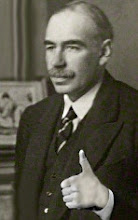
A short but good interview with James Galbraith here on the nature of the US federal debt, fiat money and trade deficits.
Saturday, November 16, 2013

Friday, November 15, 2013
Robert Murphy at Sea on MMT
The Austrian economist Robert Murphy was recently interviewed on MMT:
Murphy tells us that he understands the point of MMTers that the government is not revenue constrained, yet his major attempt to refute MMT is an analogy (from 14.05) where he just assumes that the government is like a private household. The analogy also bizarrely assumes that government deficit spending is not just immoral but criminal, in a totally absurd example of begging the question by assuming the truth of libertarian ethics.
Murphy is also committed to the flawed and unrealistic Austrian theory of price inflation. He seems oblivious of any of the empirical evidence on administered prices and the way that demand drives private sector output and employment.
Murphy is also guilty of astonishing intellectual inconsistency. At 22.43 onwards, Murphy’s explanation of recessions and idle resources invokes the Austrian business cycle theory (ABCT) that he himself says is grossly flawed by its reliance on the Wicksellian natural rate of interest (see Murphy 2003). But both the arguments of Murphy’s PhD and this paper are conveniently forgotten as he preaches to the choir and invokes the ABCT – and blames the lowering of the rate of interest below its natural rate – as the explanation of recessions.
Here is a man who tells us that he agrees with John Maynard Keynes that interest rates are a monetary phenomenon, but then in this interview throws that to the wind and requires that the interest rate is a real phenomenon caused by loanable funds and the real forces of productivity and thrift, despite the fact that his other published writings logically require a rejection of both ideas.
Further evidence of Murphy’s hapless inability to understand MMT – or even Keynesianism – is Murphy’s implied belief (from 24.58) that he thinks that MMTers or Keynesians wish to stop or abolish all frictional or seasonal unemployment. That is just rubbish.
One can note that the interviewer – one Tom Woods – is even more ignorant and incapable of understanding MMT or the theories underlying it.
BIBLIOGRAPHY
Murphy, Robert P. 2003. Unanticipated Intertemporal Change in Theories of Interest. PhD dissert., Department of Economics, New York University.
Murphy, Robert P. “Multiple Interest Rates and Austrian Business Cycle Theory.” http://consultingbyrpm.com/uploads/Multiple%20Interest%20Rates%20and%20ABCT.pdf
“Tom Woods Talks MMT With Me,” Free Advice, 14 November, 2013. (You can access interview from this post).Like most of his other efforts, it ends in disaster.
Murphy tells us that he understands the point of MMTers that the government is not revenue constrained, yet his major attempt to refute MMT is an analogy (from 14.05) where he just assumes that the government is like a private household. The analogy also bizarrely assumes that government deficit spending is not just immoral but criminal, in a totally absurd example of begging the question by assuming the truth of libertarian ethics.
Murphy is also committed to the flawed and unrealistic Austrian theory of price inflation. He seems oblivious of any of the empirical evidence on administered prices and the way that demand drives private sector output and employment.
Murphy is also guilty of astonishing intellectual inconsistency. At 22.43 onwards, Murphy’s explanation of recessions and idle resources invokes the Austrian business cycle theory (ABCT) that he himself says is grossly flawed by its reliance on the Wicksellian natural rate of interest (see Murphy 2003). But both the arguments of Murphy’s PhD and this paper are conveniently forgotten as he preaches to the choir and invokes the ABCT – and blames the lowering of the rate of interest below its natural rate – as the explanation of recessions.
Here is a man who tells us that he agrees with John Maynard Keynes that interest rates are a monetary phenomenon, but then in this interview throws that to the wind and requires that the interest rate is a real phenomenon caused by loanable funds and the real forces of productivity and thrift, despite the fact that his other published writings logically require a rejection of both ideas.
Further evidence of Murphy’s hapless inability to understand MMT – or even Keynesianism – is Murphy’s implied belief (from 24.58) that he thinks that MMTers or Keynesians wish to stop or abolish all frictional or seasonal unemployment. That is just rubbish.
One can note that the interviewer – one Tom Woods – is even more ignorant and incapable of understanding MMT or the theories underlying it.
BIBLIOGRAPHY
Murphy, Robert P. 2003. Unanticipated Intertemporal Change in Theories of Interest. PhD dissert., Department of Economics, New York University.
Murphy, Robert P. “Multiple Interest Rates and Austrian Business Cycle Theory.” http://consultingbyrpm.com/uploads/Multiple%20Interest%20Rates%20and%20ABCT.pdf
Subscribe to:
Posts (Atom)